
Best Live Casino UK 2026: How a Gambling Commission Licence Changes What a Live Dealer Table Costs
 Available in GB
A live casino table looks straightforward on a phone screen: a real human dealing real cards, a camera trained on the wheel, a chat box running down the side. The licence that lets a UK player sit at that table is less visible and considerably more consequential. A Gambling Commission licence is the only thing standing between a deposit and the protections a player actually relies on — segregated funds, GAMSTOP self-exclusion, a real complaints route, an audited game. Strip it away and the same dealer is still dealing, but the safety net under the seat is gone.

Live data current as of 23 September 2026, verified against the Gambling Commission’s public register of gambling businesses.
Table of Contents
- How live casino tables work, and why the stream alone is not the product
- What the December 2025 wagering cap does to a live casino bonus
- Playing live casino on mobile and through apps
- What a live casino no-deposit bonus actually pays
- The leading UK live casino sites compared
- Individual site reviews
- Live casino on sites not on GAMSTOP, and what that costs
- Crypto, iDEAL and anonymous play at a UK-licensed site
- What a UK-licensed live casino requires of the player
- Payment methods, withdrawal speed and credit card ban
- What the maths looks like on a £100 live casino bonus
- Choosing between the ten
- The case for staying on a UK-licensed live casino
- Frequently asked questions
How live casino tables work, and why the stream alone is not the product
A live casino game is the ordinary online casino game with the random number generator removed from the player’s side of the table and replaced by a camera pointed at one. A real dealer runs real equipment — a roulette wheel, a shoe of cards, a wheel of fortune — and sensors read the outcome. The result is relayed to players online, who place bets on a digital layout before each round and watch the physical outcome decide them. That is the entire mechanical difference between a live table and a standard digital one. Everything else — the betting limits, the side bets, the chat box — sits on top.
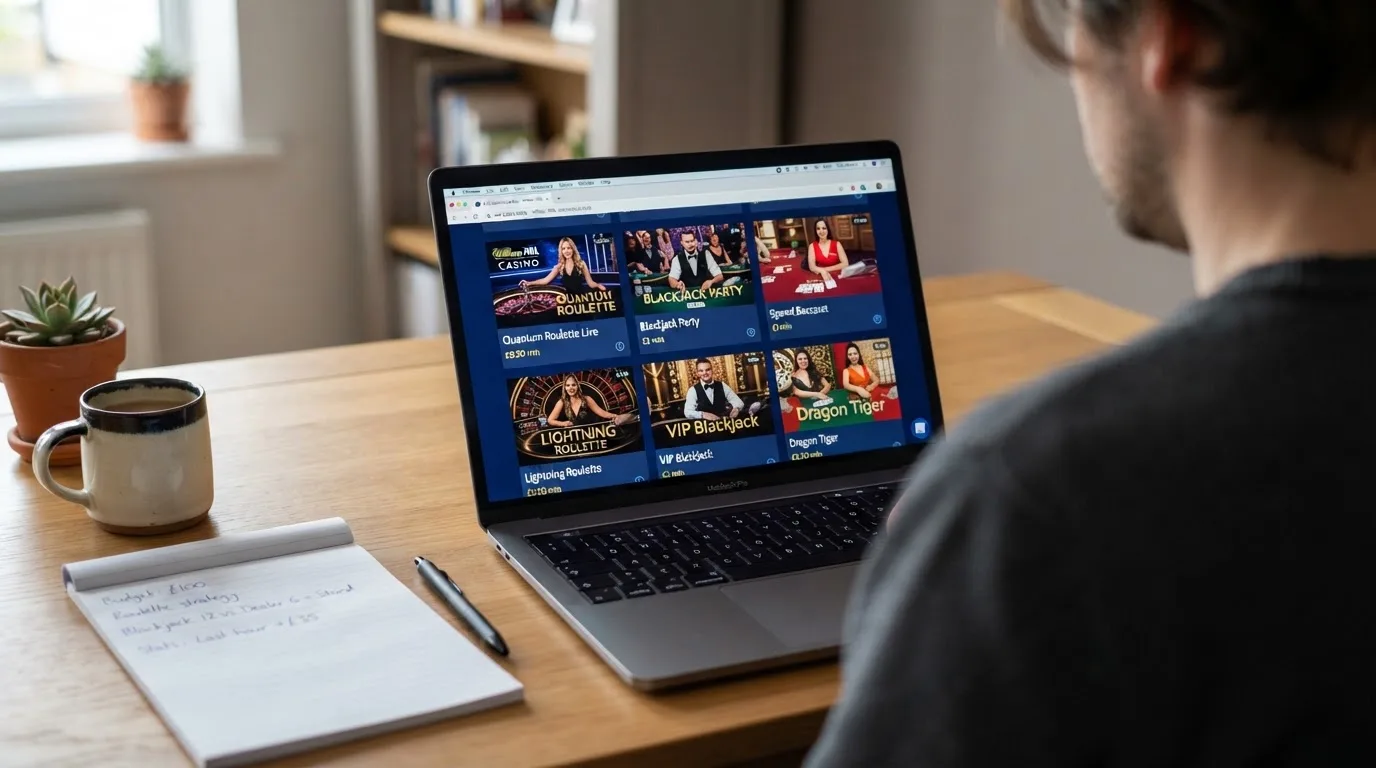
The point matters because the visible apparatus is so persuasive. A real wheel spinning on a real screen implies the rest of the experience is governed by the same real-world rules. It is not. The fairness of a UK live table comes from the Gambling Commission’s Remote Technical Standard RTS 17, which requires live dealer operations to be fair and independently auditable, with commercial-casino-quality equipment and designated staff monitoring operational integrity. The standard also requires video surveillance covering all predefined gaming areas in enough detail to confirm whether dealing procedures and game rules were followed, and training records proving croupiers can deal fairly according to documented procedures.
Three consequences follow from that. First, the dealer’s competence and the studio’s camera placement are not marketing material — they are licence conditions. Second, the standard is issued under sections 89 and 97 of the Gambling Act 2005, which means breach is a regulatory matter, not a contractual one. Third, the same licence that audits the spin also governs the rest of the site: how money is held, how a complaint is escalated, what happens when a player asks to be excluded. Buying a seat at a live table is, in effect, buying into the whole licence.
The dominant supplier of those tables is Evolution AB, founded in 2006 and headquartered in Stockholm. The company launched its first live dealer games, including live roulette and live blackjack, in 2007, listed on Nasdaq First North Premier in 2015, and moved to the main Nasdaq Stockholm list in 2017 under the ticker EVO. The supplier expanded its footprint with the NetEnt acquisition in 2020 and the Big Time Gaming deal in 2021, both of which pushed it beyond live dealer tables into RNG slots. For 2023, Evolution reported revenue of €1.798 billion and 19,221 employees. Its game show formats — Dream Catcher (2017), Lightning Roulette (2018), Monopoly Live (2019), Crazy Time (2020) and Funky Time (2023) — have become the brand of live casino for most UK players, even though many of the sites they sit on are not Evolution’s own.
A second strand sits alongside those studio tables: multiplayer crash games such as Spribe’s Aviator. Spribe was founded in 2018 and released Aviator in 2019, describing it as the first true multiplayer crash game in the regulated igaming space. The mechanic is straightforward — a multiplier curve rises from 1.00x until the round randomly crashes, and a player must cash out before that happens — and the scale is anything but: Spribe reports more than 42 million active users and around 350,000 bets per minute across more than 5,000 operators worldwide. A crash game is technically a live multiplayer product, but the Gambling Commission classifies online games by their stake limit and spin rules, and the boundary between a “live casino” title and a “slot” or “instant win” title matters when the December 2025 wagering cap is applied.
What the December 2025 wagering cap does to a live casino bonus
Live casino bonuses have long been advertised as the headline reason to pick one site over another. The promotional language — “100% up to £100”, “£50 live casino bonus”, “live dealer casino bonus” — treats the bonus amount as the prize. It is not. A bonus is a loan against future play, and the wagering requirement is the cost of returning it. Since 19 December 2025 the Gambling Commission has capped those wagering requirements at 10x for any UK-licensed operator, and banned mixed-product bonuses that offer casino spins as a reward for betting on sport. The cap is the most consequential change to UK bonus design in years.

The arithmetic it replaces is punishing. A typical £100 bonus at the old 35x wagering factor required £3,500 of qualifying play before any of it could be withdrawn — and qualifying play meant live tables contributing 10–20% at best, or nothing at all, depending on the operator’s game weighting. The new 10x ceiling cuts that to £1,000 on the bonus itself, but the live dealer weighting still applies. A £100 bonus on a site that weights live tables at 10% requires £10,000 of live table turnover before withdrawal opens. A £100 bonus on a site that excludes live tables entirely is £1,000 of slot turnover before withdrawal opens, which is the same operator’s headline number presented differently.
The honest reading of the new cap is that it bounds the multiplier, not the total turnover. The conditional band is wide: a £100 bonus at a live-friendly site means roughly £1,000 to £10,000 of qualifying turnover depending on weighting. That is the calculation that belongs on this page, not the headline figure.
There is one other rule that reshapes live casino bonuses alongside the cap. Since 31 March 2020 every UK-licensed online operator has been required to participate in GAMSTOP, the national online self-exclusion scheme. A player who has registered for self-exclusion cannot open an account, deposit, or play at any UK-licensed site for the period they selected — six months, one year or five years, none of which can be cancelled early. A live casino bonus at a licensed site is therefore only available to someone the scheme has not excluded, and that constraint sits on top of the wagering cap. The cap bounds the cost; GAMSTOP bounds the buyer.
Playing live casino on mobile and through apps
Mobile live casino has stopped being a separate product. Most UK-licensed operators run the same live dealer lobby on desktop and mobile browser, with the live stream rescaling to the device and the betting layout moving to a touch interface. The technical pipeline — camera, OCR sensor, server, betting client — is identical, and the RTS 17 standard applies to the studio whether the player is watching on a 32-inch monitor or a 6.1-inch screen. There is no longer a “mobile live casino” as a distinct category in any meaningful sense; what used to be a separate experience is now the same experience on different hardware.
The practical differences show up at the edges. A mobile browser session is fine for short play sessions, but a phone screen makes side bets harder to read at speed and chat harder to keep up with during a fast hand. Battery and data consumption are real costs of a live stream — the dealer video is not a lightweight feed. A dedicated app, where one exists, can cache lobby data and reduce reconnection delays, and it lets a player lock the betting interface behind biometrics, which is its own kind of safety. The licence conditions do not change between browser and app; the player experience does.
Operators differ in how seriously they take the app question. The very largest UK brands maintain a separate iOS and Android build with full live casino support. Smaller brands often run a single responsive web client and skip a native app entirely. Neither approach changes the regulatory position. The Gambling Commission licences the operator, not the device, and the same RTS 17 audit applies whichever way the player connects.
A genuine app question sits underneath this, and it rarely gets asked. If a player is in a session on mobile, the temptation to keep playing during a commute or in bed is higher than at a desktop. The Commission’s safer-by-design package, which has banned auto-play on slots and forced a 2.5-second minimum spin speed, does not extend the same friction to live tables, where a hand finishes every 30 to 60 seconds and a new one starts immediately. That is a real difference between playing live and playing slots on mobile, and the safer-by-design rules have not closed it.
What a live casino no-deposit bonus actually pays
A live casino no-deposit bonus is the cleanest illustration of how bonus design works in the UK. The marketing line is “£10 free, no deposit needed”. The reality is a smaller number with a wagering requirement attached. A typical no-deposit offer under the 10x cap puts £5 to £20 in the player’s account on registration, with a wagering requirement that must be cleared before any of it can be withdrawn. Withdrawals during the wagering period are blocked, and the bonus itself is usually forfeited if the player deposits before the wagering is complete.
The crucial comparison is not between one no-deposit offer and another. It is between a no-deposit offer and a deposit-gated one. A deposit-gated “100% up to £100” bonus requires £100 of the player’s own money before the bonus activates. A no-deposit bonus requires nothing, but pays a tenth of the headline figure and applies the same wagering cap to it. The December 2025 regulations have equalised the multiplier ceiling across both formats, which closes off the worst of the old disparity. The asymmetry that remains is between the bonus’s headline number and the cash it can turn into: every bonus, deposit-gated or not, runs through the same wagering funnel before a withdrawal is permitted.
Game weighting complicates the comparison further. Live tables almost never contribute 100% to wagering requirements. The more common pattern is 10–20% weighting — a £10 wager on a live blackjack hand counts as £1 toward the requirement — or zero, which excludes live tables from qualifying play entirely. A no-deposit bonus advertised as “for live casino” usually means a bonus that can be cleared on live tables, not a bonus that is cleared efficiently by them. The qualifying turnover needed is several times the headline number, and the resulting time at the table is correspondingly longer.
The leading UK live casino sites compared
Ten brands sit on the Gambling Commission’s register of active remote casino operators, and the table below lines them up by licence, domain status and the operator behind the licence. Every entry is taken from the Commission’s public register, which on 18 September 2026 held 139 businesses holding an active remote casino operating licence and a domain list of 1,065 active and 361 white-label entries. A white-label site trades under another company’s licence — its domain is registered but the underlying licence belongs to a different account. Several of the brands below share a licensee: Ladbrokes, Coral and Gala Bingo all sit under LC International Limited, and Paddy Power and Betfair both run under PPB Games Limited. They are not independent operators for regulatory purposes.
| Brand | Licence holder | GB remote casino licence | Domain status |
|---|---|---|---|
| MrQ | Tek Fox Ltd | 060629-R-337532-004 | Active |
| bet365 | Hillside (UK Gaming) ENC | 055149-R-331499-004 | Active |
| PokerStars | Stars Interactive Limited | 039108-R-319334-026 | Active |
| Paddy Power | PPB Games Limited | 039411-R-319335-010 | Active |
| Betfair | PPB Games Limited | 039411-R-319335-010 | Active |
| William Hill | WHG (International) Limited | 039225-R-319373-015 | Active |
| BetVictor | BV Gaming Limited | 039576-R-319370-028 | Active |
| Sky Vegas | Bonne Terre Gaming Limited | 065519-R-339675-002 | Active |
| Virgin Games | Gamesys Operations Limited | 038905-R-319430-022 | White label |
| Gala Bingo | LC International Limited | 054743-R-330863-014 | Active |
The single most important read off this table is that ten domains are running on six licences. A player who holds Paddy Power and Betfair open in two tabs is, for regulatory purposes, looking at the same operator. The shared licence is not a quirk of these two brands — it is the structure of the UK market, where consolidation has produced a small number of very large licensees running many consumer-facing sites between them. The Commission’s register is the only place this is visible at a glance.
The other read is what the table does not say. It does not say how each site weights live tables against wagering requirements, what the per-brand stake limits are for live play, how fast withdrawals clear, or what the deposit ceiling is. None of those facts were returned for this comparison. The table reports the regulatory floor; the variance in player experience sits above it.
Individual site reviews
MrQ — the operator Tek Fox runs on a 2024 account
MrQ runs on a Tek Fox Ltd licence, account 60629, registered under number 060629-R-337532-004. The account number sits in the 60,000 range, which is recent: most of the legacy UK licence accounts were opened before 2015. Tek Fox is a relatively new entrant to the Commission’s register by that measure, though the licence carries the same RTS 17 obligations as any other. The MrQ brand has built its reputation around no-wagering free spins on slots, which is technically separate from how a live casino bonus would behave on the same account, but it sets the operator’s tone.
For a player choosing a live casino, what MrQ’s account tells them is mostly about the licence standing rather than the live product. The live lobby and game weighting are operator-level decisions that the Commission’s register does not record. The clean reading is that MrQ is a licensed UK operator of recent vintage running on a single clean licence, with no shared-licence complications and no white-label status.
bet365 — the largest single licence account on the register
Bet365 is the largest UK-licensed online operator by almost any measure, and its licence sits under Hillside (UK Gaming) ENC on account 55149, registered as 055149-R-331499-004. That account number dates back to the early 2010s, before the post-2014 licensing shake-up fully consolidated the market. The bet365 live casino product is one of the deepest in the UK, with a full Evolution lobby alongside proprietary tables.
The cost of choosing bet365 is not financial — the licence and the safer-by-design rules apply identically. It is the practical reality that an operator of that scale has more product than a smaller competitor, more live tables running at more stakes, and more variants of any given game. For a player who wants a single account that covers every live table format and does not mind a heavier interface, bet365 is the most comprehensive licensed option in the UK.
PokerStars — Stars Interactive’s cross-vertical licence
PokerStars runs on Stars Interactive Limited, account 39108, under licence 039108-R-319334-026. The Stars Interactive account is one of the older UK licence accounts, and the licence covers poker, casino and sportsbook under the same regulatory umbrella. The poker heritage shapes how the live casino product is presented: tables run at stakes that reflect the poker site’s recreational player base.
A live casino player picking PokerStars over a casino-first operator is choosing a licence structure rather than a product structure. The same RTS 17 audit applies, the same GAMSTOP registration applies, and the same December 2025 wagering cap applies. The brand’s distinguishing feature is the cross-vertical account, which means a single self-exclusion covers poker and casino in one step.
Paddy Power — the PPB Games flagship
Paddy Power runs on PPB Games Limited under licence 039411-R-319335-010, account 39411. The licence is shared with Betfair — both brands sit on the same regulatory account. PPB Games is one of the Flutter Entertainment group companies, and the Paddy Power brand has Irish roots and a UK-facing online presence.
For a live casino player, what the PPB Games licence means in practice is that Paddy Power and Betfair are, for regulatory purposes, the same operator. A self-exclusion registered through either brand’s safer-gambling tools covers both. A complaint escalated to the Commission about either covers the underlying licence. The product on Paddy Power is a mainstream Evolution-led live lobby with standard stake tiers and standard bonus terms.
Betfair — the second PPB Games brand
Betfair shares the PPB Games Limited licence with Paddy Power: 039411-R-319335-010 on account 39411. The Betfair product is exchange-led for sports, but the casino and live casino verticals follow the standard UK pattern. The licence and the safer-by-design obligations are identical to Paddy Power’s because they are the same account.
A player who holds both Paddy Power and Betfair accounts has, in effect, two windows onto one licence. The Commission does not treat them as competing brands for the purposes of self-exclusion, dispute resolution or financial vulnerability checks — those run across the underlying account. The distinguishing factor between them is the betting interface and the cross-sell into other Flutter group verticals, not the live casino product.
William Hill — the legacy WHG licence
William Hill runs on WHG (International) Limited, account 39225, under licence 039225-R-319373-015. WHG is the international arm of the William Hill group, and the licence is one of the older UK remote casino licences. The brand has been through several ownership transitions, and the current licence holder is the vehicle that emerged from the 888-William Hill combination.
The regulatory profile is straightforward: a long-standing UK licence, no white-label complications, and a live casino product that follows the standard UK pattern. For a player prioritising licence continuity and a familiar brand, William Hill sits in the middle of the licensed market on the Commission’s register.
BetVictor — the BV Gaming independent
BetVictor runs on BV Gaming Limited, account 39576, under licence 039576-R-319370-028. BV Gaming is the family-owned Shaky and Will Fives operation behind the BetVictor brand, and the account has been through the post-2014 transition without changing hands. The licence is independent of the larger UK groups, which is its distinguishing feature.
For a player who wants a UK-licensed live casino without betting on a Flutter, Entain or 888 group brand, BetVictor is the highest-profile option. The Commission’s register does not record the product structure, but the licence is a clean single-brand licence under an independent operator.
Sky Vegas — the Bonne Terre account
Sky Vegas runs on Bonne Terre Gaming Limited, account 65519, under licence 065519-R-339675-002. The account number is in the recent range, which reflects Sky’s transition from a white-label arrangement to its own licence account. The Sky brand is consumer-facing through Sky’s television subscription base.
A live casino player considering Sky Vegas is choosing a recently-licensed operator with a media brand attached. The regulatory profile is straightforward: the licence is independent, active, and carries the standard RTS 17 obligations. The product is a mainstream UK live casino lobby. The brand’s distinguishing feature is its media tie-in, not its licence standing.
Virgin Games — the white-label Gamesys site
Virgin Games is listed on the Commission’s register as a white-label domain of account 38905, Gamesys Operations Limited, under licence 038905-R-319430-022. A white-label site trades under another company’s licence — the domain is registered, but the underlying licence belongs to Gamesys, not to a Virgin-branded entity.
For a live casino player, the white-label status affects two things. The first is that any regulatory complaint about Virgin Games is processed against the Gamesys licence, not against a separate Virgin entity. The second is that Virgin Games’ safer-gambling controls, deposit limits and self-exclusion tools are configured by Gamesys on behalf of the brand. The product experience is Virgin-branded, but the regulatory experience is Gamesys.
Gala Bingo — the LC International licence shared with Ladbrokes and Coral
Gala Bingo runs on LC International Limited, account 54743, under licence 054743-R-330863-014. LC International is the Entain vehicle that also runs Ladbrokes and Coral. The Gala Bingo brand is bingo-first, with a casino vertical attached.
For a live casino player, the LC International licence means a self-exclusion or complaint runs across the whole LC International account, not just Gala Bingo. The live casino product on Gala Bingo is the smaller part of the brand’s offering — the casino vertical is bolted onto a bingo operation, and the live lobby is not the focus. A player who wants a live casino product is better served by another LC International brand.
Live casino on sites not on GAMSTOP, and what that costs
A live casino site not on GAMSTOP is, by definition, not licensed by the Gambling Commission. The two conditions are inseparable: every Commission-licensed online operator must take part in GAMSTOP since 31 March 2020, and a site that does not participate is operating outside the UK regulatory framework. The site may still hold a Curaçao, Malta or Gibraltar licence — those are real regulatory regimes, but they are not UK ones.
The cost of choosing such a site falls entirely on the player, and it is not a marginal cost. Without a UK licence, a player gives up segregated customer funds, which means deposits sit in the operator’s general trading account rather than being ring-fenced for withdrawal. They give up the Commission’s complaints route and any approved ADR. They give up the December 2025 wagering cap, the £5 / £2 slot stake limits, the safer-by-design rules on spin speed and auto-play, and the GAMSTOP self-exclusion that would otherwise block access during a problem-gambling episode. They also step outside UK consumer protection law for the resolution of disputes.
The Commission’s response to such sites is operational, not punitive. Providing gambling to people in Great Britain without a licence is an offence under section 33 of the Gambling Act 2005, and the Commission disrupts illegal sites through cease-and-desist notices, search-engine delisting, payment and hosting referrals. It does not have ISP-blocking power. The Commission is clear that no penalty falls on the player — the player is not committing an offence by playing — but the player does lose the protections a licensed site would provide. That is the trade-off, and it is total rather than partial.
The structural risk is that the site stops paying out, changes its terms retroactively, or voids a bonus after a winning session, and the player has no recourse. The Commission’s enforcement actions on illegal sites focus on these very failure modes — the operator disappears, the player’s money is gone, and there is no UK body to complain to. The cost of an offshore live casino is therefore best understood as the absence of a safety net, priced at the value of the safety net.
Crypto, iDEAL and anonymous play at a UK-licensed site
A UK-licensed operator cannot offer anonymous play. Since 7 May 2019 the Commission has required name, address and date of birth to be verified before the first deposit or any play, regardless of the payment method. The requirement applies to cryptocurrency deposits, iDEAL transfers, prepaid vouchers, bank transfers and e-wallets alike. The payment method is irrelevant to the verification obligation; what matters is whether the player is in Great Britain and whether the operator holds a Commission licence.
Crypto and iDEAL are possible payment methods at some UK-licensed live casinos, and the verification obligation applies in full. A player funding a live table with bitcoin at a licensed site is verified exactly as they would be funding it with a debit card. The friction is identical. The advantages of those payment methods at a licensed site are reduced — instant settlement is the main remaining benefit, since the anonymity case has been closed off.
A crash-style game such as Aviator, often promoted as a crypto-friendly live product, is not a substitute for a live casino in any regulatory sense. The game has its own stake and wagering rules under the Commission’s safer-by-design package, and the 10x wagering cap from December 2025 applies to any bonus attached to it. The player is no more anonymous playing Aviator with bitcoin at a licensed site than they are playing live roulette with a debit card.
What a UK-licensed live casino requires of the player
The Commission has stacked the safer-by-design package into a fairly thick wall, and each rule answers a specific failure mode of the pre-2020 market. The headline rules: online slots carry a maximum stake per game cycle — £5 for players aged 25 and over, in force from 9 April 2025, and £2 for 18-24 year olds, in force from 21 May 2025. A slot spin may not be faster than 2.5 seconds. Auto-play is permanently banned. Losses disguised as wins are banned. Reverse withdrawals have been banned since 31 October 2021. Wagering requirements are capped at 10x since 19 December 2025. Mixed-product bonuses are banned since the same date. Credit cards are banned for gambling since 14 April 2020, including credit cards routed through e-wallets.
These rules apply to slots more than to live tables, but they shape the live casino experience at the edges. A live table bonus that previously came with a 35x wagering factor is now capped at 10x. A live casino’s auto-play on a roulette system is no longer possible at a slot product on the same account, and the player who wants that kind of structured play has to think about how live tables sit inside the safer-gambling framework. The Commission’s rules for live tables under RTS 17 have not changed since 2025’s package, but the surrounding rules make the live casino market a more regulated place than it was three years ago.
The single rule that affects a live casino player most directly is the financial vulnerability check that runs at £150 in net deposits over a rolling 30-day period, in force since 28 February 2025. The check uses publicly available data and is a flag rather than a block — it does not stop a deposit, but it triggers a customer interaction. The wider financial risk assessments the Commission has announced are not yet in force. For a live casino player with a heavy deposit habit, the £150 rolling trigger is the line at which the operator is obliged to engage.
The self-exclusion route, meanwhile, is GAMSTOP. Periods of six months, one year or five years, none cancellable early. Every UK-licensed online operator is in the scheme. The exclusion covers the whole underlying licence account, not just the brand the player registered with — so a player who excludes on Paddy Power is excluded across PPB Games Limited, which includes Betfair. A player who excludes on Gala Bingo is excluded across LC International, which includes Ladbrokes and Coral. This is the mechanism through which self-exclusion actually works at scale, and it is one of the strongest reasons to choose a licensed live casino over an offshore one.
Payment methods, withdrawal speed and credit card ban
Credit cards have been banned for gambling at UK-licensed operators since 14 April 2020. The ban extends to credit cards routed through e-wallets — a debit card-funded e-wallet is fine, but a credit card-funded e-wallet is not. The practical effect is that deposits to a live casino table require a debit card, bank transfer, or a non-credit payment method. Apple Pay and Google Pay work where the underlying card is a debit card.
Withdrawal speed at UK-licensed operators varies by payment method and operator. A debit card withdrawal typically clears in one to three working days once approved; an e-wallet withdrawal can clear in hours. The Commission does not set a maximum withdrawal time, but the operator’s internal approval process gates the timeline. Reverse withdrawals — the practice of letting a player re-gamble funds they had already requested to withdraw — have been banned since 31 October 2021, which means a withdrawal request, once made, cannot be reversed by the player. That removes a designed-in friction point.
There is no state-set deposit ceiling. The Commission’s safer-by-design package requires operators to prompt a customer to set a financial limit before the first deposit, in force from 31 October 2025, but the limit is set by the player, not by the regulator. The Commission’s deposit ceiling is therefore whatever the player imposes on themselves, plus the operator’s own affordability controls.
The tax position is the one piece of the UK live casino picture that is unequivocally favourable to the player. Gambling winnings in the UK are not taxable for the player. Operators pay Remote Gaming Duty, raised from 21% to 40% from 1 April 2026, but that is an operator-side cost. The player keeps everything they win, and there is no HMRC reporting requirement on a winning session at a UK live casino.
What the maths looks like on a £100 live casino bonus
The arithmetic on a live casino bonus depends on what the operator calls “qualifying play”. The conditional band is wide enough to be worth stating as a band rather than a single figure, and the key inputs are the bonus amount, the wagering multiplier and the live table contribution percentage.
Take a £100 bonus at a site that runs the maximum 10x wagering factor and weights live tables at 100% — the best case for a live player. The required turnover is £100 × 10 = £1,000 of live table bets. At an average live roulette spin of £5 and an average game interval of about 30 seconds, that is 200 qualifying bets and roughly 100 minutes of table time. At a site that weights live tables at 10%, the same £100 bonus requires £10,000 of qualifying turnover, which is 2,000 bets at £5 and roughly 16 to 17 hours of table time — a different kind of commitment. At a site that excludes live tables from qualifying play entirely, the bonus must be cleared on slots, and the headline figure of £1,000 of slot turnover is the same number but a completely different product.
The honest summary is therefore that the December 2025 wagering cap bounds the multiplier at 10x but does not bound the total qualifying turnover. The total turnover band, on a £100 bonus, runs from roughly £1,000 at the friendliest live weighting to £10,000 at the harshest. Anything a UK-licensed live casino advertises below that lower bound is misleading, and anything above the upper bound is a bonus whose real cost the marketing line is hiding.
The calculation is a statistical estimate. It averages over many spins at the stated stake and weighting, and it promises no win, no payout and no return. A single live casino session can finish well above or well below the average. The point of the band is to bound what the bonus costs the player in time at the table, not to predict what they will win.
Choosing between the ten
The ten brands above share most of what matters. They are all on the Commission’s active register, all subject to RTS 17 on the live studio side, all bound by the same 10x wagering cap, all integrated with GAMSTOP, and all subject to the same financial vulnerability trigger at £150 in net deposits over 30 days. The differences between them — game selection, stake tiers, withdrawal speed, mobile app quality, bonus weighting on live tables — are not in the Commission’s register and were not returned for this comparison. They sit above the regulatory floor.
The structure of the market, however, does matter for the choice. Betfair and Paddy Power run on the same PPB Games licence. Gala Bingo, Ladbrokes and Coral run on the same LC International licence. A player who self-excludes at one excludes at all three. A player who has a complaint against one is making it against the underlying licence. A player who wants the broadest regulatory protection at the lowest licence-account count should consolidate on a single account group — that gives them one GAMSTOP registration, one complaints route and one financial vulnerability check across the brands they actually use.
The remaining differentiation is product-level. Bet365 runs the deepest live lobby. BetVictor is the largest independent UK-licensed brand. Sky Vegas is the most recently licensed. Virgin Games is a white-label under Gamesys. The Commission’s register reports the regulatory standing; the player’s choice is about which product on that standing they want to play at. The single best read of the table above is that six licences cover ten brands, and the safest choice for a player is to pick one licence and stay on it.
The case for staying on a UK-licensed live casino
The live casino market in the UK is narrower than the offshore market in headline offer and broader in protection. The licensed sites cannot advertise anonymous play, cannot accept credit cards, cannot apply a wagering factor above 10x, and cannot avoid GAMSTOP. The offshore sites can do all four, and they are easy to find.
The cost of the licensed market is the friction of identity verification, the loss of credit card convenience, the wagering cap and the GAMSTOP integration. The cost of the offshore market is the loss of segregated funds, the loss of the Commission’s complaints route, the loss of ADR, the loss of safer-by-design rules, and the loss of GAMSTOP itself. The two costs are not equivalent. The licensed market’s cost is the price of a regulated product; the offshore market’s cost is the price of giving up the regulation.
A live casino player who reads the Commission’s register and the safer-by-design rules together will reach the same conclusion the regulations were written to reach. The licensed site is not a better deal in the marketing sense — it has smaller bonuses, slower withdrawals, more verification. It is a better deal in the regulatory sense, because every protection a player relies on sits inside that licence. A live dealer stream on an unlicensed site delivers the same video feed, but the safety net under the seat is gone, and a player who has not priced that absence has not finished comparing the two.
Frequently asked questions
What makes a table a “live casino” game rather than a standard digital one?
A live casino game replaces the random number generator on the player’s side with a camera trained on a real dealer and physical equipment. Outcomes are decided by a real wheel or a real shoe of cards and read by sensors, then relayed to the player online. The fairness of that stream at a UK-licensed site is governed by the Commission’s Remote Technical Standard RTS 17, which covers the studio, the equipment and the dealing staff.
Can a live casino table be played through a mobile casino app?
Yes. The RTS 17 standard governs the studio, not the device, and most UK-licensed operators run the same live lobby on desktop, mobile browser and native apps. The technical pipeline is identical. Practical differences are screen size, data consumption, and how easy it is to keep playing during a long session — friction the safer-by-design package does not address on live tables.
What happens to GAMSTOP protection on a live casino site that is not on GAMSTOP?
It does not exist. Every UK-licensed online operator is required to participate in GAMSTOP since 31 March 2020, so a site not on GAMSTOP is, by definition, unlicensed by the Gambling Commission. The site may hold a different licence from another jurisdiction, but the player loses the GAMSTOP self-exclusion, the Commission’s complaints route, segregated customer funds and ADR. The cost is paid by the player alone.
Are live casino tables available to fund with iDEAL or cryptocurrency?
Yes, at some UK-licensed sites. The payment method does not affect the identity verification requirement, which has applied to all first deposits and all play since 7 May 2019 regardless of funding source. Crypto and iDEAL offer faster settlement than debit cards, but they do not buy anonymity at a licensed site.
Do live casino no-deposit bonuses usually carry different wagering to slot bonuses?
No-deposit bonuses and deposit-gated bonuses are both subject to the same 10x wagering cap since 19 December 2025. The difference is in the qualifying turnover, which depends on how the operator weights live tables. Live tables usually contribute 10–20% of stake toward the requirement, or nothing at all, so the total qualifying turnover can be several times the headline figure.
Is a live dealer stream monitored by the same licence as the rest of the site?
Yes. The RTS 17 standard is part of the same Gambling Commission remote casino licence that covers the operator’s other products. The studio, the equipment, the dealing staff and the surveillance are all within the same regulatory scope as the slots and the cashier. The Commission audits them together.
Written by the editors at livetablesuk.