
UK-Licensed Online Craps in ££CY££: How the Tables Actually Pay, and What a Bonus Really Costs
 Available in GB
Online craps is a thin shelf on the UK market. The handful of studios that bother producing it for British players list a single live-dealer title and a sparse set of RNG versions, and most large UK brands run the games in a corner of a much bigger lobby rather than as a featured category. That makes the licensing question sharper than for slots or blackjack: a player cannot simply trust the brand name and assume the craps table sits under the same UK rules as the rest of the casino. Some brands carry the game on a white-label arrangement, some run it through an operating company based in Gibraltar, and the Commission’s domain list is the only place that answers which of those arrangements a given brand actually trades under.
This page works through what the UK market looks like in ££CY££ — who is licensed, who is not, what the craps tables themselves pay, and what a player should expect when a bonus lands in the same wallet as the dice. The angle is cost: the time it takes to clear a bonus, the margin the house keeps on each bet, and the limits that cap what a player can do once a session is underway. Every figure on the page comes from the Gambling Commission’s public register or from the same craps and game-design sources the register sits next to.
Data current as of 23 September 2026, verified against the Gambling Commission’s public register of gambling businesses.
Table of Contents
- What Mobile Play Looks Like at UK Craps Casinos
- The Craps Titles UK Players Can Actually Find
- How UK-Licensed Craps Sites Compare Side by Side
- The UK Online Casino Landscape Around Craps
- How UK Gambling Regulation Bites on a Craps Session
- Safer-Gambling Tools Around the Craps Table
- Cryptocurrency, Anonymity, and the UK Craps Market
- Bonus Terms and the Real Cost of Clearing a Craps Bonus
- The Brands: What Sets Each One Apart
- How a Craps Bonus Clears in Practice
- What the Numbers Don’t Tell You
- Where Craps Fits in a Player’s Bankroll
- What the Safer-Gambling Tools Cost a Player in Practice
- Where Craps Players Go Wrong
- The Wider Market Context
- Frequently Asked Questions
What Mobile Play Looks Like at UK Craps Casinos
The craps shelf on UK sites splits cleanly between two studios and two screen sizes. Live-dealer craps from Evolution runs in a phone browser with no download; the studio broadcast is the same picture a desktop sees, scaled down, and the betting grid remains drag-and-tap rather than click-and-drag. RNG craps, where it exists, behaves like any other digital table game — a fixed layout, a “roll” button, and an autoplay option that the Gambling Commission’s safer-gambling rules do not currently constrain in the way they constrain online slots.
App availability is the place where UK brands differ most. The big three — William Hill, Ladbrokes and Paddy Power — run native apps on both iOS and Android that include the full live casino lobby. Betfair sits inside the same Paddy Power Betfair account infrastructure and inherits the same app, so a player with one login has the craps table on every device the app supports. BetVictor and Betfred ship native apps as well. The Gamesys brands (Virgin Games, Jackpotjoy) lean heavily on a mobile browser experience rather than a downloadable app, which matters on a phone with limited storage but costs nothing in load time on a modern device.
Browser play is the universal baseline. Every brand in the Commission’s register as an active domain runs its live casino in HTML5, and Evolution’s Live Craps loads inside a Safari or Chrome tab without a plugin. The trade-off is straightforward: a browser tab opens faster than an app, but the app keeps the login state warm and lets the player reach the table without re-entering credentials each visit.
One practical limit applies across all of them. UK rules cap an online slot spin at no faster than 2.5 seconds and ban auto-play on slots entirely, but those rules apply to slots, not to table games. A craps round is not a “game cycle” in the Commission’s terminology, so the 2.5-second floor does not bind the dice. What still binds the dice is the deposit limit prompt that every licensee must run before the first deposit since 31 October 2025 — that prompt covers craps just as it covers slots.
The Craps Titles UK Players Can Actually Find
Two studios account for almost everything UK players will see under “craps” on a licensed site. The first is Evolution, whose Live Craps runs out of a speakeasy-themed studio with a built-in interactive tutorial and an “Easy Mode” that strips the betting layout down for first-time players. Evolution splits each round into a Come Out roll followed by a Point roll, with some bets resolved after a single roll and others spanning several rolls — a structural choice that mirrors a physical craps table rather than the simplified digital layouts older RNG craps versions sometimes used.

The second is the older generation of RNG craps titles from studios such as Playtech and Gamesys, which sit behind the live offering on several UK brands. These are simpler products: a flat layout, a roll button, and the same bet set Evolution teaches through its tutorial. The RTP figures are not published as cleanly as they are for slots, because craps paytables vary by bet rather than by title. A Pass Line bet carries a 1.41% house edge; an Odds bet, placed behind a Pass or Don’t Pass wager, pays at true mathematical odds and carries a 0% house edge, but only alongside that existing bet.
That last point is worth its weight. A player who treats craps as a slot-style experience — pick a button, hit spin, watch what happens — leaves the best-paying bet on the table. The Odds bet, layered behind a Pass Line wager, is the only bet on a UK craps table that costs the player nothing in expectation; everything else in the layout is a tax the house collects on every round. A live-dealer game from Evolution lets the player set Odds on the felt with the same tap that sets the line bet, and an RNG version does the same through a second click.
Dice-game siblings show up under similar labels. Spribe’s Aviator is not craps — it is a crash-style multiplier game where a curve rises from 1.00x until the round randomly crashes, and a player must cash out before the crash to win — but it appears under “dice games” or “instant win” on several UK brands alongside the craps lobby. Spribe reports more than 42 million active users and around 350,000 bets per minute across more than 5,000 operators worldwide, which puts the product next to craps in a brand’s “Other” tab rather than at the centre of a craps comparison.
What the Betting Layout Does
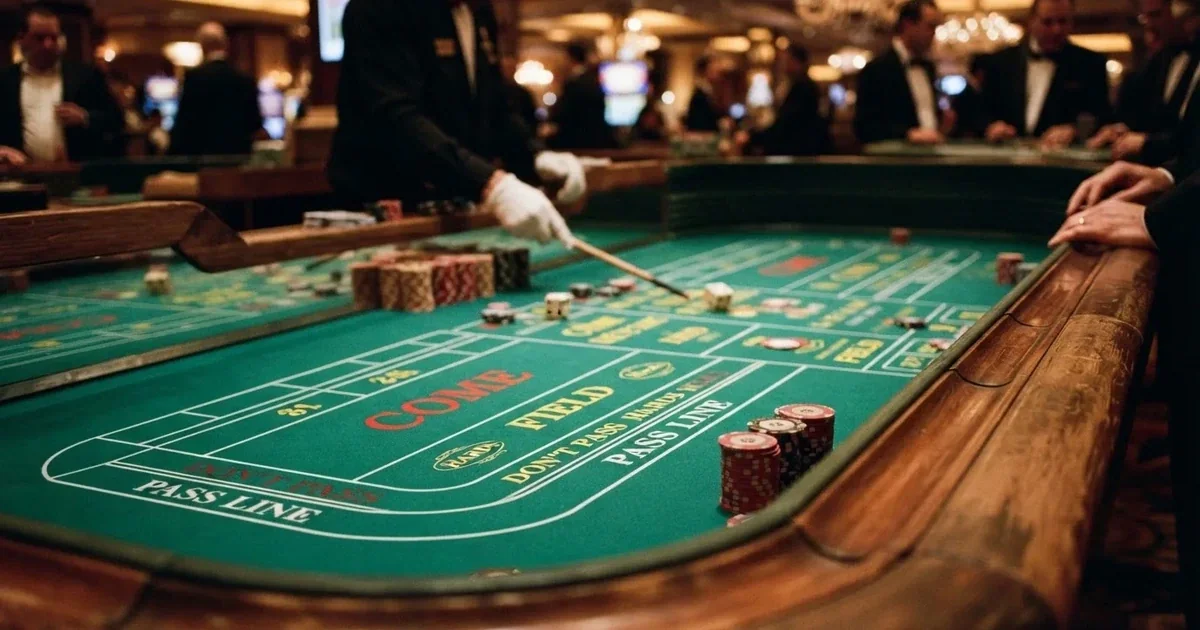
The modern casino craps layout dates from around 1907, when Philadelphia dicemaker John H. Winn introduced a Don’t Pass wager to balance the casino’s exposure whichever way a bet went. The U-shaped felt carries duplicate betting areas at each end so the same bets can be made from either side of the table, and the high-walled design with a pyramid-textured interior randomises the dice throw so a player cannot reliably aim the result. Online, the felt becomes a flat screen layout — the wall texture becomes a graphic, the duplicate ends become a single grid, and the dice throw becomes an animation. The bets are the same either way.
The bets break into three groups by edge.
| Bet Type | House Edge |
|---|---|
| Pass Line | 1.41% |
| Don’t Pass | 1.36% |
| Any Seven | 16.67% |
| Hardways | 2.78% |
Multi-roll bets (Pass Line, Don’t Pass, Come, Don’t Come) sit at 1.41% on the Pass side and 1.36% on the Don’t Pass side. Single-roll bets (Any Seven, Hardways, Field) range from roughly 2.78% on a Hop bet up to 16.67% on Any Seven. The Odds bet, layered behind any Pass or Don’t Pass wager, is the only bet on the layout at 0%. A player who knows the structure can spend an entire session on Pass plus Odds and pay the smallest tax the house charges in craps.
How UK-Licensed Craps Sites Compare Side by Side
The ten brands below all hold active Gambling Commission remote casino operating licences, and each one’s domain is recorded on the Commission’s public register. Several share a parent company — Ladbrokes and Betfair, for example, both sit under PPB Games Limited on the same licence account — and a player should read those rows as one operator running two consumer-facing brands rather than as two independent casinos.
| Brand | Licence Holder and GB Remote Casino Licence | Domain Status on the Register | Subject Support |
|---|---|---|---|
| Grosvenor Casinos | Rank Interactive (Gibraltar) Limited — 057924-R-334666-005 | Active | Not confirmed |
| Betfred | Petfre (Gibraltar) Limited — 039544-R-319290-010 | Active | Not confirmed |
| 32Red | Platinum Gaming Limited — 045322-R-324275-019 | Active | Not confirmed |
| BetVictor | BV Gaming Limited — 039576-R-319370-028 | Active | Not confirmed |
| William Hill | WHG (International) Limited — 039225-R-319373-015 | Active | Not confirmed |
| Virgin Games | Gamesys Operations Limited — 038905-R-319430-022 | White label | Not confirmed |
| Ladbrokes | LC International Limited — 054743-R-330863-014 | Active | Not confirmed |
| Paddy Power | PPB Games Limited — 039411-R-319335-010 | Active | Not confirmed |
| Betfair | PPB Games Limited — 039411-R-319335-010 | Active | Not confirmed |
| Jackpotjoy | Gamesys Operations Limited — 038905-R-319430-022 | Active | Not confirmed |
None of these brands has confirmed or denied carrying a craps title in the inputs the page is built from. The craps availability question — which of these ten runs Evolution’s Live Craps, which runs an RNG version, and which skips the category entirely — is one a player has to answer brand by brand. The licence line above is what is settled.
What the Register Tells a Player
The Commission’s public register is downloadable as a CSV or Excel file, and on 18 September 2026 it held 139 businesses holding an active remote casino operating licence. The domain list within it records each website against the licence account that runs it, with a status of Active, Inactive or White Label. A white-label site trades under another company’s licence — Virgin Games is the clearest example in the table above, sitting as a white-label domain of Gamesys Operations Limited rather than as an independently licensed brand.
The licence number format tells the same story in shorthand. A remote casino licence on the register reads as a sequence of an account number, a remote indicator, a licence number, and a suffix, where the leading six digits repeat the licence holder’s account number and the “R” marks a remote (online) licence. So 039411-R-319335-010 reads as licence account 39411, PPB Games Limited, with a remote operating licence numbered 319335 and a suffix indicating the licence’s position in the account’s history of amendments. That format is the only test of whether a brand holds what it claims to hold, and it is the line a player should look up before depositing anywhere.
By 18 September 2026 the domain list held 1,065 active and 361 white-label website entries. That is the population the Commission treats as in-scope for UK players; it dwarfs the ten brands above, which means the table is a sample of one segment — large, established, multi-product brands — rather than a complete map of where craps can be played.
The UK Online Casino Landscape Around Craps
Craps sits in a wider UK market that the Gambling Commission oversees in close detail. Every operator taking customers in Great Britain needs a Commission licence wherever it is based — the Gambling (Licensing and Advertising) Act 2014 ended the era in which an offshore licence alone was enough to serve UK players. A Curaçao or Maltese licence is no substitute; the Commission’s register is the only document that proves a brand is licensed to take a UK deposit.
The reason this matters more for craps than for slots is volume. Slots dominate UK casino lobbies and the studios behind them publish RTPs as a matter of course; craps does not have that infrastructure, so a player cannot lean on a published RTP the way they can for a Starburst or a Book of Dead. What a player can lean on is the licence line. A licensed craps table sits under the same consumer protection regime as every other game on the site — GAMSTOP enrolment, deposit-limit prompts, identity verification — and an unlicensed table sits under none of it.
The Commission itself cannot block illegal sites at the ISP level. What it can do is issue cease-and-desist notices, refer sites for search-engine delisting, and push payment and hosting providers to cut off service. The penalty is aimed at the operator, not at the player. What the player loses by going to an unlicensed site is the protection envelope — no GAMSTOP, no Commission complaints route, no approved alternative dispute resolution — and on a game like craps, where the bet structure rewards informed play, that envelope is a meaningful part of what a licensed site offers.
How UK Gambling Regulation Bites on a Craps Session
UK regulation sets three layers of protection that apply whether a player is at the craps table, the slots lobby, or anywhere else. The first layer is age and identity. Every licensed site verifies the customer’s name, address and date of birth before the first deposit or any play, under rules that have applied since 7 May 2019. Credit cards are not accepted — the ban took effect on 14 April 2020 and extends to credit cards routed through e-wallets, so a player cannot route a credit-card-funded e-wallet deposit around the rule. Anonymous play is not possible at a licensed site, regardless of what the marketing around cryptocurrency might suggest.
The second layer is financial limits. Since 31 October 2025 every UK operator must prompt a customer to set a financial limit before accepting the first deposit. There is no state-set deposit or loss ceiling — the prompt is the regulator’s chosen mechanism, and the limit the player sets is the limit the operator enforces. Since 28 February 2025 financial vulnerability checks have run at £150 net deposits in a rolling 30-day window, using public data only. The wider financial risk assessments have been announced but are not yet in force.
The third layer is GAMSTOP. The national online self-exclusion scheme became a mandatory condition of every online licence on 31 March 2020. A self-exclusion period is six months, one year, or five years, and it cannot be cancelled early. Every UK-licensed brand participates; an unlicensed brand does not. The National Gambling Helpline (GamCare) and GambleAware sit alongside GAMSTOP as the routes a player can use when a self-set limit is not enough.
These three layers apply to craps just as they apply to slots. Where they diverge from slots is on stake and spin timing. The £5 maximum stake per game cycle for players aged 25 and over (since 9 April 2025) and £2 for players aged 18-24 (since 21 May 2025) applies to online slots, not to table games. The 2.5-second minimum spin time applies to slots. The auto-play ban applies to slots. None of these bounds the speed at which a craps round resolves, and a player who switches from slots to craps will notice the difference immediately — Evolution’s live dealer craps resolves a single-roll bet in roughly the time a slot takes to spin.
The UK government has set the lower online slot stake limit for 18-24 year olds at £2 in part because that age group has the highest average problem gambling score of any age group, citing ongoing neurological development and lower disposable income alongside the score itself. The rationale is slots-specific — the rapid cycle, the autoplay risk, the disguised losses — and does not transfer cleanly to craps, where each round carries an explicit decision and a clearly stated edge.
Safer-Gambling Tools Around the Craps Table
The safer-gambling conversation at a UK-licensed craps site runs through three channels. The first is the deposit limit prompt that appears before the first deposit, where the player sets a daily, weekly or monthly ceiling that the operator enforces across the entire account — not just on the craps table. The second is GAMSTOP, which a player registers with independently of any operator and which then blocks new account openings across every UK-licensed brand for the chosen exclusion period. The third is the financial vulnerability check, which the operator runs at the £150 rolling 30-day threshold using publicly available data.
Time-out and reality-check features are also part of the toolkit. A time-out is a short self-exclusion — typically 24 hours to six weeks — that the player sets within a single operator’s account. A reality check is a periodic on-screen reminder of session length and net position, more common on slots than on table games but increasingly present in live-dealer lobbies. Where a player feels the safer-gambling tools are not enough, the National Gambling Helpline (0808 8020 133, run by GamCare) and the broader GambleAware service sit outside the operator.
The Commission has issued cease-and-desist notices, search-engine delistings, and payment and hosting referrals against unlicensed brands, and those disruptions have removed a number of offshore craps sites from the UK-facing market over the past several years. The disruption route is the Commission’s lever of choice; it has no ISP-blocking power, so a determined player can still reach an unlicensed site, but each visit carries the protection gap described in the section above.
Cryptocurrency, Anonymity, and the UK Craps Market
The crypto angle on UK craps is mostly a marketing veneer. A Gambling Commission licensee must still run identity checks before the first deposit — since 7 May 2019 — and cryptocurrency does not exempt the operator from that obligation. A brand that accepts Bitcoin or Ethereum is bound by exactly the same verification regime as a brand that accepts a debit card, and the credit-card ban of 14 April 2020 does not extend to cryptocurrency. That gap is real, but it does not equal anonymity: the operator still needs to know who the customer is.
The practical effect on the craps lobby is small. Evolution’s Live Craps does not behave differently on a crypto-funded account than on a debit-card-funded account. The bet set, the edge, the studio feed and the tutorial are identical. The only place crypto changes the experience is in deposit and withdrawal speed, where a crypto transfer can settle faster than a card transaction, and in minimum deposit, which on some brands is lower for crypto than for sterling.
Where crypto does change the picture is on unlicensed sites. An offshore casino without a Commission licence can accept Bitcoin without running identity checks in the way a UK licensee must, and the marketing around that gap targets players who want to play without the safer-gambling envelope. What the marketing does not say is what the player gives up by going offshore — no GAMSTOP, no Commission complaints route, no ADR — and on a thin-shelf game like craps, where the question of whether a given title exists at all on a given brand is already a small one, the offshore search often returns sites the Commission’s enforcement action has already disrupted.
Bonus Terms and the Real Cost of Clearing a Craps Bonus
The bonus market around craps is small, and the smallness is a feature rather than a bug. A bonus that can be used on craps is rarely a craps-specific bonus — it is a generic casino welcome offer or a live-casino promotion, and the wagering requirement applies across the whole bonus balance regardless of which game the player clears it on. Two rules in particular shape what that means.
The first is the wagering cap. Since 19 December 2025 wagering requirements on UK-licensed sites are capped at 10x the bonus amount. A £100 bonus, the highest typical UK welcome offer, carries at most £1,000 of required turnover before withdrawal. That cap is a hard ceiling, not a typical multiple — many welcome offers sit lower, at 30x or 40x in the older offshore market, and the UK cap flattens that spread.
The second is the mixed-product ban. Also since 19 December 2025, mixed-product bonuses — a stake on sport that returns casino spins, for example — are banned. A bonus is one product or the other, and a craps player cannot find their way into a casino bonus through a sportsbook free bet.
The real cost of clearing a craps bonus is the time and money the wagering requirement consumes, and the calculation provides the page’s core information. A £100 bonus at 10x wagering means £1,000 of turnover through the craps table. At a £5 Pass Line stake — the maximum stake per game cycle for a player aged 25 and over under the slots rules, though not bound to craps — that is 200 Pass Line bets. The house edge on a Pass Line bet is 1.41%, so the expected cost of £1,000 of Pass Line turnover is roughly £14.10. That is the price of clearing the bonus in expectation; the player who wins will pay less, and the player who loses will pay more, but £14.10 is the statistical centre.
Two things matter about that figure. The first is the assumption: it assumes the player wagers only on Pass Line, never on the higher-edge single-roll bets (Any Seven, Hop bets) that turn the same £1,000 of turnover into a much larger expected loss. The second is the contrast with slots. A £100 bonus cleared through an online slot at 10x wagering carries an expected loss that depends on the slot’s RTP — typically 4% to 6% on a 96% RTP slot, or £40 to £60 on £1,000 of turnover. The craps clearing route is cheaper in expectation, but only because the player picks the right bet.
A bonus cleared at £10 per round rather than £5 cuts the round count to 100 and lengthens the session from a few minutes to a longer stretch — and longer sessions are exactly what the safer-gambling tools are designed to interrupt. Each of these tools — the deposit-limit prompt, the time-out feature, and the GAMSTOP registration — works on session length rather than on stake size, and the player who clears a bonus slowly spends more time under each tool’s threshold.
The Brands: What Sets Each One Apart
The ten brands below are reviewed in the order the Commission’s register presents them, with no ranking implied. Each review ends on the question the licence and the available product mix actually answer, which differs brand to brand.
Grosvenor Casinos — the Land-Based Operator’s Online Brand
Grosvenor Casinos trades under Rank Interactive (Gibraltar) Limited on licence 057924-R-334666-005, with Grosvenor Casinos listed as an active domain on the Commission’s register. The brand runs a UK retail estate of casinos that predates its online operation, which is the angle that matters here: a player who already knows a Grosvenor retail floor will find the live-dealer craps feed familiar in studio design and betting cadence. The craps title itself is the same Evolution product every other UK brand runs; what differs is the operator and the supporting lobby around the table.
What the licence tells the player is straightforward. The Commission’s register is the only place to confirm a remote casino operating licence, and Grosvenor’s entry there is current and active. The craps availability question is not answered by the inputs the page draws from — the brand’s lobby configuration is the kind of thing a player has to check on the brand itself before depositing.
Betfred — the Bookmaker’s Casino Lobby
Betfred sits on licence 039544-R-319290-010, held by Petfre (Gibraltar) Limited, with Betfred listed as an active domain. The brand is best known as a bookmaker, and the casino lobby grew out of the sportsbook customer base rather than the other way round. For a craps player, that history matters mostly because the casino is positioned as a complement to the sportsbook rather than as a destination product — the live-dealer craps feed sits in the same tab as the slots and the table games, without a featured category of its own.
The licence is the same shape as the rest: active, current, recorded against the Gibraltar operating company on the Commission’s domain list. The craps table itself is again the Evolution live-dealer product, with the same studio and the same tutorial.
32Red — the Single-Licence Independent
32Red is the cleanest example in the table of a brand that sits on its own licence account rather than sharing one with a larger group. Platinum Gaming Limited holds 045322-R-324275-019, and the company is the only domain on that account the Commission’s register lists as active. The brand’s small size — relative to the multi-brand groups above and below it — is the angle that matters: a player at 32Red is on a single-purpose platform rather than on a shared infrastructure, and the safer-gambling and customer-protection machinery is configured for that scale.
The craps question is the same as elsewhere — the lobby configuration is not in the inputs — but the licence line is the cleanest in the table, with no white-label arrangement and no sibling brand on the same account.
BetVictor — the Sportsbook-Heavy Independent
BetVictor holds its own licence, 039576-R-319370-028, through BV Gaming Limited. Like Betfred, the brand started as a sportsbook and grew a casino product alongside it, but the casino has been a more prominent part of the brand’s identity for longer. The craps offering, where it exists, is again the same Evolution live-dealer feed the rest of the market runs. The Commission’s register lists Betvictor as an active domain against the licence account.
The angle that matters here is product depth. A sportsbook-first brand tends to run a tighter casino lobby than a casino-first brand, and a player looking for craps on BetVictor should expect the table to sit in the live-dealer tab rather than to have its own category page.
William Hill — the High-Street Bookmaker’s Online Casino
William Hill trades on licence 039225-R-319373-015, held by WHG (International) Limited, with William Hill listed as an active domain. The brand’s high-street retail history means the customer base skews older than some of the pure-online brands above, which is reflected in the lobby configuration rather than in the craps product itself. The craps table is again the same Evolution feed.
For a craps player, William Hill is one of the brands most likely to run a native iOS and Android app that includes the full live casino, which matters on a phone where browser tabs are awkward to keep open across sessions. The licence line is current and active.
Virgin Games — the White-Label Brand
Virgin Games is the only white-label domain in the table. The Commission’s register lists Virgin Games as a white-label domain of Gamesys Operations Limited, which holds the active remote casino operating licence 038905-R-319430-022. A white-label site trades under another company’s licence — the player deposits with Virgin Games, but the operating company behind the licence is Gamesys. The player protection regime is the same as it would be on Jackpotjoy (also Gamesys), because the licence is the same.
The angle for a craps player is straightforward. The brand identity is Virgin’s, but the licence and the operating company are Gamesys. The craps product, where it exists, is the same Evolution feed every other UK brand runs.
Ladbrokes — the Coral Sister-Brand
Ladbrokes sits on licence 054743-R-330863-014, held by LC International Limited, which is the same parent company that runs Coral and Gala Bingo. The Commission’s register lists Ladbrokes as an active domain. The multi-brand structure is the angle that matters: a player with an account at Ladbrokes is on the same operating infrastructure as a player at Coral or Gala Bingo, and the safer-gambling tools, the deposit limits, the GAMSTOP registration and the customer complaints route are configured across the group.
The craps product is again the same Evolution live-dealer feed, and the lobby configuration is the kind of thing a player has to check on the brand itself.
Paddy Power — the Irish Bookmaker’s UK Casino
Paddy Power trades on licence 039411-R-319335-010, held by PPB Games Limited, with Paddy Power listed as an active domain. The brand’s Irish origin is more visible in the sportsbook than in the casino, but the casino product sits on the same UK-facing licence as Betfair below. The two brands share the operating company, the safer-gambling infrastructure and the loyalty programme, and a player registered with one is registered with the other.
For a craps player, the PPB Games account structure means a deposit-limit set on Paddy Power applies across the Betfair casino lobby too, which is the kind of detail the Commission’s safer-gambling rules do not always make visible on the front end.
Betfair — the Exchange Brand’s Casino
Betfair sits on the same licence as Paddy Power — 039411-R-319335-010, held by PPB Games Limited, with Betfair listed as an active domain. The brand is best known for its betting exchange, and the casino product runs alongside rather than at the centre of the brand identity. The craps table, where it exists, is again the same Evolution live-dealer feed.
The angle for a player is the same shared account structure described under Paddy Power. A deposit-limit prompt that runs before the first deposit on Betfair applies across the PPB Games group, and the GAMSTOP registration is at the licence level rather than the brand level.
Jackpotjoy — the Bingo-First Brand’s Casino
Jackpotjoy trades on licence 038905-R-319430-022, held by Gamesys Operations Limited, with Jackpotjoy listed as an active domain. The brand’s identity is built around bingo, and the casino product is a smaller part of the offering. The craps table, where it exists, is the same Evolution feed the rest of the market runs.
For a craps player, Jackpotjoy is the same operating environment as Virgin Games — both brands run on the Gamesys licence — and the safer-gambling machinery, the deposit-limit prompt and the GAMSTOP registration are configured at the licence level.
How a Craps Bonus Clears in Practice
A worked example is the cleanest way to see what the wagering cap means in time and money. Take a £100 welcome bonus with a 10x wagering requirement — the maximum the Commission now allows. The required turnover is £100 × 10 = £1,000. At a £5 Pass Line stake, that is 200 bets. At roughly 30 seconds per round on Evolution’s live-dealer craps (a come-out roll, the bet resolution, and the next round’s setup), 200 rounds is around 100 minutes of play — an hour and forty minutes of craps to clear a £100 bonus.
The expected loss on £1,000 of Pass Line turnover is £1,000 × 1.41% = £14.10. The bonus pays £100 in cash, less £14.10 in expected house edge, for a net expected value of £85.90 — before any variance. A player who picks single-roll bets with higher edges (Any Seven at 16.67%, for example) will see that expected loss rise sharply; a player who layers Odds bets behind Pass Line wagers will see it fall to zero on the Odds portion.
The same £100 bonus cleared through online slots, for comparison, would carry an expected loss of £40 to £60 on £1,000 of turnover at a typical 96% RTP slot. The craps route is cheaper in expectation, but only because the player picks the bet. The marketing word “playthrough” hides that distinction; the arithmetic does not.
This calculation is an estimate, not a forecast. The £14.10 expected loss is the statistical centre across many spins under the stated assumptions — a player who hits an early hot streak will pay less, a player who hits a cold one will pay more. No single session is guaranteed to land on the average, and no bonus is guaranteed to clear in any particular session length. What the calculation tells a player is the shape of the offer before they take it.
What the Numbers Don’t Tell You
Three things the page’s figures cannot settle. The first is whether a given brand actually carries a craps title in its current lobby — the inputs the page draws from do not confirm or deny craps availability brand by brand, and the lobby configuration is the kind of thing that changes month to month. A player who lands on a brand’s site and finds no craps table is not looking at a brand that has decided against the game; they are looking at a brand whose lobby may not include it at that moment.
The second is the volatility of the craps product itself. The Pass Line and Odds bets are low-variance, with steady small losses per round; the single-roll bets are high-variance, with most rounds losing and a few paying large multiples. A session of 200 Pass Line bets feels very different from 200 Any Seven bets, and the £14.10 expected loss above sits on the low end of the range a craps session can produce.
The third is the wider UK regulatory calendar. The Commission has announced wider financial risk assessments that are not yet in force, and the implementation dates for the safer-gambling changes that have taken effect vary between 2021 and 2026. A player reading this page in late 2026 is at the tail end of a regulatory tightening that has changed the UK online casino market materially over five years, and further changes are likely.
Where Craps Fits in a Player’s Bankroll
For a player who already plays online casino and wants to add craps without changing their overall spend, the structure is simple. The craps table is one of the lower-edge products on a UK-licensed site, and the Pass Line plus Odds combination is the cheapest bet in the casino in expectation. A session of 100 rounds at £5 Pass Line plus £10 Odds costs the player roughly £7 in expected house edge; the same session on a 96% RTP slot costs roughly £20. The craps route is cheaper, but only for a player who knows the bet structure and picks the right bets.
The bonus route is the same logic with a deposit attached. The 10x cap on wagering since 19 December 2025 sets a ceiling on the time and money needed to clear a UK bonus, and the craps clearing path costs less in expected house edge than the slot clearing path. A player who has chosen to claim a bonus and is choosing how to clear it should pick the lowest-edge route, which on a UK site means craps with Pass Line plus Odds, or a single-deck blackjack table at around 0.5% house edge, or a 99% RTP live roulette game — in that order of cheapness.
For a player who has not yet chosen to claim a bonus, the calculus is different. A £100 bonus at 10x wagering is worth roughly £85.90 in net expected value on the Pass Line clearing path, and the player pays £14.10 in expected house edge to extract it. The session length — around 100 minutes for a £5 stake — sits well within the time-out windows the safer-gambling tools run on, and the deposit-limit prompt that runs before the first deposit is the regulator’s chosen mechanism for capping the player’s exposure. A player who has set a deposit limit before claiming the bonus has already done most of what the regulator would want them to do.
What the Safer-Gambling Tools Cost a Player in Practice
The deposit-limit prompt that runs before the first deposit is the most concrete of the safer-gambling tools, and the one most directly relevant to craps. The player sets a daily, weekly or monthly ceiling that the operator enforces across the entire account — craps, slots, sportsbook, the whole product — and the limit cannot be raised without a cooling-off period that varies by operator. The limit is the regulator’s chosen mechanism, and a player who has not set one will be prompted again before each subsequent deposit.
The financial vulnerability check at £150 net deposits in a rolling 30-day window is the next layer. The check uses public data only, and it does not block play; it surfaces information the operator has about the player’s financial position and asks the player to confirm they want to continue. A player who has deposited £150 net in the past 30 days will see the prompt regardless of which game they are playing, and a craps session that pushes them past the threshold will trigger it.
GAMSTOP is the next layer up. A player registered with GAMSTOP cannot open a new account at any UK-licensed brand for the duration of their exclusion — six months, one year, or five years, with no early cancellation. The exclusion is at the licence level rather than the brand level, so a player who has self-excluded on one site is excluded across the whole UK-licensed market. The exclusion covers craps just as it covers slots.
A time-out, set inside a single operator’s account, is a shorter version of the same mechanism — typically 24 hours to six weeks — and a player who feels a session is running long can use it without committing to a GAMSTOP exclusion. The National Gambling Helpline (0808 8020 133, run by GamCare) and the broader GambleAware service sit outside the operator for players who want help outside the brand’s own tools.
Where Craps Players Go Wrong
Three patterns show up often enough to be worth naming. The first is treating craps as a slot. A player who sits down at the craps table and hits the “roll” button on every round, ignoring the betting grid, is paying whatever edge the auto-resolved bet carries rather than picking the lowest-edge bet on the layout. The Pass Line plus Odds combination is the cheapest bet on the felt, and a player who does not pick it is leaving money on the table in a way they would not at a blackjack table.
The second is chasing a bonus through single-roll bets. A player who has chosen to clear a £100 bonus and is doing it on Any Seven bets is paying 16.67% house edge on every round rather than the 1.41% on Pass Line. The expected loss on £1,000 of Any Seven turnover is £166.70 — twelve times the cost on Pass Line. The bonus pays the same £100 either way, and the player who picks the wrong bet is paying for the privilege of clearing it.
The third is playing on an unlicensed site. The Commission’s enforcement action has disrupted offshore brands repeatedly, and the craps title on an unlicensed site is often a digital RNG version with no studio pedigree and no published paytable. The player who goes offshore loses the protection envelope — no GAMSTOP, no Commission complaints route, no ADR — and gains nothing the licensed market does not offer. The marketing around cryptocurrency and anonymity targets this gap, and the gap is real, but the cost is paid by the player rather than the operator.
The Wider Market Context
The Commission’s public register is the single best summary of the UK online casino market a player can read. On 18 September 2026 it listed 139 businesses holding an active remote casino operating licence and 1,065 active domain entries on the domain list, plus 361 white-label entries. The craps market sits inside that population as a thin shelf: Evolution’s Live Craps is the dominant live-dealer title, and a small set of RNG craps products from Playtech and Gamesys fills in around it. The rest of the UK online casino market — slots, blackjack, roulette, live game shows, bingo — dwarfs the craps offering in volume.
The market is also tightening. The wagering cap of 19 December 2025 and the mixed-product ban of the same date are the most recent in a sequence of safer-gambling changes that have run from the credit-card ban of 14 April 2020 to the GAMSTOP mandate of 31 March 2020 to the slot stake limits of April and May 2025. Remote Gaming Duty rose from 21% to 40% from 1 April 2026 — a tax on operators, not on players, but a tax that operators respond to by tightening commercial offers, and that tightening eventually reaches the bonus terms the player sees. The market the page describes is the market of late 2026, and the market of 2027 will not be identical.
For a player who has read this far, the shape of the offer is clear. The UK online casino market is regulated, the licence line is verifiable, the craps product itself is thin but well-defined, and the bonus terms are capped in a way that flattens the worst offshore excesses. The page’s angle — cost — is the angle the regulator has also taken, and the safer-gambling tools, the deposit limits and the GAMSTOP registration are the regulator’s answer to the same question. What a player does with both is the player’s call.
Frequently Asked Questions
How do craps payouts work at a licensed UK online casino?
A Pass Line bet pays 1:1 and carries a 1.41% house edge. An Odds bet, placed behind a Pass Line wager, pays at true mathematical odds and carries a 0% edge, but only as a layer on top of an existing Pass or Don’t Pass bet. Single-roll bets pay higher multiples but carry much higher edges — Any Seven pays 4:1 with a 16.67% house edge, for example. The cheapest route through a UK craps table is Pass Line plus Odds.
Is online craps available as a live-dealer game or only as a digital table?
Both. Evolution’s Live Craps runs out of a speakeasy-themed studio with a built-in tutorial and an Easy Mode aimed at new players, and is the live-dealer title most UK-licensed brands carry. RNG craps versions from studios such as Playtech and Gamesys sit alongside it on several brands. The two formats use the same betting layout and the same bet set, with the live-dealer feed adding a real studio and a real dealer.
Can craps be played through a casino app on a phone?
Yes. William Hill, Ladbrokes, Paddy Power, Betfair, Betfred and BetVictor all ship native iOS and Android apps that include the live casino lobby. The Gamesys brands (Virgin Games, Jackpotjoy) lean on a mobile browser experience rather than a downloadable app. Browser play is the universal baseline — Evolution’s Live Craps loads in HTML5 inside a Safari or Chrome tab without a plugin.
Do UK craps tables use the same bet types as a physical casino table?
Yes. The Pass Line, Don’t Pass, Come, Don’t Come, Odds, Field, Any Seven and Hardways bets are all available on a UK online craps table, and the multi-roll bets (Pass Line and Don’t Pass) carry the same 1.41% and 1.36% edges they carry on a physical felt. The U-shaped layout with duplicate betting areas at each end becomes a flat screen layout online, but the bet structure is unchanged.
What bonus terms usually apply when a bonus can be used on craps?
Since 19 December 2025 wagering requirements on UK-licensed sites are capped at 10x the bonus amount, and mixed-product bonuses are banned. A £100 bonus at 10x wagering requires £1,000 of turnover before withdrawal. The expected cost of clearing that turnover on Pass Line is roughly £14.10 — significantly cheaper than clearing it through a 96% RTP online slot, which carries an expected loss of £40 to £60 on the same turnover.
Are craps tables offered by crypto-friendly casinos different from standard ones?
No. The craps product on a UK-licensed crypto-friendly casino is the same Evolution live-dealer feed or the same RNG craps version as on any other UK-licensed brand, with the same bet structure and the same edges. The only differences are in deposit and withdrawal mechanics — crypto can settle faster and may carry a lower minimum deposit — and in the licensing itself, which is unchanged regardless of the payment method.
Created by the ”livetablesuk” editorial team.