Best 3-Reel Slots in the UK: What Players Actually Pay to Spin
 Available in GB
Data current as of 18 September 2026; verified against the Gambling Commission’s public register of licence holders and domain listings.
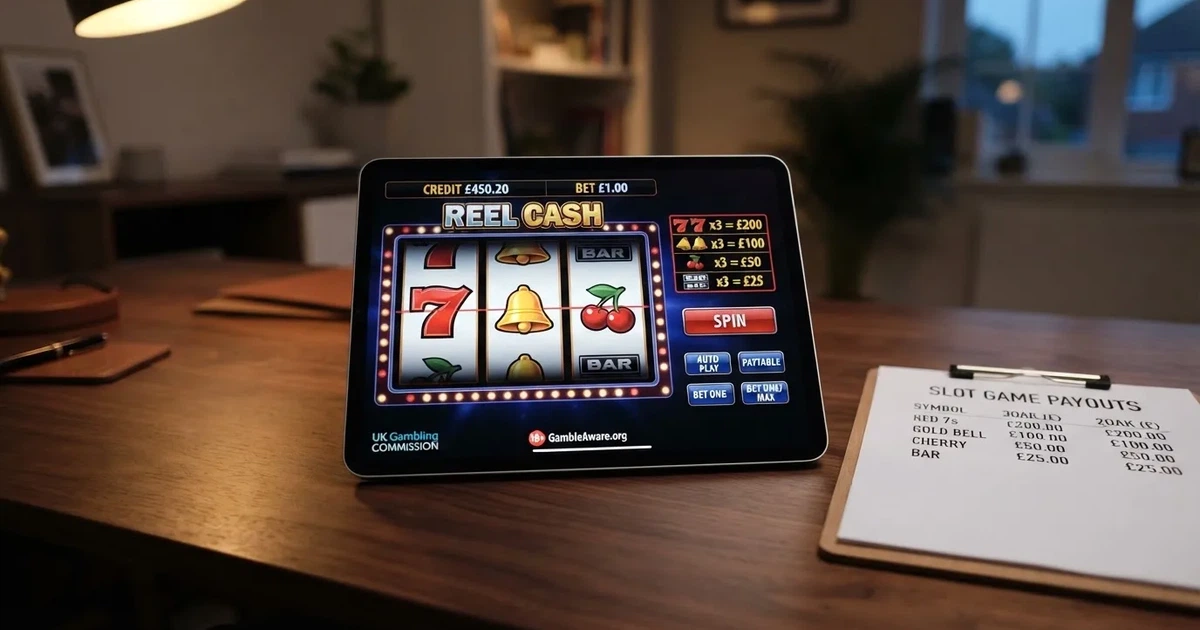
A three-reel slot looks like the simplest game in the casino lobby: one payline, three rows, a handful of symbols, a lever-arm sound when the reels stop. That simplicity is the whole point, and it is also where the cost to the player hides. The reels do the same thing whether a punter stakes twenty pence or five pounds, and the maths behind a payout does not care how many features the game has bolted on. This page reads those mechanics against what UK-licensed operators actually offer, so a player can tell which three-reel slots pay honestly, what stake limits mean for a session, and where the £2 or £5 ceiling cuts the bankroll in half.
Data current as of 23 September 2026; verified against the Gambling Commission’s public register.
Table of Contents
- How a Three-Reel Slot Pays: Reading the Paytable
- The Legal Frame: Gambling Commission Licensing and UK Player Protections
- Responsible Gaming Tools at UK-Licensed Sites
- Free Play, No-Registration Demos and the Crypto Question
- Deposits, Payouts and the 10x Wagering Cap
- The Ten UK-Licensed Sites and How Their 3-Reel Slots Compare
- Working Out the Real Cost: Stake Limits, RTPs and a Session Budget
- Frequently Asked Questions
How a Three-Reel Slot Pays: Reading the Paytable
A three-reel slot has three vertical reels, each carrying a small set of symbols, and the machine pays when matching symbols land on a single active line — usually the middle row. The original Liberty Bell, built by Charles Fey in San Francisco, used three reels with horseshoes, diamonds, spades, hearts and a bell; three aligned bells paid fifty cents, ten nickels. That mechanical structure, three reels and a payline, is still what “three-reel” means at a UK-licensed site more than a century later.

The mechanism behind the symbols changed long ago. Herbert Mills produced the first copy of the Liberty Bell in 1907, and by the time Norwegian mathematician Inge Telnaes patented his random-number-generator reel-stop technology in 1984, the symbols on a physical reel had become a way of displaying probabilities rather than determining them. The reel stops are picked electronically, and the symbols on the visible reel strip can be weighted to land more or less often without changing how often each stop is selected. A cherry might appear once on the visible strip, but the underlying number sequence can give it a hit frequency of one in ten. This is why two three-reel slots with identical-looking reels can pay at very different rates.
Paytables on modern three-reel slots range from a single line across the middle to a handful of diagonals and horizontals. The base game pays on line combinations of three matching symbols, with the top symbol typically paying the highest multiple of the line stake. Wilds substitute for other symbols to complete a line; scatters, when present, pay anywhere on the reels without needing to align. Bonus rounds on three-reel slots are usually simpler than their five-reel cousins — a pick-and-win screen, a free-spins feature, occasionally a hold-and-spin mechanic with locked symbols. The format favours straightforward play: spin, see three symbols, get paid or not, repeat.
Volatility describes how a slot distributes its wins. A low-volatility three-reel slot pays smaller amounts more often; a high-volatility slot pays less often but with bigger line hits when they come. The label is not printed on the paytable — players work it out from session behaviour, or the game information sheet lists it as low, medium or high. For a player with a small bankroll, a low-volatility three-reel slot stretches a £20 deposit into more spins at the cost of smaller returns per hit; a high-volatility slot does the opposite, with longer dry stretches between payouts. Neither is a better game; they cost differently.
Return to Player and What UK Operators Must Show
Return to player, written as RTP, is the percentage of all wagered money that a slot is programmed to return over a very large number of spins. A 96% RTP returns £96 for every £100 staked across millions of spins; the remaining £4 is the house edge. UK remote gambling operators are required to have processes in place to measure the ongoing performance of games such as online slots, comparing actual return against the advertised figure and raising alerts when performance falls outside the acceptable range; if a confirmed performance error occurs, the operator must submit a key event to the Gambling Commission. RTP monitoring is reviewed as part of annual games testing audits.

The advertised RTP is a long-run figure; in any single session a player can be well above or well below it. The Commission does not set a minimum RTP for UK-licensed online slots — Nevada requires 75% and New Jersey requires 83%, but the UK leaves the figure to the operator and the game supplier. The advertised RTP must be displayed in the game information, and a player should be able to find it before staking real money. If a game does not show its RTP in the information panel, that is a red flag at any licensed site.
The high-payout three-reel slots are those with RTPs at or above the upper end of what suppliers typically offer, in the 96% to 98% range. The “best paying” label depends on whether the comparison is RTP, volatility-adjusted return, or jackpot size — these three measures do not always agree. A game with a 97% RTP and high volatility will produce more losing sessions than a 96% RTP low-volatility game, even though the long-run return is higher. The headline RTP is the number to compare first; volatility is the number to think about second.
The Legal Frame: Gambling Commission Licensing and UK Player Protections
Any site offering three-reel slots for real money to players in Great Britain needs a Gambling Commission licence. The Gambling Act 2005 covers England, Scotland and Wales (Northern Ireland runs a separate regime), and since the Gambling (Licensing and Advertising) Act 2014 any operator taking customers in Great Britain needs a Commission licence regardless of where the company is based. A Curaçao, Malta or Gibraltar licence alone does not cover UK customers.
The public register is the test of whether a brand holds a licence. The register’s licence number format is account-R-number–suffix, where the leading six digits repeat the licence holder’s account number and the “R” marks a remote (online) licence. Each domain is listed against the licence account that runs it, with a status of Active, Inactive or White Label; a white-label site trades under another company’s licence, which is a legal arrangement rather than an independent operator. The domain list on 18 September 2026 held 1065 active entries and 361 white-label entries.
For a player, the practical protections attached to a UK-licensed site are concrete. Identity verification — name, address and date of birth — has been mandatory before the first deposit or any play since 7 May 2019. Anonymous play at a licensed site is not possible. Credit cards have been banned for gambling since 14 April 2020, including credit cards funded through e-wallets. GAMSTOP, the national online self-exclusion scheme, is a mandatory condition of every online licence since 31 March 2020; exclusion periods run six months, one year or five years and cannot be cancelled early.
Stake Limits, Spin Speed and Auto-Play
The Commission sets a maximum stake per game cycle for online slots: £5 for players aged 25 and over (from 9 April 2025) and £2 for players aged 18 to 24 (from 21 May 2025). The government tied the lower limit for under-25s to research that 18-to-24-year-olds have the highest average problem gambling score of any age group, citing lower disposable income and ongoing neurological development. At £2 a spin, a 200-spin session at five-second intervals costs £400; at £5, the same session costs £1,000. For a three-reel slot, where line wins can be modest, the stake ceiling shapes the session more than the payout rate does.
The Commission also set a 2.5-second minimum spin speed, permanently banned auto-play, and required operators to remove losses disguised as wins. The auto-play ban took effect after research indicated the feature caused players to lose track of their gambling activity; reverse withdrawals, which previously let a consumer re-gamble funds already requested for withdrawal, were banned with a 31 October 2021 implementation deadline. None of these rules targets three-reel slots specifically — they apply to all online slots — but the simple format of a three-reel game makes the impact of the spin-speed and auto-play rules easier to see in session.
There is no state-set deposit or loss ceiling for UK players. Since 31 October 2025, operators must prompt a customer to set a financial limit before accepting the first deposit, but the ceiling itself is set by the player or the operator’s affordability processes. Financial vulnerability checks run at £150 net deposits in a rolling 30-day window (from 28 February 2025), using public data only; wider financial risk assessments have been announced but are not yet in force. The player’s own deposit limit is the binding figure for most sessions.
Responsible Gaming Tools at UK-Licensed Sites
Responsible gaming at a UK-licensed site is layered: national self-exclusion, operator-level tools, and a set of mandatory features built into the games themselves. GAMSTOP is the national scheme, and every online licence-holder must take part. A player who registers with GAMSTOP is excluded from every UK-licensed online gambling site for the chosen period; the exclusion cannot be lifted early. This is the strongest tool and the one a player cannot undo, which is precisely the point.
At operator level, every UK-licensed casino offers deposit limits, time-outs (short breaks of 24 hours to several weeks), reality checks (on-screen reminders of session length), and self-exclusion from that specific brand. Deposit limits can usually be set daily, weekly or monthly; lowering a limit takes effect immediately, raising one typically has a cooling-off period. The Commission requires operators to prompt a customer to set a financial limit before the first deposit since 31 October 2025, but the figure itself is the player’s choice. If a player has registered with GAMSTOP, the operator-level tools are not needed because the national exclusion already blocks access.
For help outside the operator, the National Gambling Helpline (run by GamCare) and GambleAware are the main referral points. The Commission’s public register is also searchable if a player wants to confirm that a site is licensed before depositing; the register’s CSV download is the most reliable way to check, since marketing pages and review sites can lag behind actual licence changes.
Free Play, No-Registration Demos and the Crypto Question
The phrase “no registration” appears in most player searches for free three-reel slots, and it describes two different products. The first is a demo mode: the game loads in the browser, plays with virtual credits, requires no account, no deposit and no identity check. Most UK-licensed operators host demos for their three-reel slots through their game-lobby pages; the demos run on the same maths as the real-money game, so they let a player test volatility and bonus frequency without staking. Demo play is not the same as real-money play, and the RTP in demo mode is identical only because the random-number-generator logic is the same; a session in demo mode can feel very different from a real-money session because the player is not risking a bankroll.
The second product is “no deposit” — a free-spins or free-play bonus that does not require a deposit but does require an account. This is real-money play, and the identity checks that come with any UK-licensed site apply. Since 14 April 2020, credit cards are banned for gambling; since 19 December 2025, wagering requirements are capped at 10x the bonus amount and mixed-product bonuses (bet on sport, get casino spins) are banned. A “free spins, no deposit” offer at a UK-licensed site will still require the player to register, verify identity, and meet the wagering cap before any winnings can be withdrawn.
Crypto is a separate question. Bitcoin and other cryptocurrencies are not banned at UK-licensed sites, but the identity-verification rules apply regardless of payment method. There is no anonymous path to real-money play at a UK-licensed site; a player who wants to fund an account with crypto will still need to pass the standard checks. Offshore sites that advertise anonymous crypto play are outside the UK regime, and a player using one loses the protections the Gambling Commission provides — no GAMSTOP, no ADR, no Commission complaints route.
Deposits, Payouts and the 10x Wagering Cap
Deposits at UK-licensed sites typically clear instantly via debit card, bank transfer or e-wallet; the credit card ban means a Visa or Mastercard deposit has to be a debit card, not credit. Withdrawals depend on the payment method: e-wallets usually settle within hours, debit cards within one to three working days, bank transfers within two to five working days. The Commission’s ban on reverse withdrawals means once a player requests a withdrawal, the funds cannot be re-gambled at that operator — the request stands.
The 10x wagering cap, in force since 19 December 2025, is the most consequential change to bonus terms in years. It limits how many times a player must wager a bonus amount before withdrawing any winnings derived from it. At 10x, a £20 bonus carries a £200 turnover requirement. The cap does not remove wagering requirements — it caps them, and the result is a smaller real cost per pound of bonus. The mixed-product ban closes the door on offers that crossed verticals: a sportsbook free bet that came with attached casino spins, for instance, is no longer permitted.
For a player, the practical reading of the cap is straightforward. At £2 a spin — the under-25 ceiling — a £200 turnover requires 100 spins; at five-second intervals, that is roughly 8.3 minutes of play. At £5 a spin — the 25-and-over ceiling — the same £200 turnover requires 40 spins, or about 3.3 minutes. The arithmetic is small in both cases, which is the cap’s purpose: it makes the bonus’s true cost visible without forcing the player to grind through thousands of spins to clear it.
Worked Example: Bonus Cost Under the 10x Cap
A £20 bonus at a 96% RTP three-reel slot under the 10x wagering cap carries a £200 turnover requirement. At a £2 stake and a 2.5-second spin interval, clearing the bonus means 100 spins, taking roughly 4 minutes and 10 seconds of continuous play. The expected loss during those spins, applying the standard expected-loss formula (turnover × (1 − RTP)), is £200 × 0.04 = £8 on average.
That £8 is the bonus’s real cost against the £20 bonus amount. The player keeps the bonus and any winnings above the £8 expected loss; if the player’s session lands below the RTP, the loss is steeper than £8, and if above, smaller. The cap does not guarantee a profit — the math still favours the house — but it bounds the cost in a way the old 30x and 65x multiples did not.
For a player aged 25 or over staking £5 a spin on the same bonus, the turnover clears in 40 spins (about 3.3 minutes) with the same £8 expected loss. The stake ceiling changes how fast the requirement is met, not the requirement itself. A player who chooses a lower-volatility game for the clearing session will see more line hits during those 100 or 40 spins but smaller amounts per hit; a higher-volatility game produces fewer hits but a wider distribution of outcomes. Neither changes the expected loss.
The Ten UK-Licensed Sites and How Their 3-Reel Slots Compare
The ten brands below are listed on the Gambling Commission’s public register with active domains (one as a white-label entry) and a remote casino operating licence. The table reads the licences, domain status and three-reel slot support as the register reports them; the prose after the table picks out what each brand is known for, where the range is strongest, and what a player choosing among them should weigh.
Comparison of Featured Operators
| Brand | Licence holder and GB remote casino licence | Domain status on the register | Subject support |
|---|---|---|---|
| Paddy Power | PPB Games Limited, 039411-R-319335-010 | Active | — |
| Unibet | Platinum Gaming Limited, 045322-R-324275-019 | Active | — |
| Sky Vegas | Bonne Terre Gaming Limited, 065519-R-339675-002 | Active | — |
| kwiff | Eaton Gate Gaming Limited, 044448-R-323408-017 | Active | — |
| bet365 | Hillside (UK Gaming) ENC, 055149-R-331499-004 | Active | — |
| MrQ | Tek Fox Ltd, 060629-R-337532-004 | Active | — |
| Midnite | Dribble Media Limited, 042647-R-321653-022 | Active | — |
| Virgin Games | Gamesys Operations Limited, 038905-R-319430-022 | White Label | — |
| BetVictor | BV Gaming Limited, 039576-R-319370-028 | Active | — |
| Grosvenor Casinos | Rank Interactive (Gibraltar) Limited, 057924-R-334666-005 | Active | — |
The register’s domain listings record whether a brand trades under its own licence or a white-label arrangement; Virgin Games is listed as a white-label domain of Gamesys Operations Limited, meaning it operates under that company’s licence rather than a separate one. The distinction matters when a player wants to know which entity holds the regulatory responsibility. For game range, the register does not catalogue which three-reel slots each brand stocks — that is a catalogue question, not a licence question — so the comparison on game coverage stays qualitative here. What every brand on the table shares is the regulatory floor: identity verification, GAMSTOP participation, the £2 or £5 stake ceiling, the 10x wagering cap, the 2.5-second spin floor and the auto-play ban.
The brands diverge on positioning. Paddy Power and bet365 carry the broadest sportsbook-casino hybrids; their casino lobbies mix three-reel classics with newer five-reel and crash-style games. Sky Vegas, MrQ and Grosvenor lean toward slots-first lobbies. kwiff and Midnite position themselves around novelty mechanics. Unibet and BetVictor sit between, with broad lobbies and established player bases. Virgin Games, as a white-label, runs on Gamesys’s catalogue and infrastructure. None of these positioning differences changes the licence status; all of them shape which three-reel slots a player sees first.
Paddy Power
Paddy Power is listed on the Gambling Commission register as an active domain of account 39411, PPB Games Limited, which holds remote casino operating licence 039411-R-319335-010. The brand’s lobby mixes a sportsbook with a long-established casino product; the three-reel slot range draws on a broad supplier catalogue, including classic fruit-machine formats alongside newer three-reel variants with hold-and-spin and pick-and-win features. For a player comparing three-reel slot ranges across UK-licensed sites, Paddy Power’s catalogue is broad enough that the classics — single payline, three symbols, top-line jackpot — are easy to find.
The brand’s strength is its multi-vertical integration; a player who wants sports betting, casino, and three-reel slots under one account and one licence-holder finds it here. The weakness, for a player who only wants three-reel slots, is that the lobby’s prominence goes to higher-profile games rather than to the classic format. Time spent filtering for three-reel titles is time the more streamlined slots-first sites do not require.
Unibet
Unibet (unibet.co.uk) is listed as an active domain of account 45322, Platinum Gaming Limited, with remote casino operating licence 045322-R-324275-019. Unibet’s casino product sits alongside a large sportsbook and a poker room; the three-reel slot range is solid but not the lobby’s centre of gravity. Players looking for a particular classic three-reel title will usually find it; players looking for a deep three-reel-only experience may need to filter.
Unibet’s position in the comparison is similar to Paddy Power’s: a multi-vertical brand with a competent casino floor. The licence-holder (Platinum Gaming Limited) is a Kindred Group subsidiary, which means the regulatory and compliance infrastructure is shared with other Kindred brands. For a player, the practical effect is consistent application of the stake ceiling, the 2.5-second spin floor and the GAMSTOP enrolment.
Sky Vegas
Sky Vegas is listed as an active domain of account 65519, Bonne Terre Gaming Limited, with remote casino operating licence 065519-R-339675-002. Sky Vegas positions itself as a slots-first brand, and the three-reel slot range is accordingly easier to navigate than at a sportsbook-led site. The brand’s catalogue draws on multiple suppliers, and the classic three-reel format is well represented.
For a player whose primary interest is three-reel slots, Sky Vegas’s lobby is closer to the format they want without the filtering work a multi-vertical site demands. The brand is also known for strong promotional terms, though the 10x wagering cap applies across the UK-licensed market, so any headline promotion has the same turnover ceiling as its peers.
kwiff
kwiff (kwiff) is held by Eaton Gate Gaming Limited, which operates under remote casino licence 044448-R-323408-017. kwiff positions itself around novelty mechanics — surprise boosts, randomised features — that apply across its casino product. The three-reel slot range is present but not the brand’s headline offer; a player who wants a focused three-reel catalogue may find the lobby’s positioning distracting.
The brand’s strength is its distinctive promotional layer; the weakness, for the three-reel-focused player, is that the differentiation does not live in the three-reel format itself. A player choosing kwiff for three-reel slots is choosing the licence-holder and the platform rather than the specific three-reel catalogue.
bet365
bet365 (bet365) is held by Hillside (UK Gaming) ENC, operating under remote casino licence 055149-R-331499-004. bet365 is the largest multi-vertical operator in the UK market by customer base, and its casino product carries a deep game catalogue. The three-reel slot range is broad, drawing on multiple suppliers, and the lobby’s filtering tools make it possible to surface classic three-reel titles.
The brand’s strength is the depth of the catalogue and the robustness of the platform; the weakness, for a player who only wants three-reel slots, is the same as at Paddy Power and Unibet — the lobby leads with newer five-reel and feature-heavy games, and the classics require filtering. For a player who plays across casino, sports and other verticals under one account, bet365’s integration is hard to match.
MrQ
MrQ is held by Tek Fox Ltd, operating under remote casino licence 060629-R-337532-004. MrQ positions itself as a no-wagering-requirements casino — its promotional structure is built around real-cash rewards rather than bonus funds with turnover conditions. As a reminder, the 10x wagering cap (introduced in 2025) applies to any bonus structure; MrQ sidesteps this by offering promotions without turnover conditions.
For a three-reel slot player, MrQ’s positioning matters because the cost calculation that dominates at wagering-requirement sites does not apply here. The expected loss on a session is still the session turnover × (1 − RTP), but the bonus layer does not add a separate turnover requirement on top. A player who prefers to keep the session cost to the RTP-driven loss alone, without a bonus clearing burden, finds that structure here.
Midnite
Midnite is held by Dribble Media Limited, operating under remote casino licence 042647-R-321653-022. Midnite is a newer UK-licensed brand, positioning itself around sports betting and casino with a modern platform design. The three-reel slot range is present, drawing on a multi-supplier catalogue, but the brand’s promotional focus tends toward sportsbook integrations.
The brand’s strength is platform design and a clean interface; the weakness for a three-reel-only player is that the lobby leads with sportsbook and newer casino games. A player who values the platform experience and wants three-reel slots as part of a broader product finds Midnite well-suited; a player who wants a deep three-reel focus may prefer a slots-first brand.
Virgin Games
Virgin Games is listed as a white-label domain of account 38905, Gamesys Operations Limited, with remote casino operating licence 038905-R-319430-022. As a white-label, Virgin Games operates under Gamesys’s licence and infrastructure rather than a separate licence-holder. The Gamesys catalogue includes a strong range of slots, and Virgin Games carries that range under the Virgin brand.
For a player, the white-label structure means the regulatory entity is Gamesys Operations Limited; complaints and disputes route through Gamesys’s licence. The three-reel slot range draws on Gamesys’s catalogue and is competitive with other slots-first sites. The brand differentiation sits on the customer-facing layer (Virgin’s marketing and identity) rather than on the underlying licence or game supply.
BetVictor
BetVictor is held by BV Gaming Limited, operating under remote casino licence 039576-R-319370-028. BetVictor is an established UK brand with a sportsbook heritage and a casino product that has grown alongside it. The three-reel slot range is present and the lobby includes both classic and feature-led three-reel formats.
The brand’s strength is its longevity and its compliance track record under the BV Gaming entity; the weakness for a three-reel-only player is that the casino is one of several verticals rather than the focus. A player who values an established operator with a broad catalogue and is happy to filter for three-reel titles finds BetVictor a competent choice.
Grosvenor Casinos
Grosvenor Casinos is listed as an active domain of account 57924, Rank Interactive (Gibraltar) Limited, with remote casino operating licence 057924-R-334666-005. Grosvenor’s casino product draws on the Rank Group’s land-based casino heritage, and the online lobby reflects a casino operator’s perspective rather than a sportsbook-casino hybrid’s. The three-reel slot range is well represented, and the brand’s positioning around casino play is clearer than at multi-vertical sites.
For a player who wants a casino-led experience with three-reel slots as part of a broader slots-and-table-game product, Grosvenor’s positioning is the closest match on this list. The licence-holder (Rank Interactive Gibraltar Limited) is part of the Rank Group, and the regulatory infrastructure is shared with Grosvenor’s land-based operations.
Working Out the Real Cost: Stake Limits, RTPs and a Session Budget
For a 25-or-over player staking £5 a spin on a 96% RTP three-reel slot over a one-hour session at the 2.5-second spin floor, the session runs about 1,440 spins. Total wagered: £7,200. Expected loss at 96% RTP: £7,200 × 0.04 = £288. For an under-25 player at the £2 ceiling, the same hour runs the same 1,440 spins at £2, total wagered £2,880, expected loss £115. The stake ceiling is the largest single variable in session cost; the RTP difference between 94% and 97% on the same session moves expected loss by £216 at the £5 stake, or £86 at the £2 stake.
Volatility changes the experience without changing the expected loss much. A low-volatility three-reel slot will produce more line hits at smaller amounts; a high-volatility slot will produce longer dry stretches and larger hits when they land. The expected loss over thousands of spins converges on the RTP-driven figure regardless of which volatility class the game sits in. The practical difference is bankroll variance — how steep a drawdown a player can see before a hit lands.
The 10x wagering cap, applied to any bonus at a UK-licensed site, sets the bonus-cost ceiling at a known figure. A £50 bonus carries a £500 turnover requirement; at the £5 stake and 2.5-second spin floor, that is 100 spins, which at 2.5 seconds per spin takes 250 seconds (about 4.2 minutes) of play. Expected loss during clearing: £500 × 0.04 = £20 at 96% RTP. The bonus’s real cost is the £20 expected loss, not the £500 turnover; a player who treats the £500 figure as the cost overestimates the bonus’s expense by a factor of 25.
Frequently Asked Questions
Can I play three-reel slots without registering for an account?
Demo mode at most UK-licensed sites lets a player load a three-reel slot in the browser and play with virtual credits without creating an account. Real-money play requires registration and identity verification — name, address and date of birth — which has been mandatory at UK-licensed sites since 7 May 2019. Anonymous real-money play is not available at any site covered by the Gambling Commission’s regime.
What is the typical payout percentage on a three-reel slot?
Three-reel slots at UK-licensed sites typically carry RTPs in the 94% to 98% range, with the upper end occupied by classic-format games from major suppliers. The UK does not set a statutory minimum RTP for online slots; the figure is set by the operator and the game supplier and must be displayed in the game information. Nevada requires 75% and New Jersey requires 83%, both lower than what most UK-licensed three-reel slots actually offer.
Are three-reel slots available to play online with no deposit required?
“No deposit” at a UK-licensed site means a free-spins or bonus-credit offer that does not require a deposit to claim, but it does require an account and identity verification. Demo mode requires no account and no deposit but pays out virtual credits only. The 10x wagering cap applies to any no-deposit bonus, limiting the turnover requirement on bonus-derived winnings to ten times the bonus amount.
Which three-reel slots have the highest payout rates?
The highest-RTP three-reel slots at UK-licensed sites sit in the 96% to 98% band, with specific titles varying by supplier and operator. The advertised RTP is the long-run return across millions of spins; in any single session a player can be well above or below that figure. Comparing RTPs is the cleanest way to rank three-reel slots on payout, but volatility affects how that RTP feels in practice — a high-volatility 97% RTP slot will produce more losing sessions than a low-volatility 96% RTP slot.
How is a three-reel slot different from a five-reel slot in gameplay?
A three-reel slot has three reels and usually one to a few paylines, with wins on matching symbols across an active line. A five-reel slot has five reels and typically many more paylines, with bonus features — free spins, cascading reels, pick-and-win rounds — that are rare on three-reel formats. Three-reel slots emphasise straightforward play and clearer paytable reading; five-reel slots carry more features and more symbols per spin but more complex pay structures.
Must a site be Gambling Commission-licensed to offer real-money three-reel slots to UK players?
Yes. Under the Gambling Act 2005 and the Gambling (Licensing and Advertising) Act 2014, any operator taking customers in Great Britain for real-money gambling needs a Gambling Commission licence, regardless of where the operator is based. A Curaçao, Malta or Gibraltar licence does not cover UK customers. The Commission’s public register is the test of whether a brand holds a licence; on 18 September 2026 the register listed 139 businesses holding an active remote casino operating licence. Playing at an unlicensed site means no GAMSTOP coverage, no Commission complaints route and no approved ADR.
Written by the editors at livetablesuk.