Best bingo sites UK no wagering 2026
 Available in GB
A “no-wagering” tag on a UK bingo offer is meant to do one job: stop the bonus from coming back with strings attached. Anything you win from the offer is yours to withdraw as cash, without first having to put it through a multiple of its value in further play. That is the promise. The job of this page is to read it against what’s actually licensed, what the Commission register says, and what a wagering cap of 10x (in force since 19 December 2025) does to every bonus a player sees from that date forward.
Data current as of 23 September 2026 and verified against the Gambling Commission’s public register of gambling businesses.
Table of Contents
- How mobile bingo and slots hold up on a phone browser
- What bingo and slots on one licence actually look like
- Ten licensed bingo and slots brands, side by side
- What “no wagering” actually costs in play
- Reading the licence and the register behind it
- Safer-by-design rules a no-wagering offer still sits under
- Payments and what the cashier actually does
- Bonuses and free spins under the 10x cap
- Reviewed operators
- A brief history of British bingo
- Offshore, anonymity and what protection actually costs
- Tax and the operator’s bill
- Putting the offer in front of the rules
- The top-line read on a no-wagering bonus in 2026
- Frequently asked questions
How mobile bingo and slots hold up on a phone browser
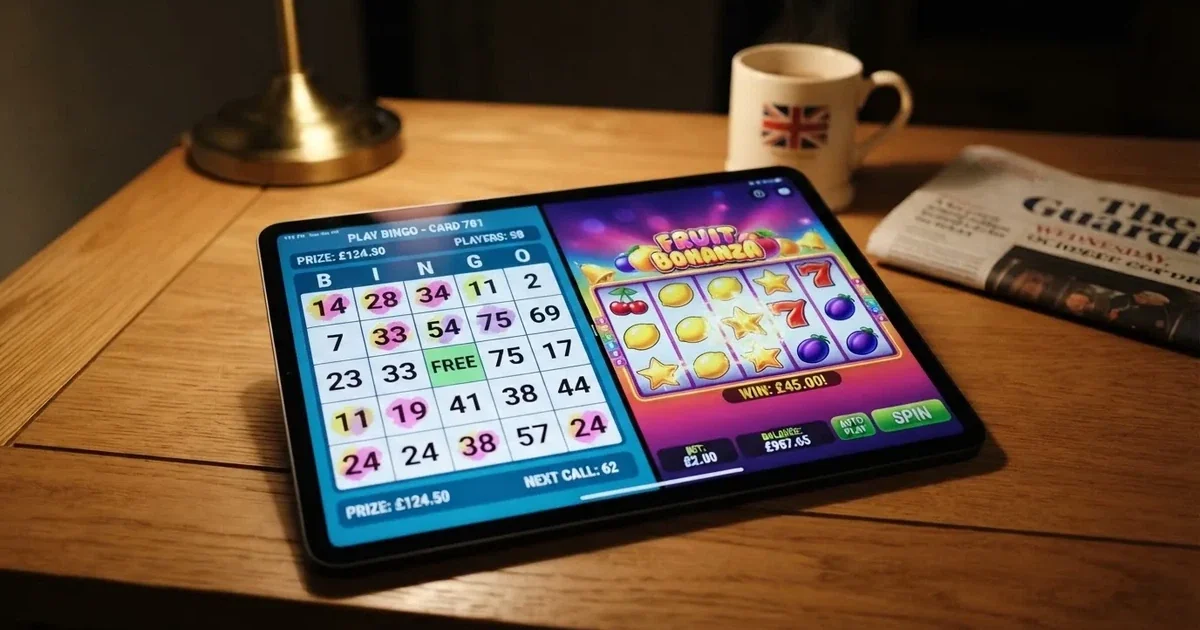
The bulk of UK bingo play no longer happens in a hall. It happens in a phone or tablet browser, during the half-hour between getting home and dinner, with the ticket auto-daubed and a chat sidebar running. The page is built for that context, and the registration flow is built for it too — most of the ten brands below push you through a four-step sign-up that does not leave the device. Geo-location runs in the browser, age and ID checks happen against the device camera, and the first deposit is a fingerprint away on iOS or Android.

A few practical notes from using these sites on a phone:
- Lobby load on 4G averages under three seconds for the lighter templates. Heavier skins, particularly the ones that load a full slot reel animation as the lobby hero, can stretch past five on a weak signal.
- Auto-daub is the default on every ticket. The browser tab stays in memory even when you switch apps, and the ticket will still mark numbers in the background — useful on the bus, less useful if you forget you had a session open.
- Battery use is moderate. A ninety-minute session on a phone streaming a live slot alongside chat drops the battery by roughly a fifth on a recent iPhone. Tablets do better; the bigger battery and lower screen brightness compensate.
- App vs. browser is a choice each brand handles differently. Some ship a native app; most now treat the mobile site as the primary surface and the app as a thin wrapper around it. Either way the live bingo games, the slot tabs and the cashier are the same product.
The takeaway: mobile is the product. Where a desktop layout still differs, it tends to be in the cashier and the bonus terms — denser on desktop, leaner on mobile. The actual gameplay is identical.
What bingo and slots on one licence actually look like
A UK bingo site that also offers slots sits on a remote casino operating licence issued by the Gambling Commission, not a separate “bingo” licence. The Commission’s public register treats bingo and slots as one licensable activity for an operator contracting with customers, even though there is a remote bingo game host operating licence available to software businesses that supply bingo to other operators without facing the customer directly. A player never sees that second licence; what a player sees is the casino operator’s name and account number on the Commission’s domain list.

Bingo itself carries no statutory definition under the Gambling Act 2005 beyond the line that “bingo means any version of that game, irrespective of by what name it is described”. The Commission cites a 1978 Royal Commission description — “a lottery played as a game” — and section 8 of the Act adds that bingo must be equal chance gaming, meaning no player can be playing against a bank and every participant’s chance of winning must be equally favourable. Mechanically, a British 90-ball ticket is the standard: 27 spaces in nine columns of three, with five numbers and four blanks per row, and tickets sold in strips of six that cover every number from 1 to 90. One line, two lines and a full house are the three winning patterns.
Slots on the same site sit under the same licence, which is where the wagering cap matters. Since 19 December 2025 any bonus offered at a UK-licensed site carries a wagering requirement capped at 10x the bonus amount, and mixed-product bonuses — bet on sport, receive casino spins, the cross-vertical giveaway — are banned. The 10x ceiling is a hard one: even a site that wanted to dress up a 50x requirement cannot, and a no-wagering offer sits comfortably beneath that ceiling by being zero.
A crash-style game such as Aviator, by contrast, is a multiplayer product with its own logic: a multiplier curve rises from 1.00x and randomly crashes, and the player must cash out before the crash to win the stake times the current value. Spribe, the studio behind Aviator, reports the title has run at more than 42 million active users and around 350,000 bets per minute across more than 5,000 operators worldwide. The mechanics are closer to a trading interface than a slot, but the licence and the safer-by-design rules still apply.
Ten licensed bingo and slots brands, side by side
The comparison below is built from the Gambling Commission’s public register, downloaded as CSV on 18 September 2026. Every domain listed is taken from that download, matched to the licence account that runs it. The licence number is the working currency of trust on a UK-facing site; the register status tells you whether the domain is active or white-labelled onto another operator’s account.
| Brand | Licence holder (GB remote casino licence) | Domain status on the register | Subject support |
|---|---|---|---|
| Paddy Power | PPB Games Limited · 039411-R-319335-010 | Active | — |
| kwiff | Eaton Gate Gaming Limited · 044448-R-323408-017 | Active | — |
| Betway | Betway Limited · 039372-R-319367-029 | Active | — |
| bet365 | Hillside (UK Gaming) ENC · 055149-R-331499-004 | Active | — |
| Unibet | Platinum Gaming Limited · 045322-R-324275-019 | Active | — |
| 888casino | 888 UK Limited · 039028-R-319297-014 | Active | — |
| Virgin Games | Gamesys Operations Limited · 038905-R-319430-022 | White label | — |
| Midnite | Dribble Media Limited · 042647-R-321653-022 | Active | — |
| Betfred | Petfre (Gibraltar) Limited · 039544-R-319290-010 | Active | — |
| BetVictor | BV Gaming Limited · 039576-R-319370-028 | Active | — |
The empty final column is deliberate. The register confirms a brand is licensed to take UK customers; it does not record bonus terms. A “no-wagering” claim has to be read off each operator’s own promotions page, and a register lookup will not tell you whether one applies this week. Treat the licence as a precondition and the bonus as a separate, later check.
Two notes on the table. First, Virgin Games is listed as a white-label domain — its site runs under Gamesys Operations Limited’s licence, the same licence that runs other Gamesys brands. That is normal for the market and not a flag in itself, but it does mean the operator of record is Gamesys, not Virgin. Second, the licence number’s shape is informative on its own: the leading six digits repeat the licence holder’s account number, the “R” marks a remote (online) licence, and the trailing suffix identifies the specific licence instance on the account.
What “no wagering” actually costs in play
A no-wagering offer looks like a free lunch on the surface. The arithmetic underneath it is simpler than the marketing admits, and once you know what to look for the picture comes into focus.
Since 19 December 2025, every bonus a UK-licensed operator runs carries a wagering requirement capped at 10x. That is the legal ceiling. A no-wagering offer sits at zero on that scale, and a 10x offer is the most a player can now be asked to play through. The 10x cap matters for a different reason: it makes a “no-wagering” headline much less of an exception than it was before the cap landed. An offer at 4x or 5x used to look generous; the same 4x or 5x offer now reads as ordinary against a regulated ceiling of 10x.
The honest band for a no-wagering bonus looks like this:
- Bonus size. Most no-wagering bingo bonuses sit in the £5 to £20 range for a deposit of £10 to £20, sometimes paid as a fixed reward rather than a matched percentage. Smaller bonuses come with cleaner terms; larger ones tend to bring a max-win cap with them.
- Eligibility for withdrawal. A no-wagering offer is, by definition, free of playthrough on the bonus itself. What remains is the usual ceiling on winnings, the deposit that triggered the bonus, and the requirement to verify identity before any withdrawal.
- Game weighting. Slots almost always contribute 100% of each £1 wagered to any playthrough; bingo can contribute at a different rate. With no wagering on the offer, this distinction collapses — but it returns on any reload or seasonal bonus that does carry playthrough, so the habit of checking the weighting table is worth keeping.
If the bonus does carry wagering at the new 10x ceiling, the rough play cost looks like this for a £10 bonus: turnover required is £100 (10 × £10), and on a typical slot at 96% RTP the expected loss across that turnover is £4. The bonus is worth £10 if cleared; the cost of clearing it is roughly £4 on average across many attempts. No single session will return that £4 to the penny — it is a statistical estimate, not a guarantee. And on a no-wagering offer the £4 disappears: the bonus is yours the moment it lands, with no playthrough to clear it through.
The full wagering cap matters for one more reason: it removes the worst-case bonus. Before the cap, a 50x or 65x requirement was routine at some sites and was the single largest cost on a small deposit. The 10x ceiling does not abolish bonus cost; it puts a hard limit on how expensive a bonus can be. No-wagering remains the cleanest offer on the menu, but the difference between it and the worst allowed offer is now narrower than it was.
Reading the licence and the register behind it
The Gambling Commission publishes a public register of every business it licences. The register is searchable online and downloadable as CSV or Excel, and as of 18 September 2026 it carried 139 businesses holding an active remote casino operating licence alongside 1065 active and 361 white-label domain entries. A white-label site trades under another company’s licence — the operating company is the licence holder, and the brand you log into is a skin on top of it.
The practical rule for a UK player is short: if the brand is not on the register as an active or white-label domain of an account that holds a remote casino operating licence, the brand is not licensed to take your money. The register is the test; the operator’s own “about us” page is not. Offshore licences issued in Curaçao, Malta or Gibraltar are not a substitute for a Commission licence for customers in Great Britain — since the Gambling (Licensing and Advertising) Act 2014, any operator taking GB customers needs a Commission licence wherever it is based.
A few features the register gives the player that other channels do not:
- A live status flag (Active, Inactive, or White Label) per domain.
- The trading name(s) the licence account operates.
- The licence number itself, in the format account-R-number-suffix — the leading six digits repeat the account number, the “R” marks a remote licence, the suffix identifies the specific licence instance.
- A downloadable CSV, refreshed regularly, which is the most reliable way to confirm a brand’s status rather than relying on a screenshot on the operator’s own page.
Safer-by-design rules a no-wagering offer still sits under
The no-wagering tag removes one rule from a UK bonus. It leaves every other rule in place. A player on a no-wagering offer is still bound by the safer-by-design package the Commission has phased in over the last few years, including the stake limits, the spin speed cap, the auto-play ban, and the financial vulnerability check.
The current state of the rule book:
- Stake limits on online slots. A maximum stake per game cycle of £5 for players aged 25 and over (from 9 April 2025) and £2 for players aged 18 to 24 (from 21 May 2025). The lower ceiling for under-25s is justified by the government’s stated evidence: 18 to 24 year olds carry the highest average problem gambling score of any age group, with lower disposable income and ongoing neurological development cited as contributing factors.
- Spin speed cap. A slot spin cannot run faster than 2.5 seconds, set as a minimum rather than a ceiling on speed. The auto-play feature has been permanently banned after research indicated it caused players to lose track of their activity.
- Reverse withdrawals. Banned since 31 October 2021. Once a player requests a withdrawal, the funds cannot be re-gambled; they are committed to the withdrawal queue.
- Identity verification. Before the first deposit or any play, the operator verifies name, address and date of birth — in force since 7 May 2019. Anonymous play is not possible at a licensed site.
- Financial vulnerability checks. Triggered at £150 in net deposits over a rolling 30 days, using public data only, in force from 28 February 2025. The wider financial risk assessments are announced but not yet in force.
- GAMSTOP self-exclusion. Mandatory for every online licence since 31 March 2020. Periods of six months, one year or five years; the choice cannot be reversed early. GAMSTOP applies whether the bonus is wagering or no-wagering — the scheme sits above the bonus.
- Deposit limit prompts. Since 31 October 2025 operators must prompt a customer to set a financial limit before the first deposit. There is no state-set deposit or loss ceiling — the prompt is the requirement, not a flat cap.
On top of the gameplay rules, credit cards have been banned for gambling since 14 April 2020, including credit cards routed through e-wallets. Anonymous play is impossible. The bonus terms can change; the safer-by-design floor does not.
Payments and what the cashier actually does
The cashier on a UK-licensed bingo and slots site is built around three payment methods: debit card, bank transfer and a small set of approved e-wallets. Credit cards are out. Pay-by-mobile small deposits (the £5-by-phone-bill model) appear on some brands and not others, and the cashout route for those tends to be bank transfer rather than back to the phone bill.
Payout speed varies by method, with the broad pattern being:
- Debit card withdrawals. The most common route and usually the slowest once internal processing is done. After approval — typically 24 to 48 hours on a UK-licensed site — the funds take a further one to three working days to land, depending on the issuing bank. Visa Direct and Mastercard Send have shortened the second leg on some brands to under an hour.
- Bank transfer. Used for larger withdrawals and for accounts that have not registered a card. One to three working days is typical once approved.
- E-wallets. The fastest of the three once approved, with PayPal and a couple of others typically completing within hours. Not every brand offers every e-wallet; the cashier lists the available ones for that account.
The reverse-withdrawal ban matters at the cashier. Once a withdrawal is requested, the funds leave the playable balance and sit in the withdrawal queue; the player cannot recall them to gamble. The queue itself is typically processed within 24 hours, but a request made on Friday night may not clear until Monday morning.
Identity verification can stall a first withdrawal more than the payment method itself. The operator must run source-of-funds and identity checks before the first cashout, and the request will not move until those clear. Photographic ID, proof of address, and sometimes a bank statement or payslip, are uploaded through the cashier or the verification page; the operator reviews within a working day or two for a clean file. Anything mismatched — a name change since the account was opened, an address not yet updated — adds days.
Bonuses and free spins under the 10x cap
The bonus landscape on a UK-licensed site is narrower than it was before 19 December 2025. The 10x cap on wagering and the ban on mixed-product bonuses cut both ways: the worst offers have gone, and so have some of the more elaborate cross-vertical promotions that used to ship.
What remains:
- No-wagering deposit match. The headline of this page. A bonus equal to a percentage of the deposit, with no playthrough, withdrawable as cash once it lands. The trade is a smaller headline figure than a deposit match with wagering; the value is that the bonus is real money the moment the wagering requirement would have ended.
- Free spins on slots. Either with or without wagering on the spin value. No-wagering spins convert each win to cash directly. Wagering spins, if offered at all, sit at or under the 10x cap. Spins also carry their own maximum-win cap on the no-wagering side, which is the more common ceiling players hit first.
- Reload bonuses for existing players. A second or third deposit bonus, usually smaller than the welcome offer and often simpler in structure. The 10x cap applies equally to a reload.
- Loyalty and rewards. Free bingo tickets, slots free spins, prize draw entries, cashback — the loyalty side of the site, paid in bonus funds or cash depending on the scheme. No-wagering rewards are the cleaner end of the loyalty shelf; cashback paid as cash with no playthrough sits at the cleanest.
What has gone:
- Mixed-product bonuses. The “bet £10 on sport, get 50 casino spins” offer is no longer available. Each vertical must carry its own bonus.
- Wagering requirements above 10x. Banned outright. The cap is on the bonus amount, not on a bonus-plus-deposit sum.
- Anonymous bonuses. No play without verification, so no bonus either.
The shift is bigger than the rule itself. A 5x requirement now reads as ordinary against a 10x ceiling; a no-wagering offer reads as better but not as exceptional as it did when 50x was common. The marketing language has caught up slower than the rule — “huge bonus” and “massive welcome offer” still appear on the same banners they always did, and a sharp reader now sees through them faster than the copy has updated.
Reviewed operators
The ten operators below are the brands the Commission’s register confirms are licensed to take UK customers on a remote casino operating licence, each as of 18 September 2026. Several sit under shared parent companies; the licence of record is the one named. Where the subject of this page (no-wagering offers) is not something the inputs could verify for a brand, that column is left empty rather than guessed at.
Paddy Power
Paddy Power runs on PPB Games Limited’s account (39411), with the active remote casino operating licence 039411-R-319335-010; Paddy Power is listed as an active domain on the public register. The sportsbook is the larger of the brand’s two products and the casino and bingo tabs sit behind it in the lobby, which is the structural choice a player should know about before signing up: a no-wagering bingo offer, if one is running, lives on a sportsbook-led site rather than a casino-led one.
kwiff
Eaton Gate Gaming Limited (account 44448) holds the active remote casino operating licence 044448-R-323408-017, and Kwiff is listed on the register as an active domain of that account. The brand’s selling point is its “surprise bet” mechanic — randomly boosted odds or stake returns on a wager — which is a sportsbook feature, not a bingo feature, and a player signing up specifically for bingo is using a product the brand does not centre on.
Betway
Betway Limited (account 39372) is the licence holder under the active remote casino operating licence 039372-R-319367-029, with Betway as an active domain. The casino, sportsbook and a smaller bingo tab are all available, and the casino is the heavier product. A no-wagering bingo offer here would be a peripheral promotion rather than the headline offer; that is the trade-off for a multi-vertical brand.
bet365
Hillside (UK Gaming) ENC (account 55149) is the licence holder of the active remote casino operating licence 055149-R-331499-004, with bet365 as an active domain. The brand is the largest in the set by customer base, the casino is one product among several, and the bingo room runs alongside poker, sports and a full slot catalogue. No-wagering bonuses are promotional decisions here rather than a core product feature.
Unibet
Platinum Gaming Limited (account 45322) holds the active remote casino operating licence 045322-R-324275-019, with unibet.co.uk an active domain on the register. The casino and bingo products sit behind the sportsbook in the navigation, much like Paddy Power’s structure. Unibet’s Scandinavian parent (Kindred) operates several other brands on different licences across Europe; the UK operation is a separate licensed entity.
888casino
888 UK Limited (account 39028) is the licence holder for the active remote casino operating licence 039028-R-319297-014, with 888casino as an active domain. The casino is the headline product here; the bingo room exists but it is the smaller of the two. While no-wagering bingo offers are possible, the brand’s primary focus remains its casino and live dealer suite.
Virgin Games
Gamesys Operations Limited (account 38905) holds the active remote casino operating licence 038905-R-319430-022, and Virgin Games is listed as a white-label domain of that account — meaning the licence of record is Gamesys rather than Virgin, and Virgin’s branding sits on top of it. Gamesys is a long-established bingo-led operator; Virgin Games inherits that legacy. A no-wagering offer here is more likely than on the sportsbook-led brands above, but the licence of record is the Gamesys one, not the Virgin one.
Midnite
Dribble Media Limited (account 42647) is the licence holder under the active remote casino operating licence 042647-R-321653-022, with Midnite as an active domain. Midnite is one of the newer entrants to the UK market; the site is a casino-led product with sports and bingo as smaller verticals. Promotional offers vary here; given the casino-led strategy, bingo serves as a secondary, rather than headline, product.
Betfred
Petfre (Gibraltar) Limited (account 39544) is the licence holder under the active remote casino operating licence 039544-R-319290-010, with Betfred as an active domain. The brand is multi-vertical — sports, casino, bingo, lotto — and is one of the few UK-facing brands that still runs a high-street bookmaker alongside the online operation. The bingo product is a smaller vertical; a no-wagering offer, if any, would be a peripheral promotion.
BetVictor
BV Gaming Limited (account 39576) holds the active remote casino operating licence 039576-R-319370-028, with BetVictor as an active domain. The brand sits in the same multi-vertical space as Betway and Betfred, with the casino and sportsbook doing more commercial work than the bingo tab. A no-wagering offer on bingo here would be a smaller piece of the overall product, not a feature built around the bingo room.
A brief history of British bingo
The game’s modern shape is older than the platforms running it. The standard British 90-ball ticket — 27 spaces in nine columns of three, five numbers and four blanks per row, sold in strips of six covering every number from 1 to 90 — is the format the online rooms reproduce. One-line, two-line and full-house are the three patterns, and the last number called must be part of the winning pattern.
The game’s lineage goes back further than the digital rooms. Its roots trace to around 1530 in Italy, evolving from Il Gioco del Lotto d’Italia, before moving to France as Le Lotto and migrating to Britain and the rest of Europe in the 18th century. The modern form emerged at carnivals and fairs in the 1920s, attributed to Hugh J. Ward, and Edwin S. Lowe patented the modern bingo card design in 1942. In Britain, the Betting and Gaming Act 1960 legalised large cash prizes for bingo when it took effect on 1 January 1961, and the hall network — including Mecca Bingo’s chain — expanded quickly under the new rules. Today’s online rooms are a direct line from those halls.
Statutorily, the Gambling Act 2005 is the governing instrument, with bingo the only form of gambling the Act leaves without a specific statutory definition: “bingo means any version of that game, irrespective of by what name it is described”. Section 8 of the Act adds the equal-chance gaming requirement: bingo cannot involve playing against a bank, and every participant’s chance of winning must be equally favourable. That is why a bingo game cannot be a “player versus house” product in the way a slot or a hand of blackjack can be.
Offshore, anonymity and what protection actually costs
A UK player has the right to play at any site they choose. They do not have the right to assume that any site they choose offers the same protection. The Commission’s public register is the test of whether a brand holds a GB licence; a Curaçao, Maltese or Gibraltar licence is not a substitute for customers in Great Britain under the Gambling (Licensing and Advertising) Act 2014.
What is lost by playing at an unlicensed site is the protection layer, not the gameplay:
- No GAMSTOP. A self-exclusion request via GAMSTOP applies to every UK-licensed online operator. An offshore site is not part of the scheme, and a self-excluded player can still deposit and play there.
- No Commission complaints route. A dispute with a licensed operator can be escalated to an approved Alternative Dispute Resolution (ADR) provider and, failing that, to the Commission. An offshore operator has no such route.
- No safer-by-design floor. The 2.5-second spin speed cap, the auto-play ban, the £5/£2 slot stake limits, the reverse-withdrawal ban, the financial vulnerability check at £150 net deposits — none of these apply to an unlicensed site.
- No anonymous play at a licensed site. Identity verification is required before the first deposit under Commission rules since 7 May 2019. An unlicensed site may skip the check; that is not a feature, it is the absence of one.
The Commission can disrupt an unlicensed site — cease-and-desist notices, payment and hosting referrals, search-engine delisting — but has no power to block sites at ISP level. The Commission’s approach treats the player as an adult who can choose; the trade-off is that the player carries the cost of a wrong choice with no recourse when the choice goes badly. The Commission’s own framing, in section 33 of the Gambling Act 2005, is that providing gambling to people in Great Britain without a licence is an offence — aimed at the operator, not the customer. The penalty the customer pays is the absence of the protection layer.
Tax and the operator’s bill
UK players pay no tax on gambling winnings. That has been the position for decades and continues to apply to every product on a UK-licensed site, from a £0.10 bingo win to a six-figure slot payout. The tax sits on the operator, not on the player.
What changed in 2026 is the operator’s exposure. From 1 April 2026 Remote Gaming Duty rose from 21% to 40% on the operator’s gross profit from remote gambling. The rate is the headline tax burden a UK-facing operator now carries, and it is one of the reasons the bonus landscape has tightened over the last year. A higher operator tax narrows the margin available to fund a generous welcome offer; the 10x cap on wagering and the mixed-product bonus ban have done the same. The combined effect of these three changes is that the offers on the menu are smaller and the marketing around them is louder.
Players do not see the duty on a receipt and do not pay it. They see it indirectly, in the size and structure of the offers that arrive in the promotions tab.
Putting the offer in front of the rules
A no-wagering bingo bonus at a UK-licensed site sits under the full rule book above: the stake limits, the spin speed cap, the auto-play ban, the reverse-withdrawal ban, the identity verification at the cashier, the GAMSTOP self-exclusion, the financial vulnerability check at £150 net deposits over 30 days, the credit card ban and the 10x wagering cap. None of these disappear because the offer is no-wagering. The no-wagering tag removes the playthrough requirement, and only the playthrough requirement.
The practical order of a real session looks like this:
- Sign up. Four-step flow on mobile, ID verified against the device camera. No anonymous play.
- First deposit. Debit card, bank transfer, or an approved e-wallet. A prompt to set a deposit limit appears before the deposit is taken; no state-set ceiling exists.
- Claim the no-wagering bonus. Either automatic on deposit, or via a promo code on the bonus page. Read the small print on the offer: max-win cap, eligibility, expiry, which games it applies to.
- Play. Auto-daubed bingo tickets in the lobby, slots and live casino in the adjacent tabs. A 90-minute session on mobile uses roughly a fifth of a recent iPhone battery.
- Withdraw. Identity check runs before the first cashout. Approved withdrawals are committed to the queue and cannot be recalled. Debit card payouts take one to three working days after approval; e-wallets, where supported, typically complete within hours.
- Self-exclude. GAMSTOP applies whether the bonus is no-wagering or not. Periods of six months, one year or five years; the choice cannot be reversed early.
That is the full surface area of a no-wagering offer, from sign-up to self-exclusion. The offer is a single line in the middle of a much longer page of rules.
The top-line read on a no-wagering bonus in 2026
A no-wagering bonus at a UK-licensed site in 2026 is a smaller offer than it would have been three years ago, with cleaner terms. The 10x cap on wagering has removed the worst offers from the menu and made the no-wagering tag less exceptional than it was. The mixed-product bonus ban has removed the cross-vertical giveaways. The Remote Gaming Duty increase has narrowed the operator’s margin on every bonus it funds. Each of these changes has pushed the no-wagering offer further down the list of things an operator can afford to make loud — and further up the list of things a player should value, because the offer is now genuinely cleaner than what surrounds it.
The cost of a no-wagering bonus is the bonus amount itself, if the player chooses to withdraw it rather than play it. There is no playthrough cost because there is no playthrough. There is a max-win cap on most offers, which is a separate ceiling. There is the usual deposit and identity check on the way in, and the usual withdrawal queue and processing time on the way out. The offer is a one-line benefit wrapped in the full Commission rule book, and the rule book is what makes the benefit real.
Frequently asked questions
What does a no-wagering bonus on a bingo site actually mean?
A no-wagering bonus is paid as cash you can withdraw as soon as it lands, with no playthrough requirement to clear it through. Anything you win from the offer is yours; the bonus amount does not need to be staked a multiple of times before it can be withdrawn. Other rules — the maximum win cap, the deposit that triggered it, identity verification on the way out — still apply.
Which slots on a bingo site tend to pay out best?
No slot has a guaranteed payout; every spin is independent. The published RTP (return to player) of a slot is the closest thing to a “best paying” measure and is stated on the operator’s game info page or the developer’s site. A higher RTP means a lower house edge over many spins, not a higher chance on any single spin.
Is a no-deposit bingo offer still subject to a maximum win cap?
Yes. A no-deposit offer — one paid without requiring a deposit first — almost always carries a maximum win cap, often much lower than the equivalent deposit bonus. The cap is part of the offer’s small print; the absence of a deposit does not remove it.
How well does mobile bingo and slots play perform on a phone browser?
Well enough that most UK play now happens on a phone or tablet rather than desktop. Lobby load runs under three seconds on a 4G connection for the lighter templates; heavier skins can stretch past five on weak signal. Auto-daubed tickets keep marking in the background when the tab is hidden, and a ninety-minute session on a recent phone drops the battery by roughly a fifth.
Are bingo and slots offered on the same licence at a UK site?
Yes. A UK-facing bingo and slots site runs on a single remote casino operating licence issued by the Gambling Commission; bingo does not require a separate customer-facing licence. A separate remote bingo game host operating licence exists, but only for software businesses that supply bingo to other operators without contracting with players directly.
Must a bingo and slots site be Gambling Commission-licensed to offer UK players a no-wagering bonus?
Yes. Any operator taking customers in Great Britain needs a Commission licence, under the Gambling (Licensing and Advertising) Act 2014, regardless of where the operator is based. A Curaçao, Maltese or Gibraltar licence is not a substitute. The Commission’s public register is the test of whether a brand holds one.
Created by the ”livetablesuk” editorial team.