
What a 30, 50, 100 or 150 Free Spins No Deposit Offer Really Costs in the UK
A no-deposit spin offer is a marketing door: the operator invites a player in, runs a fixed number of reels at no cost, and converts whatever the reels yield into a balance subject to the small print. The tier — 30, 50, 100, 150 — changes how long the reels spin, not what sits behind the small print. Every tier still needs a Gambling Commission licence, still falls under the same wagering cap, and still has to honour a self-exclusion registered on GAMSTOP. Treating the tier as the variable that matters is the mistake this page is written to undo.
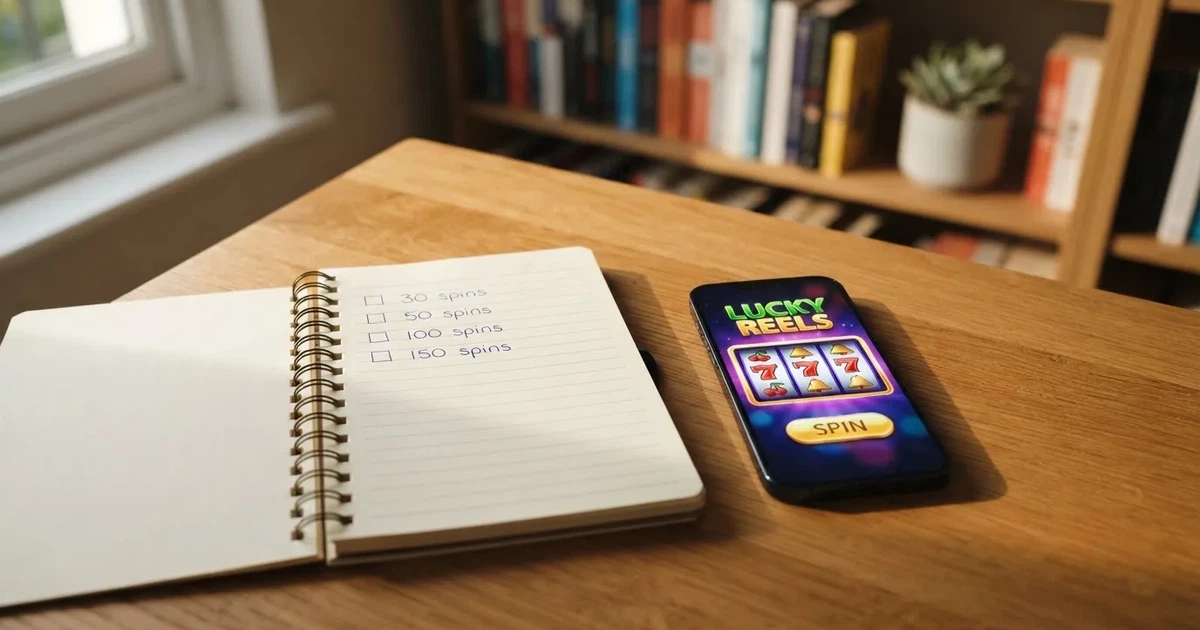
The data is current as of 5 November 2026 and was checked against the Gambling Commission’s public register of gambling businesses.
Table of Contents
- Why Tier Size Is the Wrong Question
- The UK Licensing Landscape in Numbers
- How to Read the Register Before You Deposit
- What the Wagering Cap Changes
- The Anatomy of a No-Deposit Spins Package
- GAMSTOP and the Safer-Gambling Layer
- Paying In, Paying Out
- Ten Licensed Operators on the GB Register
- Brand-by-Brand Read
- The Cost of a No-Depposit Spins Package in Real Terms
- How the Offer Type Fits the Wider Market
- Payment Options and Their Limits
- Tax and What the Player Keeps
- Offshore Sites and Why the Register Matters
- Reading the Terms
- What “Best” Means in This Market
- What to Do Before Claiming
- Frequently Asked Questions
Why Tier Size Is the Wrong Question
Players searching for a specific count of spins tend to ask “which 150-spin offer is best?” The more honest question is what each tier asks in return. A 30-spin package at a low wagering multiple often returns more usable value than a 150-spin headline where the bonus funds carry steep conditions, because the wagering requirement, the maximum-conversion cap and the eligible slot list all act on whatever the reels pay out. Stretch the reel count and you stretch the time spent under those terms, not the value that survives them.

A second reason to look past the tier: the no-deposit incentive is now heavily regulated. Since 19 December 2025, no UK-licensed bonus can carry a wagering requirement higher than 10x the bonus amount, and mixed-product bundles (the kind that give casino spins on top of a sports bet) have been banned outright. The 10x cap sits on the same shelf for a 30-spin offer and a 150-spin one. So does the £5-per-spin ceiling for players aged 25 and over, the £2 ceiling for 18–24-year-olds, the credit-card funding ban in force since 14 April 2020, and the GAMSTOP enrolment that every online licence demands.
The implication is simple. Licensing, the wagering cap and the safer-gambling regime apply across the board; the tier is just a knob on the duration of the offer. A reader who shops by tier alone is reading the headline instead of the contract.
The UK Licensing Landscape in Numbers
The Gambling Commission runs the only register that matters when the question is whether a site may legally take a deposit from a player in Great Britain. Two snapshots from that register fix the size of the market:
- 139 businesses held an active remote casino operating licence on 18 September 2026.
- The same register held 1065 active and 361 white-label domain entries on 18 September 2026.
| Matter | Description |
|---|---|
| Wagering Cap | Max 10x bonus amount |
| Spin Time | Minimum 2.5 seconds |
| Max Stake | £5 (25+), £2 (18-24) |
| Credit Cards | Banned for funding |
| Self-Exclusion | GAMSTOP mandatory |
| Brand | Licence Holder | Licence Number |
|---|---|---|
| 32Red | Platinum Gaming Limited | 045322-R-324275-019 |
| Midnite | Dribble Media Limited | 042647-R-321653-022 |
| Sky Vegas | Bonne Terre Gaming Limited | 065519-R-339675-002 |
| Jackpotjoy | Gamesys Operations Limited | 038905-R-319430-022 |
| BetVictor | BV Gaming Limited | 039576-R-319370-028 |
| Casumo | Recro Limited | 061549-R-336718-002 |
| Coral | LC International Limited | 054743-R-330863-014 |
| Unibet | Platinum Gaming Limited | 045322-R-324275-019 |
| Paddy Power | PPB Games Limited | 039411-R-319335-010 |
| bet365 | Hillside (UK Gaming) ENC | 055149-R-331499-004 |
A white-label entry is a domain trading under another company’s licence rather than its own — a useful distinction when a reader is cross-checking a brand and finds the domain listed but no separate licence. The remote licence number follows a fixed shape: the first six digits repeat the licence holder’s account number, an “R” marks a remote (online) licence, and the trailing digits identify the specific licence instance. So 045322-R-324275-019 belongs to account 45322, Platinum Gaming Limited. That account appears on the register as the home of more than one major brand, which means two well-known casino names can share a single licence holder without being independent businesses.
How to Read the Register Before You Deposit
The register is the test of whether a brand is licensed. Three checks resolve almost every question a player has:
- Is the domain on the register, marked Active or White Label? If neither, the operator is offering remote casino play in Great Britain without a Commission licence — and that is an offence under section 33 of the Gambling Act 2005, even if the brand is licensed elsewhere.
- Whose licence sits behind the domain? The account name and licence number need to match a real, currently active licence. Licence numbers on the register are public and downloadable as CSV or Excel — no need to take the operator’s word for it.
- Is the licence still in force? The register distinguishes Active, Inactive and White Label. An Active entry means the Commission currently authorises that domain to operate; Inactive means the licence has lapsed or been surrendered.
Any brand that resists this check, hides its licence number in the small print, or points to an overseas regulator instead is not a GB-licensed site. The player protections attached to a GB licence — GAMSTOP enrolment, ADR access, the Commission’s complaints route — do not follow the player to a Curaçao or Malta-licensed site.
What the Wagering Cap Changes
The wagering requirement is the multiplier a player must turn the bonus over before any winnings can be withdrawn. A 30x requirement means £30 wagered for every £1 of bonus; a 10x requirement means £10 wagered for every £1. The new cap, in force since 19 December 2025, drops the maximum to 10x. That is a meaningful drop: under the previous regime, offers at 30x, 40x or even 65x were common, and the bonus was effectively a marketing spend that the player had to chase through several thousand pounds of wagers.
A worked example on a notional £30 bonus, wagered at the new ceiling:
- Required turnover at 10x: £30 × 10 = £300.
- At a £0.10 stake per spin on a typical online slot: 3,000 spins.
- A slot spin may not run faster than 2.5 seconds, so 3,000 spins take roughly 7,500 seconds, or about 2 hours 5 minutes of continuous play.
That is the new ceiling: about two hours to clear a small no-deposit bonus. The figure assumes only the bonus is wagered and that the slot in question runs at the maximum permitted spin rate. It is also a statistical estimate — an average over many spins rather than a guaranteed outcome. In real terms, an online slot’s RTP sits well below 100%, so the £300 of required turnover is also an expected loss equal to the turnover multiplied by (1 − RTP); on a 96% slot, that is about £12 of expected loss against a £30 starting bonus.
The point of the cap is not that a small bonus becomes cheap. It is that an unattractive bonus becomes hard to dress up. A 65x wagering requirement on the same £30 would have demanded £1,950 of turnover, which at £0.10 a spin is 19,500 spins and roughly 13 hours 30 minutes of continuous play — and an expected loss closer to £78. The 10x cap kills the worst of that arithmetic. The tier count of the offer does not.
The Anatomy of a No-Deposit Spins Package
The headline — “150 free spins, no deposit” — covers four moving parts. Each part is set by the operator, not by the tier.
The eligible slot. A no-deposit package almost always restricts the spins to one title, occasionally two or three. The slot’s RTP and volatility set the realistic return on the spins; a high-volatility slot will produce more dead spins and a few larger hits, while a low-volatility slot produces a steadier trickle. Neither is free of the house edge; both are subject to it.
The stake per spin. Most no-deposit offers pre-set the stake at the smallest denomination the slot allows, often £0.10. The stake also has to fit inside the £5 / £2 per-spin ceiling the Commission imposes on age-restricted game cycles. Because no-deposit spins usually run at well below £1, the stake ceiling is rarely the binding constraint; the operator’s own choice is.
The wagering requirement. As above, capped at 10x since 19 December 2025. The cap applies to the bonus, not to deposit plus bonus, and the offer’s terms will say which. A “10x on bonus” condition is meaningfully easier to clear than a “10x on bonus plus deposit” condition that may still surface in older promotional material.
The maximum-conversion cap. Many offers still write a ceiling on how much of the bonus balance can be withdrawn — £50 is a common cap on smaller no-deposit packages. Anything above the cap is forfeited when the player withdraws. The cap is silent in marketing copy and almost always present in the small print.
A reader who checks only the spin count misses three of these four. The tier tells the player how long the reels run; the conditions tell the player what survives the run.
GAMSTOP and the Safer-Gambling Layer
Every GB-licensed online casino must integrate GAMSTOP, the national online self-exclusion scheme, as a condition of its licence. A player who registers with GAMSTOP for six months, one year or five years cannot open an account, deposit or play at any participating site until the exclusion period ends, and the registration cannot be cancelled early. The integration is mandatory since 31 March 2020.
That obligation sits across every tier. A 30-spin no-deposit offer at a licensed site cannot be claimed by a self-excluded player; a 150-spin offer at the same site cannot be claimed either. The tier is irrelevant once the exclusion is registered, and the operator must check GAMSTOP before the first deposit, before the first spin and on a regular cadence thereafter.
Other safer-gambling rules layer on top:
- Minimum age 18. Name, address and date of birth are verified before the first deposit or any play, under rules in force since 7 May 2019. Anonymous play is not possible at a licensed site.
- Reality checks at intervals the operator sets, with mandatory time-outs after extended sessions.
- A financial vulnerability check at £150 of net deposits in a rolling 30-day window, using public data only, in force since 28 February 2025.
- A mandatory prompt to set a financial limit before the first deposit, in force since 31 October 2025.
Auto-play is banned and spins may not run faster than 2.5 seconds. Losses disguised as wins are also banned — the visual cue that a stake has been lost but a win-line has flashed is no longer permitted in the design of any UK-licensed slot.
Paying In, Paying Out
Funding. Credit cards have been banned for gambling since 14 April 2020, including credit-card funding routed through e-wallets. The Commission estimated in 2018 that around 800,000 UK adults used credit cards to gamble, and that 22% of online gamblers who used a credit card were classed as problem gamblers — the basis for the ban. Debit cards and bank transfers remain unrestricted, and Apple Pay is accepted where the operator supports it; Apple Pay itself launched on 20 October 2014 and began supporting UK-issued cards on 14 July 2015. AstroPay is another option on some sites, with its UK arm (Larstal Limited) authorised by the Financial Conduct Authority as an electronic money institution under the Electronic Money Regulations 2011.
Withdrawals. Most UK withdrawals move through the Faster Payments Service, the UK scheme launched in 2008 and operated by Pay.UK, which runs 24 hours a day, seven days a week. Most withdrawals arrive instantly or within a couple of minutes; the upper bound in normal operation is about two hours, and the scheme sets a £1,000,000 per-transaction limit (individual banks often set their own, lower limits). The Bank of England oversees Faster Payments’ safety and stability and provides final settlement, but is not a direct participant.
What that means for a no-deposit withdrawal in practice: once the wagering requirement has been met and the maximum-conversion cap honoured, the cleared balance usually reaches a UK debit card or bank account within minutes, occasionally within the hour. The bottleneck is rarely the payment rail and almost always the wagering requirement or the document check on first withdrawal.
Ten Licensed Operators on the GB Register
The ten brands below are each listed on the Gambling Commission’s public register as active domains, with the licence holder named. The set is not a ranking and is not a recommendation. Several licence holders run more than one of these brands, and a reader who values independence between brands should note that.
32Red
Licence: 045322-R-324275-019, held by Platinum Gaming Limited (account 45322); 32red is listed as an active domain. The licence number follows the standard register shape — the leading six digits repeat the account number, the “R” marks a remote licence, and the trailing digits identify this licence instance. The brand trades under the same account as another entry further down this list, so the two are not independent businesses at the corporate level.
Midnite
Licence: 042647-R-321653-022, held by Dribble Media Limited (account 42647); Midnite.com is listed as an active domain. A newer entrant on the register, with a smaller account number footprint than the legacy brands.
Sky Vegas
Licence: 065519-R-339675-002, held by Bonne Terre Gaming Limited (account 65519); Sky Vegas is listed as an active domain. Sky’s broadcast parentage makes the brand widely known; the licence sits with a separate gaming entity.
Jackpotjoy
Licence: 038905-R-319430-022, held by Gamesys Operations Limited (account 38905); Jackpotjoy.com is listed as an active domain. A long-standing brand in the bingo-led segment, with a casino product attached.
BetVictor
Licence: 039576-R-319370-028, held by BV Gaming Limited (account 39576); Betvictor.com is listed as an active domain. Independent at the licence-holder level — a relatively rare position among the larger UK brands.
Casumo
Licence: 061549-R-336718-002, held by Recro Limited (account 61549); Casumo.com is listed as an active domain. Originated outside the UK and relicensed into the GB regime after the 2014 advertising and licensing changes.
Coral
Licence: 054743-R-330863-014, held by LC International Limited (account 54743); coral.co.uk is listed as an active domain. LC International also holds the licences for other large UK brands, which a reader comparing offers across operators will want to factor in.
Unibet
Licence: 045322-R-324275-019, held by Platinum Gaming Limited (account 45322); unibet.co.uk is listed as an active domain. The same licence holder as 32Red; the brands trade independently but are not separately capitalised or regulated as distinct businesses.
Paddy Power
Licence: 039411-R-319335-010, held by PPB Games Limited (account 39411); Paddy Power is listed as an active domain. The brand’s primary association is with sports betting; the casino product is a secondary line.
bet365
Licence: 055149-R-331499-004, held by Hillside (UK Gaming) ENC (account 55149); Bet365.com is listed as an active domain. The largest privately owned operator in the GB market by many measures, with a Casino product attached to its sportsbook.
Brand-by-Brand Read
Each of the ten brands above carries the same regulatory floor — same licence type, same GAMSTOP obligation, same credit-card ban. The differences lie in corporate structure, in the product mix the operator actually runs and in what the small print looks like in practice. What follows is a guide to what each brand offers a player comparing them, written to highlight the variation that exists inside a market where the licensing is uniform.
32Red — Long-Standing Casino Brand on a Shared Licence
The 32Red brand has been trading under the Platinum Gaming Limited account for many years, and the licence number appears on the public register with an Active status. The casino product is the brand’s primary line; the bingo and sports products are smaller. For a player prioritising a casino-only experience with a GB-licensed operator, 32Red is one of the more concentrated options. The corporate point worth noting is that 32Red shares its licence holder with another brand further down — a single licensing decision governs both, which is a structural fact rather than a product fact.
Midnite — Newer Account, Smaller Footprint
Dribble Media Limited holds the licence behind Midnite.com, and the account number is lower than the legacy operators’. The brand is comparatively recent, and the casino product sits alongside a sportsbook. For a player who prefers a newer operator with a combined account for both sports and casino, Midnite is a strong contender, provided the operator’s shorter history is not a concern.
Sky Vegas — Broadcast Recognition, Separate Licence
The Sky brand carries obvious name recognition from the broadcast parent, but the casino licence sits with Bonne Terre Gaming Limited, not with Sky plc. The licence number is distinct from any other entry on this list, which is unusual — most broadcast-linked brands share their licence holder with another brand. Sky Vegas is one of the clearer cases where the brand and the licensed entity are visibly separate.
Jackpotjoy — Bingo Heritage, Casino Attached
Gamesys Operations Limited has held the Jackpotjoy licence for years; the brand’s identity is rooted in the bingo segment, with a slots and casino product layered on. Jackpotjoy is worth considering for a player who enjoys a casino product within a brand whose history is in bingo, though players seeking a casino-only experience may find the heritage focus distracting.
BetVictor — Independent Licence Holder
BV Gaming Limited is the licence holder behind Betvictor.com, and the licence number is not shared with any other brand on this list. Among the larger UK brands, that is a relatively rare structural position. The corporate independence does not change the regulatory regime the player sits under, but it does mean that the operator’s product, terms and safer-gambling defaults are set by a single accountable business rather than negotiated across a portfolio.
Casumo — Relicensed into the GB Regime
Casumo originated outside the UK and now holds its GB licence through Recro Limited, account 61549. The relicensing followed the 2014 Gambling (Licensing and Advertising) Act, which brought every operator taking GB customers inside the Commission’s remit regardless of where it was based. For a player, the practical implication is that the GB protections apply directly rather than by courtesy of an overseas regulator.
Coral — Large Brand, Shared Licence Holder
LC International Limited holds the licence behind coral.co.uk, and the same licence holder also governs several other large UK brands. The brand is one of the largest in the high street bookmaker heritage, with a casino product alongside the sportsbook. The shared licence-holder structure means that policy decisions — on safer gambling, on bonus terms, on withdrawals — are typically set at the LC International level rather than brand by brand.
Unibet — International Brand, GB Licence
Unibet trades in the UK as unibet.co.uk, on the same Platinum Gaming Limited licence as 32Red. The international brand recognition is wider than the GB licence footprint. For a player who values international brand reputation, that is the draw; for a player who wants separate corporate accountability, the shared licence-holder is the relevant point.
Paddy Power — Sportsbook-Led, Casino Secondary
PPB Games Limited holds the Paddy Power licence; the brand’s main product is the sportsbook, with casino and gaming products attached. Paddy Power is best suited to players who want a casino product alongside a major sportsbook; those looking for a casino-first operator may prefer an alternative with a more dedicated gaming focus.
bet365 — Largest GB Footprint by Many Measures
Hillside (UK Gaming) ENC holds the bet365 licence, and the brand is the largest privately owned operator in the GB market by many measures. The casino product sits alongside a sportsbook of comparable scale. The sheer size means more payment options, more product lines and a longer customer-history baseline — and, for some readers, a less personal experience than a smaller operator offers.
The Cost of a No-Depposit Spins Package in Real Terms
Working through a single example on a notional 50-spin offer, £0.10 stake per spin, 96% RTP, 10x wagering on the bonus:
- The 50 spins cost the player nothing in cash.
- The expected value of the spins is 50 × £0.10 × 0.96 = £4.80. The remaining £0.20 is the expected house edge over those spins, an expected loss to the player.
- If the operator applies a £50 maximum-conversion cap, anything above £50 of post-wagering balance is forfeited on withdrawal.
- The wagering requirement at 10x is applied to the bonus amount credited from the spins, not to the stake itself. If £4.80 of bonus balance is credited, the turnover required is £48 — about 480 spins at £0.10.
A 150-spin version of the same offer multiplies each of these. The expected value of the spins is 150 × £0.10 × 0.96 = £14.40. The wagering turnover at 10x on that bonus is £144, or roughly 1,440 spins at the same stake. Time at the maximum spin rate of 2.5 seconds per spin: about 1 hour. The conversion cap, if it remains at £50, is more easily hit on the larger offer — and any winnings above £50 are forfeited.
That is the arithmetic the tier count hides. A higher tier can clear a small cap less often than a lower tier if the cap is not raised in proportion. A 150-spin offer with a £50 cap is more likely to lose part of its expected value at withdrawal than a 30-spin offer with the same cap, all else equal.
How the Offer Type Fits the Wider Market
No-deposit spins are one part of a casino’s incentive stack, not the whole of it. The wider stack on a GB-licensed site typically includes deposit-match bonuses, free bets on sportsbooks and loyalty rewards. The current regulatory position, since 19 December 2025, is that mixed-product bundles — the kind that combine a sportsbook free bet with a casino spins credit — are banned. A no-deposit spins offer is therefore either a standalone casino promotion or part of a casino-only package; it cannot be bundled with a sports free bet.
The cap on wagering requirements at 10x sits across the whole incentive stack. A £100 deposit-match bonus at 10x requires £1,000 of turnover — about 10,000 spins at £0.10 and roughly 6 hours 57 minutes of continuous play at the maximum permitted spin rate. The expected loss on a 96% slot is about £40. The figure is comparable to the no-deposit case scaled up — the arithmetic is the same shape, just larger.
Players choosing between offers should consider the entire stack, not just the no-deposit headline. A casino with a low-value no-deposit offer and a generous deposit-match on top may return more usable value than a casino with a high-value no-deposit offer and a stingy deposit match. The tier size of the spins package is one number among several.
Payment Options and Their Limits
The funding options below are the ones most GB-licensed casinos accept; not every operator supports every option.
Apple Pay. Operated by Apple Inc., launched 20 October 2014 in the United States and rolled out to UK-issued cards on 14 July 2015. The system replaces the actual card number with a device-specific tokenised Device Primary Account Number and generates a dynamic security code per transaction; in-store payments communicate via NFC. Authentication on an iPhone with Face ID is a double-click of the side button; on Touch ID models, a double-click of the Home button. Apple Pay is not available in all markets, and a supported card from a participating issuer is required. In the UK, Apple Pay has been the subject of regulatory attention from the European Commission (an investigation opened in 2020 into NFC access) and from the US Consumer Financial Protection Bureau (a November 2024 rule bringing large nonbank wallet operators under bank-like federal oversight).
AstroPay. Founded in 2009, headquartered in Uruguay, and operating globally as a digital wallet. AstroPay spun off its payment-processing arm, dLocal, as a separate company in 2016. In the UK, AstroPay’s entity is Larstal Limited, an electronic money institution authorised by the Financial Conduct Authority under the Electronic Money Regulations 2011; the Isle of Man entity is licensed by the Isle of Man Financial Services Authority, the Brazilian entity is authorised by the Brazilian Central Bank as an electronic currency issuer, and the Danish entity is authorised by the Danish Financial Supervisory Authority. AstroPay serves users across Argentina, Australia, Brazil, Canada, Colombia, Denmark, Spain, the UK, the US and Uruguay. Not every GB-licensed casino supports AstroPay; the operator-by-operator list is set in the cashier.
Bank transfer. The Faster Payments Service, launched in 2008 and operated by Pay.UK, runs 24 hours a day, seven days a week. Most payments arrive instantly or within a couple of minutes; transfers can occasionally take up to two hours. The scheme sets a £1,000,000 per-transaction limit, although individual banks can and do set lower limits. The Bank of England oversees the system’s safety and stability and provides final settlement. Bank transfers work for both deposits and withdrawals; deposits are typically immediate, withdrawals are usually instant once approved but occasionally take up to two hours.
Debit cards. Unaffected by the 14 April 2020 credit-card ban. Standard processing times for withdrawals: typically instant to a few hours, occasionally longer on the first withdrawal when a document check is required.
Tax and What the Player Keeps
Players pay no tax on gambling winnings in the UK. Operators pay Remote Gaming Duty, raised from 21% to 40% from 1 April 2026 — a model figure here, the actual liability is a matter for the operator and HMRC. The player-side picture is simpler: any cleared, capped and withdrawn balance from a no-deposit spins package is the player’s, gross.
The cap on maximum conversion is not a tax; it is a contractual ceiling set by the operator. The two are easy to confuse because both are written in the small print. The tax is on the operator, not the player; the cap is on the player, and applies to the bonus balance only.
Offshore Sites and Why the Register Matters
Any operator offering remote casino play to customers in Great Britain without a Commission licence commits an offence under section 33 of the Gambling Act 2005. The Commission disrupts illegal sites — through cease-and-desist notices, search-engine delisting referrals and payment and hosting referrals — but has no power to compel ISP-level blocking. No penalty is aimed at the player; what the player loses on an unlicensed site is the protection layer that a GB licence provides.
That layer is not abstract. A licensed site must integrate GAMSTOP, run affordability checks, follow the LCCP and the social responsibility code, submit to Remote Technical Standards and offer ADR on disputes. An offshore site is bound only by its own jurisdiction’s rules, which may or may not cover the equivalent ground. The most common concrete losses for a player on an unlicensed site are: no GAMSTOP enrolment (so the self-exclusion does not follow through), no ADR route (so disputes end in correspondence rather than adjudication), no approved complaints route to the Commission, and no enforceable safer-gambling framework.
For a player comparing offers across licensed and unlicensed sites, the question is not whether the offer is bigger — unlicensed sites can advertise anything. The question is whether the protection layer the player has been relying on still applies. It does not, on an unlicensed site.
Reading the Terms
Three clauses in the small print catch more players than any others.
The eligible slot list. A no-deposit package is almost always restricted to one title, occasionally two or three. The slot’s RTP and volatility set the realistic return on the spins; the wagering requirement is applied to whatever the slot pays out. If the player cannot choose the slot, the slot’s design is the offer’s design.
The maximum-conversion cap. A ceiling on the bonus balance that can be withdrawn. Anything above the cap is forfeited on withdrawal. The cap is silent in marketing copy and almost always present in the small print. A £50 cap on a 30-spin offer is meaningfully different from a £50 cap on a 150-spin offer; the larger offer is more likely to forfeit part of its expected value.
The expiry. No-deposit offers typically carry an expiry on the bonus balance — 7 days is a common figure. A player who does not complete the wagering requirement inside the window forfeits the balance. The tier count of the offer does not change the expiry; the player has the same number of days to clear the bonus whether the spins are 30 or 150.
The combined effect of the three: a player who reads only the headline is missing the slot, the cap and the clock.
What “Best” Means in This Market
No-deposit spins offers are not a product category with a clear leader. The market is dominated by GB-licensed operators running promotions within the 10x cap, with terms varying brand by brand and week by week. The honest answer to “which 150-spin offer is best?” is “the one whose terms you have read and can clear inside the expiry.”
A reader comparing offers on tier alone is choosing on the variable the marketing puts forward. A reader comparing offers on wagering multiple, eligible slot, maximum-conversion cap and expiry is choosing on the variables the small print actually sets. The two readers reach different conclusions about the same offer more often than not.
What to Do Before Claiming
A short checklist that holds for every tier:
- Confirm the operator is on the Gambling Commission’s public register as Active or White Label.
- Confirm the licence holder named on the register is the same business standing behind the brand.
- Read the wagering requirement, the eligible slot, the maximum-conversion cap and the expiry.
- Check whether you are registered with GAMSTOP. If you are, the offer is not available to you regardless of tier.
- Decide what you can afford to lose. The house has an edge on every spin; the offer does not remove it.
The checklist is the same whether the offer is 30 spins or 150. The tier count is not on it.
Frequently Asked Questions
What is the actual difference between a 30-spin and a 150-spin no-deposit offer?
The difference is duration. Both tiers run under the same Gambling Commission licence regime, the same 10x wagering cap in force since 19 December 2025, the same maximum-conversion terms and the same GAMSTOP enrolment. A 30-spin package typically takes about half an hour to clear at the maximum 2.5-second spin rate; a 150-spin package takes roughly two hours. The expected value scales with the spin count on a slot of fixed RTP, but the conversion cap does not.
Do the wagering requirements change between the 30, 50, 100 and 150-spin tiers?
No. The wagering cap is set across the market, not by tier. Since 19 December 2025 the cap is 10x the bonus amount for any GB-licensed bonus, and that includes every spin-count tier. A 150-spin offer is not allowed to carry a 30x multiplier where a 30-spin offer carries a 10x; the cap binds them all.
Is there a maximum win cap that applies across all these spin-count tiers?
Many offers carry a maximum-conversion cap on the bonus balance, frequently £50. The cap is set by the operator and written into the offer terms, not into the licensing regime. A higher spin count does not raise the cap — a 150-spin offer with a £50 cap is more likely to forfeit part of its expected value at withdrawal than a 30-spin offer with the same cap, all else equal.
Does GAMSTOP self-exclusion cover every tier of a no-deposit spins offer?
Yes. GAMSTOP enrolment is a mandatory condition of every GB-licensed online casino since 31 March 2020, and the enrolment does not distinguish between a 30-spin offer and a 150-spin offer. A self-excluded player cannot claim either. The exclusion periods are six months, one year or five years, and cannot be cancelled early.
How long do winnings from a 50 or 100-spin no-deposit offer stay valid?
The bonus balance typically carries an expiry window — 7 days is a common figure — set by the operator and written into the offer terms. The tier count does not extend the window. A player who does not complete the wagering requirement inside the expiry forfeits the bonus balance. Once wagering is cleared and any maximum-conversion cap honoured, the cleared funds are the player’s and do not expire.
Must every spin-count tier come from a Gambling Commission-licensed site?
Yes. Any operator offering remote casino play to customers in Great Britain needs a Commission licence, regardless of whether the offer is 30 spins, 50 spins, 100 spins or 150 spins, and regardless of whether a deposit is required. The Gambling (Licensing and Advertising) Act 2014 brought every operator taking GB customers inside the regime. An offer from an unlicensed site is an offence under section 33 of the Gambling Act 2005, and the player on that site loses the protection of GAMSTOP, ADR and the Commission’s complaints route.