
Online casino tournaments in the UK: 2026 rules, costs and what a leaderboard actually pays
A slot tournament is a marketing format wearing a game’s clothes. The reels, the symbols, the bonus rounds — none of that changes. What changes is what counts: instead of the absolute return from your own spins, what gets measured is how your spin value stacks up against every other player on the same slot, over the same window, for the same prize pot. Every UK-licensed casino runs them because they are cheap to host and they pull players into one game for a fixed stretch of time. The cost of that pull, to the player, is what this page works through.
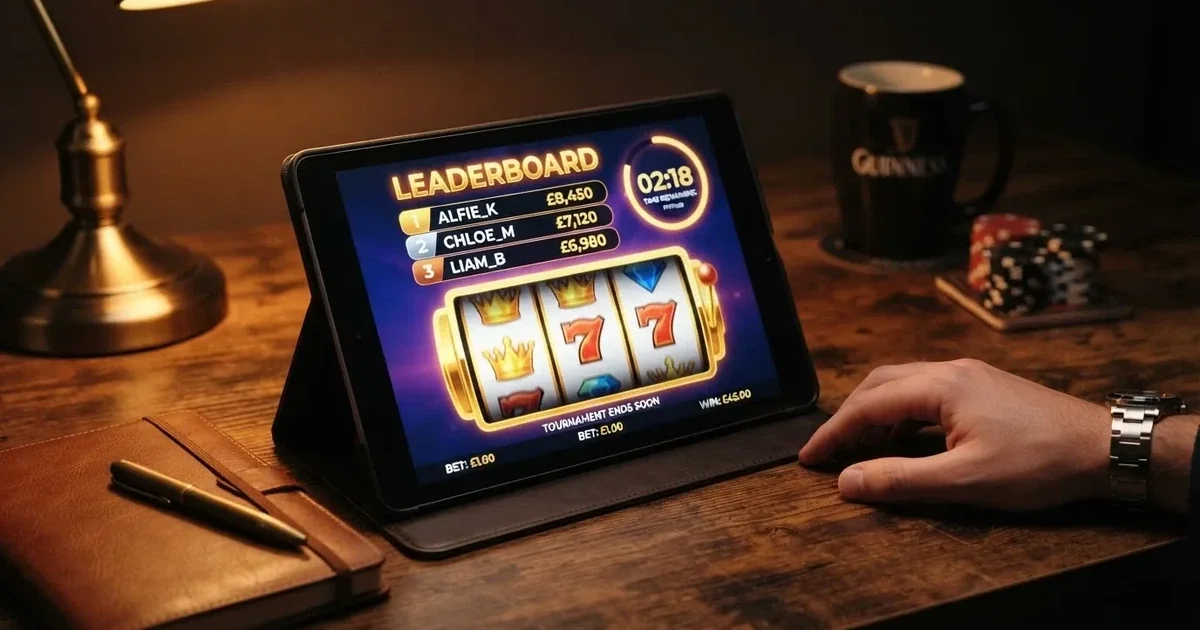
Currency stamp: the figures here were checked on 23 November 2026 against the Gambling Commission’s public register and its remote casino operating licence listings.
Table of Contents
- Why a tournament is not a bonus, and what the difference costs
- Incentives on the prize side: free spins, freerolls and what each really gives
- Free or no-deposit tournaments: what the small print actually pays
- Fundamentals: how a slot tournament actually runs under the rules
- Game and provider landscape: which titles carry the leaderboards
- Comparing the ten UK-licensed operators: licence, domain and what the register actually shows
- Overview of the UK tournament market: who runs what
- Legality: which operators can legally run a tournament for British players
- Offshore sites: the cost the player pays for an unlicensed leaderboard
- Responsible play at a leaderboard: the time limit no one sets
- Cryptocurrency and tournament entry: what the rule actually allows
- Payment speed: how fast a tournament prize actually lands
- What the 10x wagering cap means for a tournament prize: the work behind the win
- Operator write-ups
- Reading the register yourself
- Frequently asked questions
Why a tournament is not a bonus, and what the difference costs
A bonus gives you extra money or extra spins to play with, on terms that say how much you have to wager before you can withdraw. A tournament gives you nothing extra at all. You play with your own cash, on a slot you could open any other day, and the casino ranks the field by some score — usually the sum of win multipliers over a fixed number of spins, sometimes the single biggest win, sometimes raw credit gained. At the end of the window the top finishers split a pre-announced prize pot.

The “free” framing that sometimes wraps a tournament entry — a few free spins credited to enter, a small cash credit — is still marketing copy. The free spins are wagered under the same conditions as the rest of the leaderboard run, and any prize credit is locked behind the operator’s standard bonus terms. Since 19 December 2025 the Gambling Commission has capped wagering requirements at 10x for any bonus a UK player can claim, and banned mixed-product bonuses outright — a “deposit on sport, get casino spins” offer is no longer legal. That cap is the ceiling that governs any prize credit a tournament pays out in bonus funds.
The arithmetic is where the marketing word deflates. A £100 tournament prize credited as bonus funds, wagered 10x, means £1,000 of slot play before the funds convert to withdrawable cash. At £1 a spin that is a thousand spins. At the 2.5-second minimum spin interval that is just over forty minutes of continuous play to clear one prize. The prize itself is £100; the work to make it yours is the £1,000 turnover, and the house edge on that turnover is what the £100 actually costs the player. A tournament leaderboard therefore does two things at once: it ranks who played best on the day, and it guarantees the operator a slice of every pound wagered across the entire field before any prize is paid.
Incentives on the prize side: free spins, freerolls and what each really gives
The incentive shelf is the one most UK players land on first. The shapes recur, and they recur because they work on the player. Three of them do most of the work in 2026.
Freerolls
A freeroll costs nothing to enter. You register an account — already verified under the Gambling Commission’s name, address and date-of-birth checks before your first deposit — and you are credited a fixed bundle of spins or a fixed credit stake on a named slot. The leaderboard is the same as a paid tournament: highest cumulative win, or biggest single multiplier, over the run. Prizes are typically split between the top ten or top twenty finishers, with the bulk going to the top three.
The cost to the player is the entry of time. The freeroll asks for an account, a verified identity, and a window of attention long enough to play through the credited spins. The cost to the operator is the prize pot they have committed and the play they have guaranteed on a chosen title for a chosen stretch.
Deposit-gated entries
The larger pots ask for a deposit first. A £10 minimum deposit typically unlocks either a fixed bundle of spins or a fixed tournament credit on a chosen slot. The leaderboard and prize split work the same way as a freeroll; what changes is the qualifying spend. Since the credit-card ban of 14 April 2020 the qualifying spend has to come from a debit card, a bank transfer or an accepted e-wallet — credit-funded routes, including credit cards routed through digital wallets, do not work for gambling in Great Britain.
Buy-in events
A handful of operators run buy-in tournaments where the entry fee is taken from cash balance rather than credited. These are rarer at UK-licensed sites than the first two, and they tend to run on higher-volatility slots where a single spin can move a player twenty places up the board. Buy-ins are the format most likely to be advertised with the words that mean least — “win a share of £X” is a share of the pot, not a share of what each finisher actually takes home once wagering terms bite.
Free or no-deposit tournaments: what the small print actually pays
The phrase “free slot tournament” and its near-twins — no-deposit tournament, freeroll, free entry — cluster together because searchers use them interchangeably. The UK market splits them into two shapes.
The first is the freeroll already described. You enter at no cost, play the credited spins, and the prize pot is whatever the operator has chosen to put up. Prizes are credited as bonus funds, and the 10x wagering cap (in force from 19 December 2025) governs how those funds convert.
The second is a free-spins bundle credited on signup, with or without a deposit code, and a leaderboard attached. The bundle is the same as any other free-spins offer on a UK-licensed site — credited on a named slot, often with a 24- or 48-hour expiry, with winnings returned as bonus funds. The leaderboard ranks players by what they got out of those spins. Where this differs from a pure freeroll is that the credited bundle may not be enough to play through to a competitive leaderboard score, which is the shape of entry the player actually has. You are not entering a tournament so much as being put on a scoreboard for the spins the casino would have given you anyway.
What both shapes share is the position of the player. You are running against other players on a slot the casino has chosen, with a stake the casino has chosen, for a window the casino has chosen, for a pot the casino has chosen. The freeroll name does not change who picked the game.
Fundamentals: how a slot tournament actually runs under the rules
A tournament is a closed scoring session. The mechanics are simple and worth setting out in full, because most of the friction between the marketing word and the player’s evening comes from misreading them.
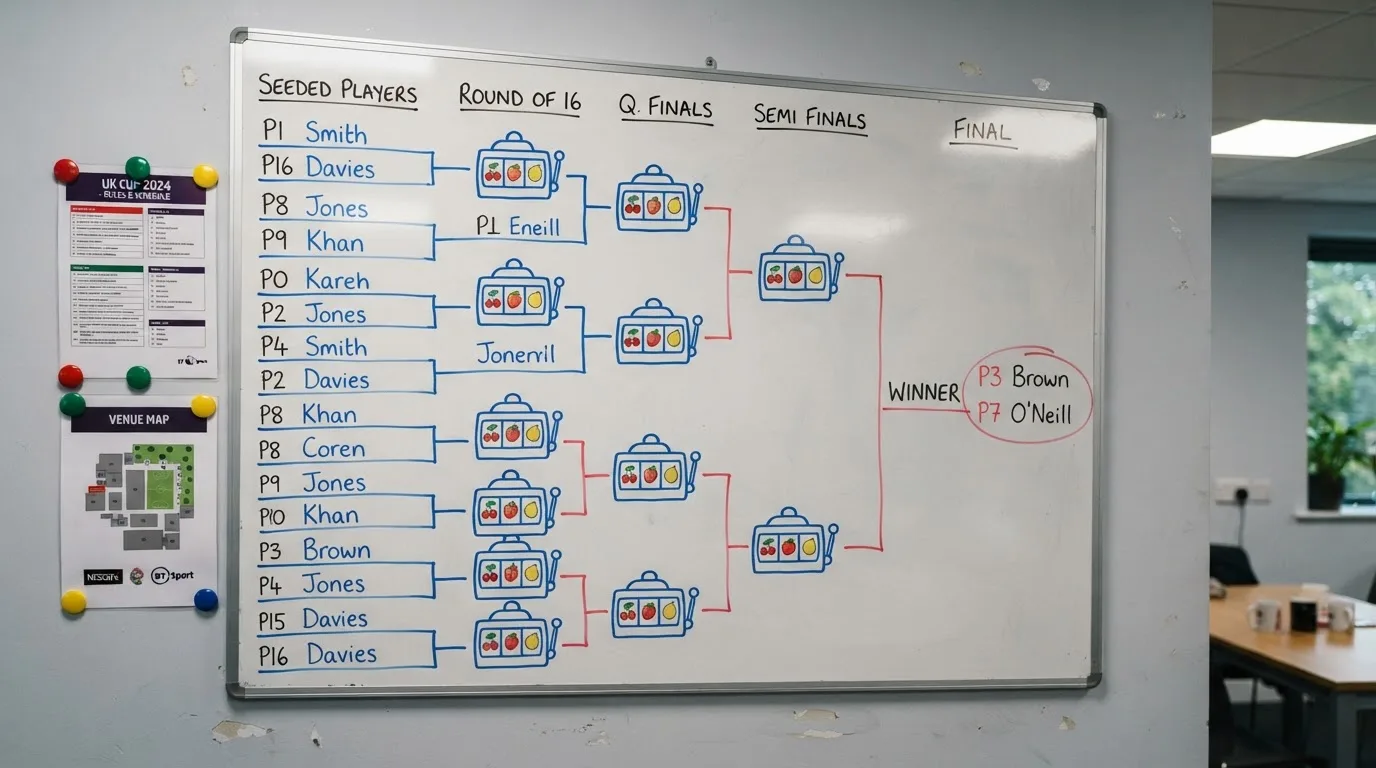
Scoring systems
| Scoring type | Mechanics | Reward focus |
|---|---|---|
| Total credits | Sum of wins | Consistent play |
| Big win multiplier | Biggest single win | Luck/High volatility |
| Raw credit | Net credits gained | Frequency variance |
The window
Tournaments run on one of two clocks. The first is a fixed start and finish — say, Friday 18:00 to Sunday 22:00 — under which any qualifying spins inside that window count. The second is a per-player window, where each entrant gets a fixed number of hours or a fixed number of spins from the moment they enter. The fixed-window model is more common at UK-licensed sites because it makes the leaderboard easy to read in real time.
The qualifying spins
The qualifying spins are nearly always on a single named slot. A small number of tournaments span two or three slots from the same provider, with leaderboard points credited on whichever of the named titles the player chose. What does not happen, on a UK-licensed site, is a tournament that lets you grind through your entire game library — the operator wants the action concentrated on the chosen title.
The prize split
Prize pots are split by rank. The split is published in the tournament terms before entry, and the split is the contract: top place gets X, places two through five get a smaller Y each, places six through twenty get a token amount. The split favours the top finishers heavily — a typical split on a £1,000 freeroll puts £400 with first place, £200 with second, £100 with third, and £20 each to places four through twenty. Knowing the split before you start is the single biggest piece of information about how to play the window.
Real spin speed and what it does to the window
Since 31 October 2021 a slot spin on a UK-licensed site cannot resolve faster than 2.5 seconds. That floor sets the minimum time the qualifying spins will take, irrespective of the slot’s “fast play” setting or any turbo mode the operator might offer on a non-UK market. A 100-spin tournament credit at the minimum interval runs just over four minutes; a 500-spin window runs just over twenty. The slot speed limit is the reason no UK tournament is the thirty-second grind that some offshore marketing material suggests.
Game and provider landscape: which titles carry the leaderboards
Tournaments cluster on the slots operators can put behind a leaderboard without breaking any of the regulator’s product rules. That is a narrower list than the slots catalogue.
High-frequency, medium-volatility titles
The most common slot under a UK tournament is one with a low-to-medium volatility rating and a hit frequency high enough that most players will record a reasonable score over the qualifying window. Games in this shape get chosen because the leaderboard stays competitive — a high-volatility slot produces a leaderboard where one player has four-figure credit gains and the rest of the field has near-zero, which makes the tournament look bad in marketing screenshots. Pragmatic Play’s high-frequency catalogue and the medium-volatility NetEnt and Play’n GO titles do most of this work in 2026.
Branded and seasonal titles
Around major sporting events and holidays a tournament is sometimes built on a themed slot — a football-themed title during a tournament window, a festive slot over December. The mechanics are identical; the choice is promotional. Prizes are often higher on these because the operator has underwritten the pot to support a campaign.
Live-dealer tournaments
A separate shelf is the live-dealer tournament, which scores the result of a fixed number of live-game rounds rather than slot spins. These run less often, on a smaller set of titles, and are more often restricted to VIP players or to a separate leaderboard inside an existing loyalty scheme.
What is not on the list
Crash games, instant-win titles and most slingo variants are not typical tournament carriers at UK-licensed sites. The mechanic does not always translate cleanly to a leaderboard — instant-win rounds resolve too fast to score, crash games depend on a player choosing when to cash out, and slingo mixes reel and bingo mechanics in ways that resist simple totals. Where they do appear, it is usually as a side bet inside a wider promotion rather than as the qualifying slot.
Comparing the ten UK-licensed operators: licence, domain and what the register actually shows
The table below takes the ten brands from §6 of the research and lays out what the Gambling Commission’s public register shows for each. None of them is endorsed over another. The columns are the ones that decide whether a player can legally play a tournament at the brand in question, and nothing more.
| Brand | Licence holder and GB remote casino licence | Domain status on the register | Subject support |
|---|---|---|---|
| Paddy Power | PPB Games Limited, 039411-R-319335-010 | Active | — |
| Ladbrokes | LC International Limited, 054743-R-330863-014 | Active | — |
| MrQ | Tek Fox Ltd, 060629-R-337532-004 | Active | — |
| Coral | LC International Limited, 054743-R-330863-014 | Active | — |
| bet365 | Hillside (UK Gaming) ENC, 055149-R-331499-004 | Active | — |
| Betfred | Petfre (Gibraltar) Limited, 039544-R-319290-010 | Active | — |
| Casumo | Recro Limited, 061549-R-336718-002 | Active | — |
| 888casino | 888 UK Limited, 039028-R-319297-014 | Active | — |
| Jackpotjoy | Gamesys Operations Limited, 038905-R-319430-022 | Active | — |
| Gala Bingo | LC International Limited, 054743-R-330863-014 | Active | — |
The first thing the table shows is that three of the brands — Ladbrokes, Coral and Gala Bingo — share a single licence holder. They are separate sites with separate brands and separate product catalogues, but they sit under one licence number on the register. From the player’s perspective that matters mostly in complaints: a dispute routes to LC International Limited regardless of which of the three sites you were playing on.
The second thing is what the column headings encode. A remote casino licence number on the register has the form account-R-number-suffix, where the leading six digits repeat the licence holder’s account number and the R marks a remote (online) licence. The number is the legal artefact: the licence, the licence holder and the active remote casino operating licence. The domain listing is the second check — a licence number with no active domain is a brand that has stopped trading online without surrendering its licence.
The third thing is the absence in the last column. The research does not carry a per-brand breakdown of which operator runs which tournament format on which schedule. The register tells you whether the brand is allowed to run a tournament at all; it does not tell you whether this week’s leaderboard is freeroll or buy-in. That detail lives on each operator’s promotions page, and it changes week to week.
Overview of the UK tournament market: who runs what
The British online casino market runs tournaments year-round, with concentrated bursts around major sporting events and the festive period. On 18 September 2026 the Gambling Commission’s public register listed 139 businesses holding an active remote casino operating licence; its domain register recorded 1,065 active and 361 white-label entries on the same date. A white-label site trades under another company’s licence — the domain is on the register, the licence number belongs to the host operator.
What this scale means in practice is that the tournament market in the UK is not a niche product. It is a recurring promotional layer sitting on top of every reasonable slot catalogue on a licensed site. The variance between operators is in the prize structure, the qualifying slot choice and the leaderboard format — not in whether they run tournaments at all.
The bigger competitive picture, for a player choosing where to enter, is shaped by three forces. The first is the prize split: a heavier top-place share rewards players who can credibly challenge for first; an even split across the top twenty rewards players who can hold a mid-table score over a long window. The second is the qualifying window: a fixed-window tournament rewards players who can put in time over the run; a per-player window rewards players who can play one strong session. The third is the qualifying slot’s hit profile: a low-volatility title favours consistent play, a high-volatility title favours patience for the single big spin.
Legality: which operators can legally run a tournament for British players
Only Gambling Commission-licensed operators can run an online casino tournament for players in Great Britain. The relevant statute is the Gambling Act 2005, which covers England, Scotland and Wales (Great Britain, not Northern Ireland). The Gambling (Licensing and Advertising) Act 2014 closed the previous offshore-from-the-UK loophole: any operator taking customers in Great Britain now needs a Commission licence, wherever the operator itself is based. A Curaçao, Malta or Gibraltar licence is not a substitute.
The way the rule meets the player is the public register. Every active remote casino operating licence in Great Britain is listed there, against the licence holder’s account number, with each domain the licence covers. On 18 September 2026 the register held 139 active remote casino operating licences and 1,065 active domains. The register can be searched online and downloaded as CSV or Excel.
The second layer is product rules. Since 31 October 2021 auto-play is banned, slot spins may not resolve faster than 2.5 seconds, and losses disguised as wins are banned. Since 9 April 2025 the maximum stake per game cycle is £5 for players aged 25 and over; since 21 May 2025 the maximum is £2 for players aged 18 to 24. These are the stake limits any tournament’s qualifying spins must respect. A tournament that lets a 22-year-old wager £5 a spin is breaking the rules.
The third layer is the player-side protection. Every online licence now carries GAMSTOP as a mandatory condition — players can self-exclude for six months, one year or five years, and the exclusion cannot be cancelled early. From 28 February 2025 the Commission runs light-touch financial vulnerability checks at £150 net deposits in a rolling 30 days, using public data only. The wider financial risk assessments the Commission has signalled are not yet in force; the operator prompts the customer to set a financial limit before the first deposit (since 31 October 2025) but the prompt is the operator’s job, not the Commission’s.
The fourth layer is payments. Credit cards have been banned for gambling since 14 April 2020 — including credit cards routed through e-wallets. Debit cards, bank transfers and approved e-wallets work; credit does not. Anonymous play is not possible at a licensed site: name, address and date of birth are verified before the first deposit or any play, since 7 May 2019.
The fifth layer is bonus rules. Since 19 December 2025 wagering requirements on any bonus a UK player can claim are capped at 10x, and mixed-product bonuses (deposit on one product, get a bonus on another) are banned. Any tournament that pays its prize as bonus funds is bound by the 10x cap on those funds.
What this means at the tournament shelf is straightforward. Any prize you are offered as a UK player on a licensed site comes attached to a 10x wagering requirement as the worst case; any free spins you are credited as part of an entry carry the operator’s standard bonus terms; any qualifying slot you are asked to play is one that has been approved under the Commission’s Remote Technical Standards. The tournament format itself is not separately regulated — what is regulated is the slot underneath and the bonus terms on top.
Offshore sites: the cost the player pays for an unlicensed leaderboard
Providing gambling to people in Great Britain without a Commission licence is an offence under section 33 of the Gambling Act 2005. The Commission disrupts illegal sites — cease-and-desist notices, search-engine delisting, payment and hosting referrals — but has no power to block them at the ISP level.
The penalty does not fall on the player. What falls on the player is the protection they lose. An unlicensed site does not connect to GAMSTOP, which means a self-exclusion registered on the UK scheme does not stop that player from opening an account offshore. An unlicensed site does not sit inside the Commission’s complaints route, so a dispute over a withheld tournament prize has no approved ADR to escalate to. An unlicensed site does not have to honour the 2.5-second spin floor or the £2/£5 stake limit, and does not have to pay Remote Gaming Duty, which raises the question of what it does with the stake money it would have paid.
The single practical test is the public register. If the operator’s domain is not on the register, the rest of the discussion does not apply.
Responsible play at a leaderboard: the time limit no one sets
A tournament is a session with a finish line. That is what makes it different from ordinary slot play, where a player can leave whenever the balance looks wrong. The leaderboard creates a window, the window has a clock, and the clock rewards the player who plays inside it most aggressively. For most players the right thing to do is set a time limit before entering, and stick to it. For a player who has registered a GAMSTOP self-exclusion, the right thing is not to enter at all — the Commission requires every licensed site to check the GAMSTOP register before account opening, and the exclusion will block the entry regardless of how the tournament page is framed.
A second practical step is to check the prize split before qualifying spins start. A pot weighted to the top three finishers is a different shape of competition from a pot weighted evenly across the top twenty, and the difference changes how aggressive the player should be during the window. A third is to read the wagering terms on any prize credit. A 10x cap on a £100 prize is forty minutes of play at £1 a spin; a £500 prize is over three hours of the same. The marketing word on the leaderboard poster is the share of the pot, not the share of the turnover.
The National Gambling Helpline (GamCare) and GambleAware are the two routes a player who feels the leaderboard has become the structure of the week can call. Neither charges; both take the call.
Cryptocurrency and tournament entry: what the rule actually allows
A licensed UK casino does not accept cryptocurrency deposits. The payment-method list on a UK-licensed site is debit card, bank transfer and a closed set of e-wallets — AstroPay, Apple Pay (where supported), PayPal and the operator’s own fast-transfer rails. The Commission’s anonymous-play ban, in force since 7 May 2019, rules out the wallet-only deposit model that offshore crypto casinos run on.
What this means at the tournament shelf is that “crypto casino tournaments” is not a UK product. A searcher asking for one is being pointed at offshore sites, and the offshore protection argument in the section above applies in full. A player who wants to enter a tournament using a digital coin has to convert to a fiat balance first — through a regulated exchange, into a UK bank account, then onto the casino — at which point the deposit is a bank transfer in everything that matters for the licence.
AstroPay is the closest UK-licensed analogue. AstroPay was founded in 2009 and is headquartered in Uruguay; its UK entity, Larstal Limited, is an electronic money institution authorised by the Financial Conduct Authority under the Electronic Money Regulations 2011. It operates as a global digital wallet offering online payments, virtual and physical debit cards and peer-to-peer transfers. Used at a UK-licensed casino it is a deposit route, not a cryptocurrency route — the wallet holds sterling or euro, the casino sees a debit-card-funded transfer, and the tournament entry is governed by the same rules as any other UK player on the site. Its Brazilian entity (Astro Instituição de Pagamento Ltda) is authorised by the Brazilian Central Bank as an electronic currency issuer; its Danish entity (Larstal Denmark ApS) is authorised by the Danish Financial Supervisory Authority; its Isle of Man entity (AstroPay Global (IOM) Limited) is licensed by the Isle of Man Financial Services Authority. The UK piece is the FCA authorisation. The rest is geography.
Payment speed: how fast a tournament prize actually lands
The question of how fast a tournament prize reaches the winning player’s account turns on two clocks — the operator’s internal approval clock and the payment-rail clock — and on whether the prize is paid as cash or as bonus funds.
Cash prizes
A prize credited as withdrawable cash is, in practice, a withdrawal request. On a UK-licensed site the operator runs an approval pass before releasing the funds, which typically takes a few hours but can run longer over weekends. Once approved, the funds move on the player’s chosen rail. UK bank transfers within the Faster Payments Service — launched in 2008 and operated by Pay.UK — usually arrive instantly or within a couple of minutes, and the rail operates 24 hours a day, seven days a week. The Faster Payments scheme sets a £1,000,000 per-transaction limit, though individual banks can and do impose lower limits on their own customers. The Bank of England oversees the system’s safety and stability and provides final settlement, but is not a direct participant in Faster Payments. Most UK players therefore see their tournament cash prize inside an hour of the leaderboard closing, with the operator’s approval window as the only meaningful delay.
Bonus-fund prizes
A prize credited as bonus funds is not a withdrawal — it is a balance on the bonus side of the account. Until the wagering requirement is cleared, the funds cannot be withdrawn at all. With the 10x cap (since 19 December 2025) the time to clear is bounded: a £100 prize at £1 a spin is forty minutes of play at the minimum interval; a £500 prize is just over three hours of the same. The arithmetic in the next section works through the shape of the clearing time in detail.
Apple Pay and AstroPay at the cashier
Apple Pay and AstroPay both work at the cashier of a UK-licensed site on the same basis as any other debit-funded rail. Apple Pay was launched on 20 October 2014, initially supporting only US-issued payment cards; UK-issued card support followed on 14 July 2015. It protects card data through tokenization, replacing the actual card number with a device-specific tokenised Device Primary Account Number and generating a dynamic security code for each transaction; in-store payments use near-field communication to talk to contactless terminals. Apple states that a supported card from a participating card issuer is required, and that Apple Pay is not available in all markets. Authentication on an iPhone with Face ID is a double-click of the side button; on a Touch ID model, a double-click of the Home button. None of that changes the fact that at the cashier it is still a debit-funded deposit.
AstroPay’s UK authorisation is the relevant piece for a player in Great Britain. The wallet operates as a global digital wallet offering online payments, virtual and physical debit cards and peer-to-peer transfers. Its broader regulatory footprint — authorisation by the Brazilian Central Bank as an electronic currency issuer (Astro Instituição de Pagamento Ltda), authorisation as an electronic money institution by the Danish Financial Supervisory Authority (Larstal Denmark ApS), licensing by the Isle of Man Financial Services Authority (AstroPay Global (IOM) Limited) — describes the company’s global reach rather than the protection a UK player gets at a UK cashier. The protection comes from the FCA authorisation of Larstal Limited, which makes AstroPay a regulated e-money institution in Great Britain for the purposes of a casino deposit.
What the 10x wagering cap means for a tournament prize: the work behind the win
The arithmetic of the wagering cap is where the marketing word and the player’s evening part company. Take a £100 tournament prize paid as bonus funds, a 10x wagering requirement (the maximum the Commission has allowed since 19 December 2025), and a stake-per-spin of £1 on a slot at the 2.5-second minimum interval. The work to clear that prize, assuming only the bonus amount is wagered, is £1,000 of qualifying turnover, or 1,000 spins, or just over forty minutes of continuous play at the legal minimum spin speed. That is the floor.
The same prize at a stake of £0.20 a spin is the same £1,000 of turnover, but 5,000 spins, or just over three and a half hours of play. The same prize at a stake of £5 a spin (the maximum stake per game cycle for players aged 25 and over, in force since 9 April 2025) is the same £1,000 of turnover, but 200 spins, or just over eight minutes of play. The stake choice is therefore the only variable the player controls, and it is bounded above by the stake limit and below by the player’s appetite for time.
The shape of the answer matters because the work scales linearly with the prize. A £500 prize at the same stake of £1 a spin is £5,000 of turnover, 5,000 spins, just over three and a half hours of play. A £50 prize is £500 of turnover, 500 spins, just over twenty minutes. The relationship between prize and time is direct: the bigger the prize, the more of the player’s evening the clearing work eats, and the only way to shorten the evening is to raise the stake, which the stake limit caps.
The result, written as a band: a single-digit-pound prize clears in minutes at any reasonable stake; a three-figure prize is an evening’s play at low stakes; a four-figure prize is the work of multiple sessions, and a player who does not want to give multiple sessions should not enter for a four-figure prize they cannot afford to clear.
Operator write-ups
The ten brands below are the GB-licensed operators the research carries. The research gives no per-brand tournament format detail, so the write-ups lean on the licence and domain facts and on what each brand’s general proposition does to the tournament shelf. Each closes on a judgement of what the brand is worth to a player who specifically wants to play tournaments, not to a player who wants a casino.
Paddy Power
Paddy Power operates under the PPB Games Limited remote casino licence 039411-R-319335-010. Its casino is a high-volume sportsbook-led product; tournament activity aligns with the sports calendar. It benefits from cross-product familiarity, which suits players who already have a sportsbook account and want casino play as an occasional side event.
Ladbrokes
Ladbrokes, like Coral and Gala Bingo, is part of LC International Limited (licence 054743-R-330863-014). This shared ownership is notable for complaints routing. The casino serves as a robust secondary product to its sportsbook, featuring a broader slot catalogue and more consistent tournament frequency than other multi-product brands. Serious tournament players will find the deeper schedule here preferable to casual alternatives.
MrQ
MrQ operates under Tek Fox Ltd (licence 060629-R-337532-004). It differentiates itself through a no-wagering-requirements model, meaning tournament prizes are frequently paid as cash rather than bonus funds. While the Commission still enforces a 10x wagering cap on bonuses, this operator’s preference for cash prizes makes it a top choice for players prioritizing withdrawable tournament rewards.
Coral
Coral is managed by LC International Limited (licence 054743-R-330863-014), sharing its licence with Ladbrokes and Gala Bingo. Its casino leans toward bingo-adjacent promotions rather than pure slots. While it offers a stable tournament calendar, the selection of qualifying slots is more curated and limited than at dedicated slot casinos. It remains a reliable secondary option for existing sportsbook customers.
bet365
bet365 runs under Hillside (UK Gaming) ENC (licence 055149-R-331499-004). Its casino is a significant product, backed by one of the largest player pools in the UK. This scale results in substantial prize pots, though competitive scoring thresholds are high. The brand suits players who engage daily and have sufficient time to navigate multi-day leaderboard windows.
Betfred
Betfred is listed on the Gambling Commission register as an active domain of account 39544, Petfre (Gibraltar) Limited, which holds the active remote casino operating licence 039544-R-319290-010. Betfred’s casino is a smaller proposition than bet365’s, with a more UK-focused slot catalogue and a tournament schedule that tends to run on mid-volatility titles. The smaller player pool is the trade-off in the other direction: smaller pots, easier to land a paid place. A reasonable fit for a player who wants a more local feel and is happy with a smaller prize for a higher hit rate.
Casumo
Casumo runs on licence 061549-R-336718-002, held by Recro Limited. Its tournament experience is tied to its loyalty tiers, which gate access to specific events and exclusive freerolls. This model rewards high-frequency players, though it offers less immediate value for casual entrants seeking quick access to tournaments.
888casino
888casino is licenced under 039028-R-319297-014 (888 UK Limited). Unlike many rivals, it incorporates proprietary titles alongside third-party slots, offering a tournament shelf with unique game variety. Players seeking an alternative to the standard Pragmatic Play or NetEnt tournament rotation will find this focus distinct.
Jackpotjoy
Jackpotjoy, powered by Gamesys Operations Limited (licence 038905-R-319430-022), focuses on bingo-integrated gaming. The tournament schedule is consistent, though qualifying slots lean toward lower-volatility titles. This makes leaderboards a test of endurance and consistency rather than high-volatility variance, making it better for players who prefer a steady pace.
Gala Bingo
Gala Bingo, part of LC International Limited (licence 054743-R-330863-014), offers a limited tournament schedule. As the brand’s casino offering is modest compared to standalone slot sites, it is most appropriate for players who use the site primarily for bingo and treat the tournament activity as a secondary feature.
Reading the register yourself
The single most useful thing a player can do before entering a tournament is to check the register. The check is two questions.
First: is the operator’s domain on the register as an active entry? On 18 September 2026 the register’s domain list held 1,065 active and 361 white-label entries, and the CSV or Excel download is searchable by domain name. The check takes a minute.
Second: which licence holder runs the domain? The licence holder is the company the player is contracting with, not the brand on the homepage. Three of the ten brands reviewed above — Ladbrokes, Coral and Gala Bingo — share LC International Limited as the licence holder, which is the company the player would name in a complaint. The licence number on the register has the form account-R-number-suffix, where the leading six digits repeat the licence holder’s account number and the R marks a remote licence.
What the register does not tell the player is whether this week’s leaderboard is a freeroll or a buy-in, whether the prize split favours the top three or spreads across twenty, or whether the qualifying slot is one the player wants to spend an hour on. Those questions are for the operator’s promotions page, and they change weekly.
Frequently asked questions
How do online slot tournaments work at UK casinos?
A slot tournament is a closed scoring session on a named slot, usually over a fixed window. You play with your own cash or with credited spins, your score is your total credits won (or your biggest single win), and the top finishers split a pre-announced prize pot. The pot is published in the tournament terms before you enter; the qualifying slot, the window and the stake size are fixed by the operator.
Can I enter a slot tournament without making a deposit?
Yes, at any operator that runs freerolls. A freeroll credits you a bundle of spins or a fixed tournament stake at no cost, after the standard name, address and date-of-birth verification the Commission requires before your first deposit or any play. Prize pots on freerolls are typically smaller than deposit-gated events, and the prize is usually paid as bonus funds subject to the 10x wagering cap.
What determines my ranking on a tournament leaderboard?
The score is the total credits won across a fixed number of spins, or the biggest single win multiplier, or raw credit gained depending on the format. The score is set by the operator and published in the tournament terms before entry. Some operators use a points-per-£1-won formula (for example, one point per £0.10 won) to flatten the difference between stake sizes.
How quickly are tournament prizes paid out?
A prize credited as withdrawable cash is a withdrawal request — operator approval typically takes a few hours, and the funds then move on the player’s chosen rail. UK bank transfers within the Faster Payments Service usually arrive instantly or within a couple of minutes, and the rail operates 24 hours a day. A prize credited as bonus funds is not a withdrawal; it clears through wagering first, with the 10x cap setting the worst-case time at the stake limit and the minimum spin interval.
Do crypto deposits count towards tournament entry the same as card payments?
Crypto deposits are not accepted at a UK-licensed casino. The Commission’s anonymous-play ban, in force since 7 May 2019, rules out the wallet-only deposit model, and the credit-card ban of 14 April 2020 closes off credit-funded routes including credit cards routed through e-wallets. A player who wants to use a digital coin has to convert to sterling through a regulated exchange and deposit as a bank transfer — at which point the deposit is a bank transfer in everything that matters for the licence.
What tips help with slot tournament strategy?
Read the prize split before qualifying spins start — a pot weighted to the top three is a different shape of competition from a pot weighted evenly across the top twenty. Pick the stake that lets you play the full qualifying window inside your budget, and remember the 2.5-second minimum spin interval and the £2/£5 stake limit. Set a time limit before entering, and leave when the limit hits — the leaderboard will still be there next week.