
Daily casino promotions in the UK: a practical guide for 2026
A daily promotion is not a separate licence category. It is the same Gambling Commission-licensed casino running the same games, with a recurring incentive layered on top: a prize pool that resets every 24 hours, a handful of free spins credited at the same hour, a leaderboard that pays out at midnight. The reason the UK market has a recognisable daily-promotion scene at all is structural — the Commission licence and the £5 (or £2, depending on age) per-spin stake cap, the GAMSTOP hook, the 10x wagering ceiling. Recurring incentives live or die inside that frame.
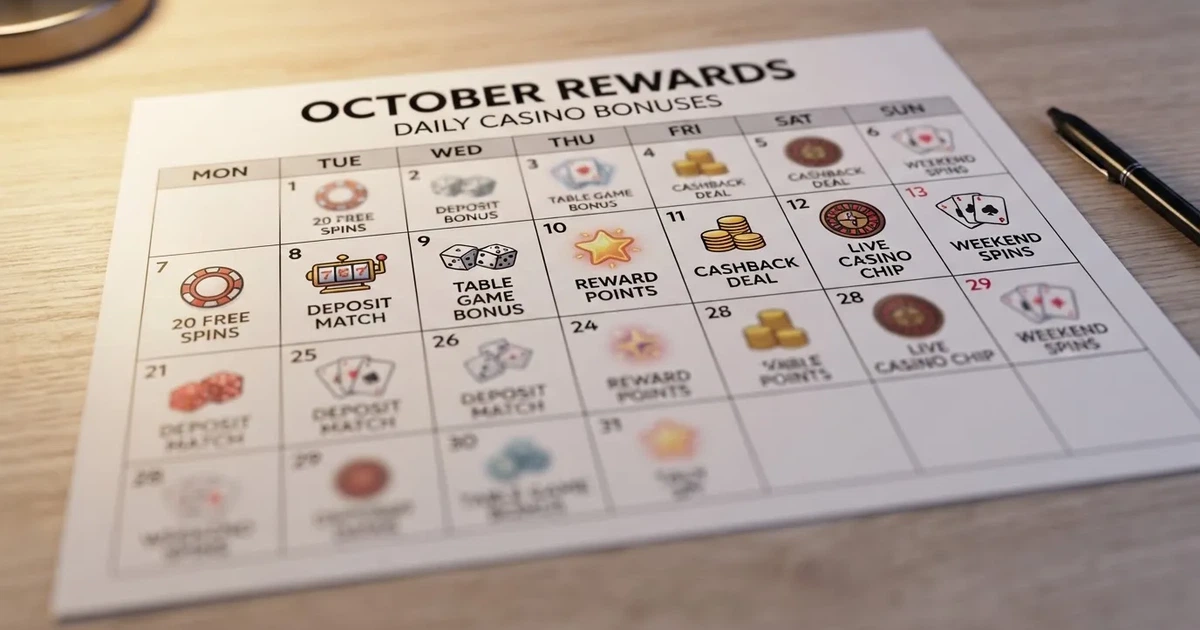
Data current as of 23 November 2026 and cross-checked against the Gambling Commission’s public register.
Table of Contents
- What a daily casino promotion actually is
- The licensing frame: who is allowed to run a daily offer
- Daily promotions under the Commission’s wagering ceiling
- Responsible play: what changes when a promotion resets every day
- Daily promotion mechanics, side by side
- The featured set at a glance
- The brands, in detail
- Payment routes into a UK daily-promotion casino
- The arithmetic behind a daily offer
- What a daily promotion costs the operator, and what the player gets in return
- Limits, taxes, and what falls outside the licence
- A reader’s checklist for a daily promotion
- Reading the register, in practice
- The closer comparison: which brand, which reader
- The single decision the daily format forces
- Frequently asked questions
What a daily casino promotion actually is
The phrase covers several distinct mechanics that share one feature: they reset on a clock.

A daily drop-and-win pool is the most common. A network of slots (or sometimes a single slot, or a table-game tournament) carries a fixed prize pot — say, £10,000 a day — split across hundreds or thousands of randomly triggered prizes. A spin that lands inside a qualifying window can pay anything from a few pounds to a five-figure jackpot, regardless of stake size, though larger stakes raise the chance of triggering. The pool empties when the day does.
A daily free spin bundle is closer to the marketing image: a fixed number of spins, on a fixed slot, credited at a fixed time, with whatever the spins win landing as bonus money or as cash depending on the operator’s own terms.
A daily leaderboard awards the top stakers or top winners of a 24-hour window — a points race on a specific game, a multiplier climb on a single slot. The reset is what makes it daily.
Two more variants turn up often enough to name: a daily login reward (open the site, claim a token, sometimes a free spin, sometimes a small cash chip), and a daily reload match (deposit today, get a percentage back as bonus funds). Both ride the same 24-hour clock; both answer to the same Commission rules.
The category is not a Government-recognised term. Search the Commission’s register and “daily promotion” does not appear. What does appear is the licence that authorises the operator to run any promotion at all, and the wagering ceiling that determines what every British-facing offer is allowed to cost the player.
The licensing frame: who is allowed to run a daily offer
Every British-facing online casino, including every operator running a daily prize pool, must hold a remote casino operating licence issued by the Gambling Commission under the Gambling Act 2005. The Commission’s public register is the test: if the domain is not on it, the site has no business taking deposits from people in Great Britain.
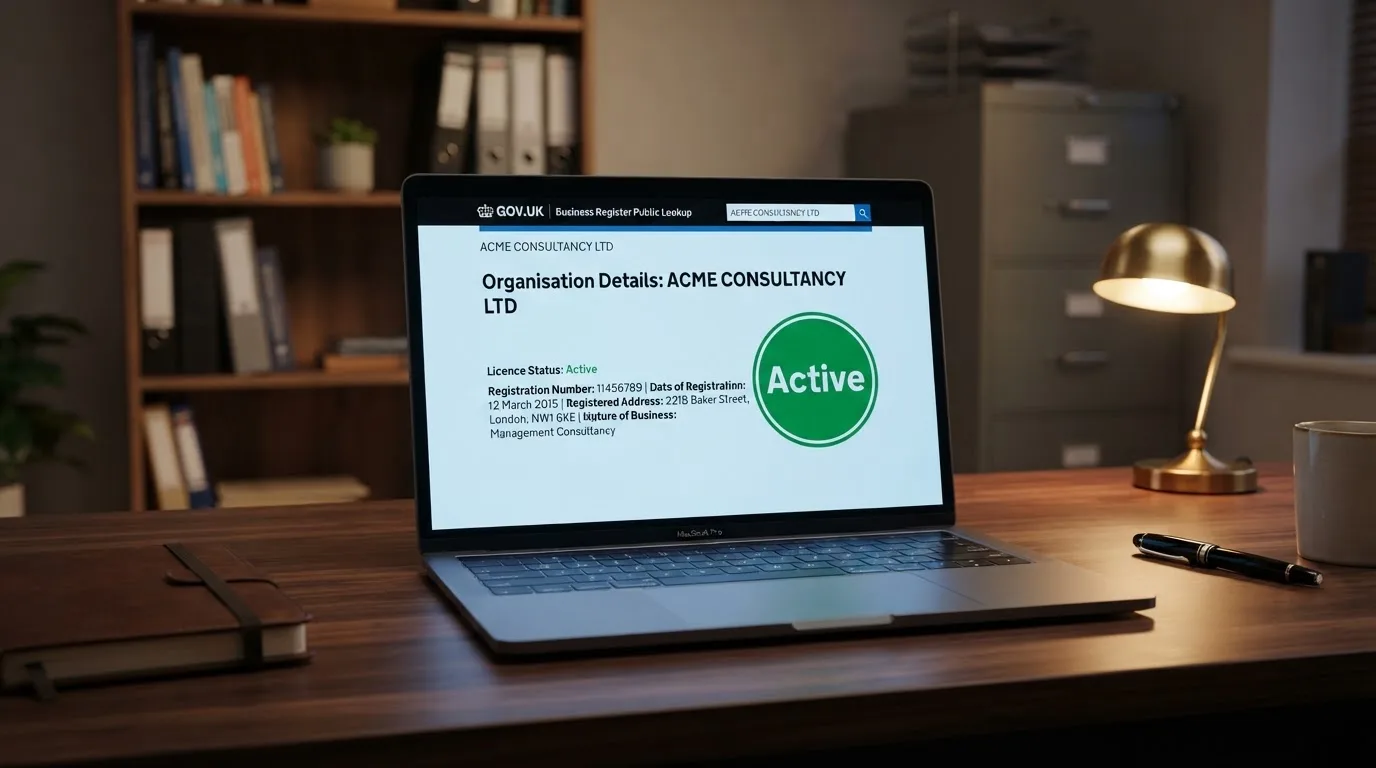
The register’s structure is worth knowing, because most write-ups describe a licence as a single string when it is actually three parts glued together. A remote casino licence number on the register has the form account-R-number-suffix, where the leading six digits repeat the licence holder’s account number and the “R” marks a remote (online) licence. So 054743-R-330863-014 reads as: account 54743, remote licence, slot 330863, suffix 014. The account number identifies the company that holds the licence (which may run several brands under one licence); the slot and suffix change with each renewal or amendment. Coral and Gala Bingo both list under account 54743 because both sit under LC International Limited — one company, two brands, one licence.
On 18 September 2026 the Gambling Commission’s public register listed 139 businesses holding an active remote casino operating licence. The register can be searched online and downloaded in full as CSV or Excel files; the version a reader needs is the public register, downloadable as a single spreadsheet. The domain list records each website against the licence account that runs it, with a status of Active, Inactive or White Label; on that date it held 1065 active and 361 white-label domain entries. A white-label site trades under another company’s licence — the operator is a different business, but the licence it operates against belongs to someone else. Virgin Games runs as a white-label of Gamesys Operations Limited; the licence number is Gamesys’s, not Virgin’s.
This matters for a daily-promotion reader because the licence — not the brand name — is what brings a site inside the British rule book. A white-label site must still respect GAMSTOP, must still verify identity before the first deposit, must still apply the £5 (or £2) per-spin cap, must still honour the 10x wagering ceiling that landed on 19 December 2025. The brand is the marketing surface; the licence is the contract with the regulator.
A site that takes a British customer without a Commission licence is committing an offence under section 33 of the Gambling Act 2005. The Commission can issue cease-and-desist notices, refer sites for payment and hosting disruption, and petition search engines to delist — but it has no ISP-blocking power. The customer is not penalised for landing on such a site; the customer simply has none of the protection a licensed site provides. No GAMSTOP. No Commission complaints route. No approved ADR.
Daily promotions under the Commission’s wagering ceiling
The single change that reshaped the British bonus market in 2026 is the 10x wagering cap that took effect on 19 December 2025. Before that date, wagering requirements of 30x, 40x, even 65x were routine at licensed sites. The Commission’s argument, set out in the consultation that preceded the change, was that very high multiples made bonus funds materially harder to clear than the marketing suggested. The new ceiling applies to the bonus amount alone, not to bonus plus deposit combined.
The number matters here because daily promotions have always carried a wagering cost in the background. A daily drop-and-win pool pays cash, no wagering required — that is part of why the format took off. A daily free spin bundle typically carries a 10x multiple on whatever the spins win, which is the new maximum and exactly the figure the ceiling was set at. A daily reload match almost always carries the same 10x figure on the bonus portion.
For a player trying to read a daily offer, the practical translation is this. Assume a free spin bundle of 50 spins at £0.10 credited at noon, on a slot with a 96% RTP, with a 10x wagering requirement on winnings. A modest spin return of, say, £4 leaves £40 to wager through before withdrawal. At £0.10 a spin that is 400 spins. At a 2.5-second game cycle the arithmetic runs to roughly 17 minutes of continuous play — assuming the bonus returns land at the modest end. A heavier spin return of £20 leaves £200 to clear, or 2,000 spins, or about an hour and 23 minutes of continuous play. The band is wide because slot returns are not; what is fixed is the wagering ceiling itself.
The point is not that daily promotions got worse. The point is that they used to carry the same wagering ceiling as one-off welcome offers did, which could be much higher. Now both share a 10x floor on bonus cost. The format of the promotion is unchanged; the multiplier on it is capped.
Responsible play: what changes when a promotion resets every day
A daily promotion is, by design, a reason to come back tomorrow. The reset creates a habit hook that an operator with a 24-hour reward schedule is plainly relying on. The Commission’s response is to keep the player inside a different rhythm — one of pre-set limits rather than reactive ones.
Every Commission-licensed site must offer GAMSTOP registration before a customer can deposit. GAMSTOP is the national online self-exclusion scheme, mandatory for every online licence since 31 March 2020; the exclusion periods are six months, one year or five years, and cannot be cancelled early. A player who has self-excluded through GAMSTOP cannot open an account at any licensed site for the duration; the daily promotion is irrelevant, because the account does not exist.
Outside GAMSTOP, the daily-promotion reader has three specific protections to set in motion.
Time-out and reality checks. The Commission requires a reality check at least once an hour for online slots, and a session clock that the player can extend only after an explicit prompt. Auto-play has been banned since 31 October 2021, and the minimum game cycle sits at 2.5 seconds — the slow reel is not an aesthetic choice but a regulatory floor.
Financial limits. Since 31 October 2025, every licensed site must prompt the customer to set a financial limit before the first deposit. The limit is the player’s own, not a Commission-set ceiling; the operator must honour it. There is no state-set deposit or loss ceiling in Great Britain. The figure a player picks is the figure the site holds them to.
Financial vulnerability checks. Since 28 February 2025 the Commission has required operators to run a light-touch vulnerability check at £150 net deposits in a rolling 30 days, using publicly available data only. Wider financial risk assessments were announced but had not entered force at the time of writing. The £150 figure is not a deposit cap; it is the trigger at which a check runs.
The specific danger of a daily-promotion environment is not that the offers are mispriced. It is that a player who would not open the site every day starts doing so. A practical countermeasure is to pick a single day, set a fixed budget against it, and treat every other day as closed. The free spin credit that expires at midnight is the marketing budget of the operator; the player’s budget is the one they set themselves.
The National Gambling Helpline (GamCare) and GambleAware are the two routes the Commission’s social responsibility code names as referral destinations. Both are free to British residents; both run outside the operator entirely.
Daily promotion mechanics, side by side
| Mechanic | How the clock resets | What the player receives | Wagering posture |
|---|---|---|---|
| Drop-and-win pool | 24-hour prize pot, typically 00:00–23:59 | Random prize triggers inside a qualifying window | Pool prizes paid as cash, no wagering |
| Daily free spin bundle | Credited at a fixed hour, often noon or evening | A fixed number of spins on a named slot | Winnings carry the site’s standard 10x cap |
| Daily leaderboard | 24-hour point race on a named game | Top finishers share a fixed pot | Cash or bonus depending on the operator |
| Daily login reward | One claim per calendar day | A small token, sometimes a free spin | Usually none on the token itself |
| Daily reload match | Available for one calendar day after deposit | A percentage match as bonus funds | 10x on the bonus amount under the December 2025 cap |
A reader weighing these formats against each other should note two things the table does not say. First, the wagering posture column assumes a fully Commission-compliant site; offshore operators set their own multipliers, and an unlicensed daily offer can sit at 30x or higher without breaking any rule the player can enforce. Second, the qualifying window for a drop-and-win pool is usually opt-in, and the player’s stake size affects the probability of triggering — the small-stake reader is in the pool, just with thinner odds per spin.
The featured set at a glance
The ten brands below all hold a Gambling Commission remote casino operating licence, with their domains listed as active (or, in one case, white-label) on the Commission’s public register. Several share a single licensee. None is recommended over another; the comparison is the page’s job, the choice is the reader’s.
| Brand | Licence holder and GB remote casino licence | Domain status on the register | Daily-promotion support |
|---|---|---|---|
| Midnite | Dribble Media Limited, 042647-R-321653-022 | Active | — |
| Coral | LC International Limited, 054743-R-330863-014 | Active | — |
| 32Red | Platinum Gaming Limited, 045322-R-324275-019 | Active | — |
| Gala Bingo | LC International Limited, 054743-R-330863-014 | Active | — |
| Jackpotjoy | Gamesys Operations Limited, 038905-R-319430-022 | Active | — |
| Virgin Games | Gamesys Operations Limited, 038905-R-319430-022 | White-label | — |
| Unibet | Platinum Gaming Limited, 045322-R-324275-019 | Active | — |
| PokerStars | Stars Interactive Limited, 039108-R-319334-026 | Active | — |
| Betway | Betway Limited, 039372-R-319367-029 | Active | — |
| Grosvenor Casinos | Rank Interactive (Gibraltar) Limited, 057924-R-334666-005 | Active | — |
The pattern to read off the table is the licence column. Four distinct companies run the ten brands: LC International (Coral, Gala Bingo), Platinum Gaming (32Red, Unibet), Gamesys Operations (Jackpotjoy, Virgin Games), and the rest one-to-one. Two of those four are white-label arrangements of one kind or another: Virgin Games trades under Gamesys’s licence, and any “new casino” that arrives under one of these licences without a separate register entry is operating the same arrangement by another name. The remote licence number on the register is the only place the parentage is plain.
The fourth column is empty on purpose. None of the brands in the featured set carries a daily-promotion claim that the register can confirm; what each brand runs is a marketing schedule, not a register entry. Daily promotion support is a thing an operator publishes on its own promotions page, not a thing the regulator certifies. The reader who needs a yes-or-no answer on a specific mechanic — drop-and-win, daily spin bundle, daily leaderboard — has to check the brand’s own terms page, with the licence number to hand in case the terms need to be cross-checked.
The brands, in detail
Midnite
Midnite is the newest name in the featured set, and the only one whose licence holder reads as a single-brand operation. Dribble Media Limited, account 42647, runs Midnite under remote casino operating licence 042647-R-321653-022; no second brand sits on that account. The site pitches itself at the esports-crossover casino reader, and that positioning shapes which daily promotions are likely to land on its schedule — the operator’s own terms page is the place to confirm any specific mechanic.
For a reader who values a small, single-purpose operator with no shared-licence ambiguity, Midnite is the cleanest fit in the featured set. For a reader who wants the longest-running daily schedule, the brand’s relative youth works against it.
Coral
Coral is one of the high-street names that moved into online under LC International Limited, which also runs Gala Bingo. The shared account is 54743, the licence number 054743-R-330863-014. Both brands sit on the same platform, with the same game library, the same payment routes, and — typically — a shared set of promotional mechanics rolled out across both.
The catch with Coral, and with any brand that shares a licence, is that the “daily promotion at Coral” question is partly the “daily promotion at LC International” question. A reader who has already seen a daily offer at Gala Bingo should not expect Coral to run something substantively different at the same hour.
32Red
32Red sits under Platinum Gaming Limited alongside Unibet, on the same remote licence: 045322-R-324275-019, account 45322. The two brands are visually distinct — 32Red in its long-standing red livery, Unibet in green — but the promotional mechanics they publish often share a backbone.
For a daily-promotion reader, the practical effect is that the day’s headline offer at one brand is a reasonable proxy for the day’s headline offer at the other, at least within the first hour of publication. By the second hour, the marketing teams have typically diverged the copy.
Gala Bingo
Gala Bingo is the bingo side of LC International’s operation, sharing the Coral licence. Bingo rooms have their own daily mechanics — a daily jackpot, a daily pattern game — that sit naturally inside a 24-hour rhythm, so a daily-promotion reader looking at Gala Bingo is sometimes asking a slightly different question than the one they ask at Coral.
The licence line is identical to Coral’s, because it is the same licence. The two brands should not be counted as two independent operators; they are one operator with two marketing surfaces.
Jackpotjoy
Jackpotjoy is the senior brand in the Gamesys stable, run by Gamesys Operations Limited under remote licence 038905-R-319430-022. The site has a long-running identity around slots and bingo, and the daily schedule that goes with that positioning tends to lean on free spin bundles rather than drop-and-win pools.
Virgin Games sits on the same licence — see the next entry. A reader considering either brand is in practice choosing between two marketing surfaces for one operator.
Virgin Games
Virgin Games runs as a white-label domain of Gamesys Operations Limited — the licence is Gamesys’s, account 38905, number 038905-R-319430-022. The white-label status on the register is the marker that the underlying operator is not a Virgin-branded business but a Gamesys operation under licence.
For a daily-promotion reader this is mostly a service-level question rather than a regulatory one. The terms the player accepts are Gamesys’s terms, regardless of which front door they walked in through.
Unibet
Unibet runs on Platinum Gaming Limited’s licence — same account as 32Red, same remote casino operating licence number. The Kindred Group, which owns Unibet, has a long European sportsbook pedigree; the daily promotional mechanics that surface tend to be tied into events rather than running as pure slot or casino tournaments.
A reader with an established Unibet identity who is moving into the casino product for the first time is in practice extending a Platinum Gaming relationship rather than opening a new one with a different operator.
PokerStars
PokerStars runs under Stars Interactive Limited, account 39108, on remote casino operating licence 039108-R-319334-026. The brand is primarily a poker room; the casino product is a separate vertical inside the same login, and the daily promotion schedule on the casino side is typically lighter than at a casino-first operator.
A reader whose interest is in poker-driven rewards rather than slot pools should expect the daily casino promotion list at PokerStars to be a shorter one. The licence is the same Stars Interactive licence either way.
Betway
Betway runs under Betway Limited, account 39372, on remote casino operating licence 039372-R-319367-029. The brand has its own licence holder rather than sharing with anyone in the featured set, which is unusual in a UK market where consolidation has become the norm.
The single-operator licence makes Betway the cleanest answer in the featured set for a reader who wants to know exactly which company is on the other side of the table.
Grosvenor Casinos
Grosvenor Casinos runs under Rank Interactive (Gibraltar) Limited, account 57924, on remote casino operating licence 057924-R-334666-005. The parent company is the Rank Group, which has the longest history of any operator in the featured set — Grosvenor’s land-based casinos date back to the 1970s.
The Gibraltar registration of the licence holder does not change the daily-promotion mechanics the brand can run for British customers; the licence it operates against is a Commission licence, and that licence carries the full set of Commission rules.
Payment routes into a UK daily-promotion casino
Deposits at a Commission-licensed site are limited to methods the operator can verify under the LCCP social responsibility code, and since 14 April 2020 credit cards have been banned for gambling across all online and offline products in Great Britain, including credit-card-funded e-wallet top-ups. Debit cards, bank transfers, and authorised e-wallets remain available.
Three methods carry most of the volume.
Debit card. The default. Visa and Mastercard debit cards move money through Faster Payments or the card networks, typically arriving instantly. The Commission’s identity-verification rules apply before the first deposit: name, address and date of birth are checked against public data, and a credit check is run where the operator considers it proportionate. The verification has been a condition of every Commission licence since 7 May 2019.
Bank transfer (Faster Payments). UK bank transfers typically move through the Faster Payments Service, launched in 2008 and operated by Pay.UK. Faster Payments operates 24 hours a day, seven days a week, and most payments arrive instantly or within a couple of minutes, though transfers can occasionally take up to two hours. The Faster Payments scheme sets a £1,000,000 per-transaction limit, though individual banks can and do impose lower limits on their customers. The Bank of England is not a direct participant in Faster Payments but is responsible for overseeing the system’s safety and stability and providing final settlement.
Apple Pay. Available at most Commission-licensed casinos as a deposit route, with a different security profile from card payments. Apple Pay protects card data through tokenization, replacing the actual card number with a device-specific tokenised Device Primary Account Number and generating a dynamic security code for each transaction. Apple Pay in-store payments use near-field communication (NFC) to communicate wirelessly with contactless payment terminals, which is not the casino flow but explains the underlying security model. On an iPhone with Face ID, Apple Pay in-store purchases are authenticated by double-clicking the side button; on models with Touch ID, by double-clicking the Home button. Apple Pay began supporting UK-issued payment cards on 14 July 2015, having launched on 20 October 2014 initially supporting only US-issued payment cards. Apple states that a supported card from a participating card issuer is required to use Apple Pay, and that Apple Pay is not available in all markets. The US Consumer Financial Protection Bureau finalised a rule in November 2024 bringing large nonbank digital wallet operators, including Apple Pay, under bank-like federal oversight, which is the kind of regulatory attention the Commission is also bringing to digital payments. The European Commission opened an investigation in 2020 into whether Apple abused its control of iPhone NFC hardware to block rival payment apps’ access to contactless payments, in relation to Apple Pay; the British regulatory question has not followed the European line.
AstroPay and other e-wallets. A global e-wallet route, founded in 2009 and headquartered in Uruguay. AstroPay operates as a global digital wallet offering online payments, virtual and physical debit cards, and peer-to-peer transfers. AstroPay spun off its payment-processing business, dLocal, as a separate company in 2016. AstroPay’s UK entity, Larstal Limited, is an electronic money institution authorised by the Financial Conduct Authority under the Electronic Money Regulations 2011. AstroPay’s Isle of Man entity, AstroPay Global (IOM) Limited, is licensed by the Isle of Man Financial Services Authority for money transmission. AstroPay’s Brazilian entity, Astro Instituição de Pagamento Ltda, is authorised by the Brazilian Central Bank as an electronic currency issuer. AstroPay’s Danish entity, Larstal Denmark ApS, is authorised as an electronic money institution by the Danish Financial Supervisory Authority. AstroPay serves users across markets including Argentina, Australia, Brazil, Canada, Colombia, Denmark, Spain, the United Kingdom, the United States and Uruguay. The point for a UK reader is that AstroPay’s UK authorisation is FCA, not Gambling Commission, and that the e-wallet layer is therefore covered by a separate regulator.
The Commission does not set a deposit ceiling. The operator’s own pre-deposit prompt — in force since 31 October 2025 — asks the player to set a financial limit before the first deposit, and the operator must honour it. Faster Payments’ £1,000,000 transaction ceiling is the practical upper bound on any single deposit by bank transfer; individual banks set lower limits.
The arithmetic behind a daily offer
A free spin bundle is the cleanest illustration of how the December 2025 wagering ceiling plays out in practice. Take a 50-spin daily bundle at £0.10 per spin on a slot returning 96% in the long run, with a 10x wagering requirement on winnings. Two scenarios — a modest spin return and a heavier one — give a band rather than a single figure.
A modest return of £4 produces £40 of wagering to clear, at £0.10 a spin that is 400 spins of qualifying play. At the Commission’s 2.5-second minimum game cycle that is roughly 17 minutes of continuous play. A heavier return of £20 leaves £200 to clear, or 2,000 spins, or about an hour and 23 minutes. The band is “between a quarter of an hour and an hour and a half of continuous play to clear a single day’s free spin bundle”, with the actual figure set by what the spins return.
The arithmetic assumes only the bonus is being wagered, which is the position the Commission’s wagering ceiling was set to enforce — bonus only, not bonus plus deposit combined. It assumes the player is clearing at minimum game cycle speed, which is the legal floor and the fastest the play can move. It is a statistical estimate, not a guaranteed outcome for any single player: no spin sequence is obliged to return the long-run average in a single session, and the 10x ceiling caps the wagering requirement but does not change what the spins pay back.
The cost question, viewed through expected loss rather than time, runs the same inputs. Expected loss on a £4 return cleared through £40 of qualifying turnover at 96% RTP is £40 × (1 − 0.96) = £1.60. Expected loss on a £20 return cleared through £200 of qualifying turnover is £8.00. The promotion pays for itself if the cash return exceeds the expected loss; at 96% RTP the expected loss is 4% of the turnover, which is exactly the slot’s house edge expressed as pounds. A reader can read the band’s two figures either way — by time or by expected loss — and arrive at the same conclusion: the day’s offer costs between a pound and a few pounds in statistical expectation, with the wider figure reflecting the wider return the spins might produce.
What a daily promotion costs the operator, and what the player gets in return
The Commission caps the wagering requirement on the player’s side; it does not cap the value of the offer. A daily promotion is, for the operator, a marketing cost measured against a target metric — session frequency, deposit size, retention. The target metric shapes the offer.
A drop-and-win pool is funded out of the slot’s RTP rather than out of marketing budget. The slot still pays back its long-run percentage; a slice of that payback is simply routed through a prize pool rather than through ordinary line wins. The player does not see a worse RTP for being in the pool; they see a different distribution of outcomes, with the tail of the distribution carrying the prize. For a player who values a small chance at a large prize over a steady trickle of small wins, the pool is a different shape of the same slot.
A daily free spin bundle is funded out of marketing budget, and the operator’s goal is to get the player back the next day. The economics matter to the player because they determine whether the offer scales with deposit size (most do not, on a daily schedule), whether the free spin value is fixed or scales with prior play, and whether the bonus portion is cashable or non-cashable.
A daily leaderboard pays out at midnight and resets empty. A player who is competitive against other players on the site rather than against the random number generator sees a different incentive structure — the question is not “what will this spin return” but “how am I ranked at this hour”.
The format choice is the player’s, and the format’s wagering posture is the Commission’s.
Limits, taxes, and what falls outside the licence
The British market’s tax position on the player side is straightforward: no tax on gambling winnings in the UK. Operators pay Remote Gaming Duty, raised from 21% to 40% from 1 April 2026, which is an operator-side figure the player never sees but which shapes how aggressively an operator can fund a daily promotional schedule. A higher duty is a reason for an operator to trim the headline value of a daily offer, not a reason to abandon the format.
The limits the player should know about sit in three places. The £5 (or £2) per-spin cap is in the Commission’s online slots rules and is enforced by the operator’s own software. The pre-deposit financial-limit prompt has been in force since 31 October 2025 and is the player’s own choice, not a Commission ceiling. The financial vulnerability check at £150 net deposits in a rolling 30 days is a check, not a cap, and runs on publicly available data only at the time of writing.
Outside the licence, the picture is simpler and less protective. An unlicensed site has no GAMSTOP, no Commission complaints route, no approved ADR. The Commission’s response to unlicensed operators is administrative — cease-and-desist notices, search-engine delisting referrals, payment and hosting referrals — and does not extend to blocking access at ISP level. A player who has self-excluded through GAMSTOP and then lands on an unlicensed site has no Commission backstop and no ADR; the exclusion’s protection ends at the licensed boundary.
The 800,000 UK consumers the Commission estimated used credit cards to gamble in 2018, and the figure that 22% of online gamblers who used credit cards to gamble were classed as problem gamblers, are the figures that justified the credit-card ban that took effect on 14 April 2020. The figures are historical — 2018 is the survey year — but the policy they support is current.
A reader’s checklist for a daily promotion
The mechanics differ across operators; the questions the reader should ask are common.
What is the licence number, and what is its account? Every Commission-licensed brand publishes its licence on its own site, with the licence number on the register behind it. The account number tells the reader which company runs the brand. A reader who values a single-brand operator is asking the right question.
Is the bonus 10x, or is the wagering ceiling set lower? Since 19 December 2025, 10x is the legal maximum. A figure higher than 10x on the bonus amount alone is not possible at a licensed site.
Is the offer cash, or is it bonus funds? A drop-and-win pool pays cash. A daily free spin bundle typically pays bonus. A reload match is bonus. The difference matters on withdrawal: cash is the player’s, bonus is the player’s after the wagering ceiling is cleared.
What is the qualifying window? A 24-hour pool is opt-in at most operators; the player has to register the first spin of the day. A daily free spin bundle is automatic at most operators; the credit appears at a fixed hour. A reload match is opt-in at deposit.
Is the daily mechanic a true 24-hour cycle, or is it reset at the operator’s local midnight? The difference matters at month boundaries and on bank holidays.
What happens to unused free spins? Most operators forfeit unplayed free spins at midnight; a small number roll them forward by one day. The reader should know which it is before claiming.
A reader who runs through that list on each new daily offer has done the work the marketing copy is designed to skip.
Reading the register, in practice
The Commission’s public register is a single download. The version a reader wants is the public register of gambling businesses, distributed as CSV or Excel. The columns the reader needs are limited to a handful: the account number, the licence number, the licence type (look for “Remote Casino Operating Licence”), the trading name, the domain status (Active, Inactive, White Label), and the domain itself.
To check a brand, the reader filters on the licence number, then reads down the trading names and domains that sit against that licence. If the brand the reader is checking does not appear on the licence’s row, the brand is operating outside the register, which is a regulatory problem regardless of whether the brand claims a UK licence elsewhere.
To check a licence holder, the reader filters on the account number. The brands under that account are the parent company’s full UK-facing stable. A reader comparing Coral and Gala Bingo for promotional overlap is doing exactly this check.
The register’s domain status column is where the white-label arrangements surface. A white-label status is a marker that the operator is a different business from the licence holder. The licence still applies in full; the brand on the door is just not the company the regulator has the contract with.
The closer comparison: which brand, which reader
The featured set covers a range of licence arrangements and a range of brand profiles. Three reader types get clean fits.
The reader who values a single-operator licence — one company on the other side of the table, no shared licence — has the cleanest answer at Midnite, Betway, PokerStars, or Grosvenor Casinos. Each runs under a licence held by a company that is not shared with another brand in the set.
The reader who is already inside the Gamesys or Platinum Gaming stable has a related but different choice. A player who already holds an account at Jackpotjoy can extend into Virgin Games without re-verifying identity; a player already at 32Red can extend into Unibet the same way. The daily schedules at sister brands are typically different in detail even when the licence is shared, but the underlying player-protection rules, payment routes, and GAMSTOP registration are identical because the licence is identical.
The reader who values brand pedigree lands at Grosvenor Casinos, on the longest-running licence holder in the set. The Rank Group’s history is not a regulatory advantage, but it is the brand with the deepest UK-facing history on the register.
A reader with no existing relationship is choosing between licence holders and marketing surfaces rather than between regulatory regimes — every brand in the set is on the same side of the British rule book. The licence holder column is where the actual differences sit.
The single decision the daily format forces
A daily promotion is a habit, and a habit is a cost the player sets themselves rather than the cost the operator publishes. The Commission’s pre-deposit prompt is the structural answer to the question a daily schedule creates: how much, and how often. The Commission’s 10x wagering ceiling is the structural answer to the question the bonus terms create: how much the offer is allowed to cost the player in qualifying turnover.
Between those two answers, the daily-promotion scene in the UK operates inside a frame that no other jurisdiction quite matches. A licence that has to be renewed, a register that has to list the brand, a self-exclusion that has to be honoured, a financial-limit prompt that has to fire before the first deposit, a wagering ceiling that has to be enforced, a credit-card ban that has to hold. The daily promotion is the marketing layer on top of all of that, and the marketing layer is what the reader can compare.
Frequently asked questions
What counts as a daily casino promotion?
A daily casino promotion is any recurring incentive that resets on a 24-hour clock — a drop-and-win prize pool, a daily free spin bundle, a daily leaderboard, a daily login reward, or a daily reload match. The format is set by the operator; the regulatory frame (licence, wagering ceiling, age verification, GAMSTOP) is the same across all of them.
How does a drop-and-win prize pool work?
A drop-and-win pool is funded out of a slot’s return rather than out of marketing budget. A fixed pot — often a five-figure sum — is split across hundreds or thousands of randomly triggered prizes over a 24-hour window. The slot’s long-run return is unchanged; a slice of that return is routed through the pool rather than through ordinary line wins, with the tail of the distribution carrying the prize.
Do I need to opt in each day to qualify for a daily promotion?
Most operators require a one-time opt-in to a drop-and-win pool or a daily leaderboard, after which the player is in for the duration of the promotion. A daily free spin bundle is typically automatic, with the credit landing at a fixed hour. A daily reload match is opt-in at deposit.
Are daily free spin offers subject to wagering requirements?
At a Commission-licensed site, yes. Since 19 December 2025 wagering requirements are capped at 10x on the bonus amount, and most daily free spin bundles carry exactly that ceiling on whatever the spins win. A figure higher than 10x is not legal at a licensed site; an unlicensed site can set its own multiples.
How is a daily promotion prize paid out?
A drop-and-win pool prize typically lands as cash, with no wagering and no cap on withdrawal beyond the operator’s standard verification. A daily free spin bundle typically lands as bonus funds subject to the 10x wagering ceiling. A daily leaderboard prize lands as the operator’s terms state — cash at some operators, bonus at others.
Can I take part in a daily promotion more than once a day?
At most operators, yes. A drop-and-win pool is open to any qualifying spin during the window, so a player who plays multiple sessions can have multiple winning triggers. A daily free spin bundle is typically a one-per-day credit. A daily leaderboard is open to any qualifying play, with the score reflecting cumulative activity over the 24-hour window.