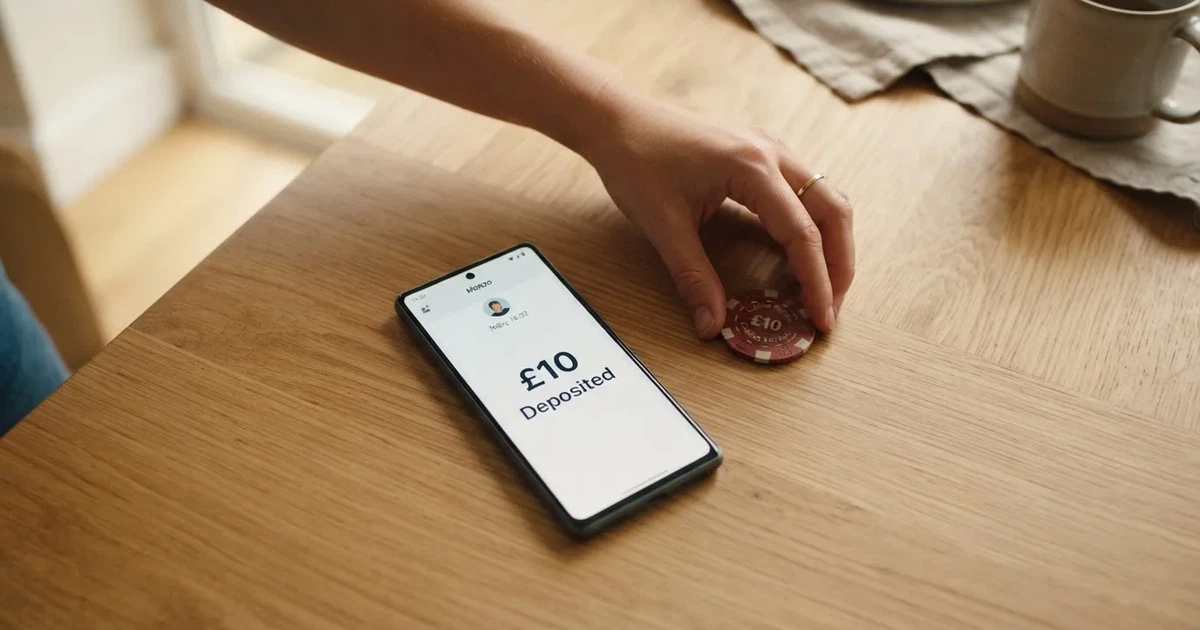
A £2 minimum deposit at a UK casino, and what that stake actually buys
 Available in GB
A £2 minimum deposit is one of the smallest stakes a UK-licensed casino will accept. It is also a small enough figure that the question shifts away from how to fund an account and toward what the regulator behind it actually guarantees — because the deposit size is the easy half of the deal, and the rules around it are what decide whether the small stake is worth making at all.
The data here is current as of 23 September 2026, checked against the Gambling Commission’s public register of gambling businesses.
Table of Contents
- The £2 minimum deposit sits inside a licensed market, not outside one
- A £2 stake is allowed because the maximum stake is set, not the minimum
- Responsible gambling tools cover the £2 deposit exactly as they cover any other
- A £2 deposit moves through the same rails a £200 deposit uses
- A £2 deposit has the same payout speed the same method would have at any other stake
- The wagering requirements that apply to a £2 deposit, and how long they take to clear
- The licensed UK casinos accepting a £2 minimum deposit, side by side
- The arithmetic that sits behind a £2 bonus under the 10x cap
- Offshore is not a workaround, and it is not a shortcut
- What the £2 minimum deposit does not change
- Frequently asked questions about £2 minimum deposit casinos in the UK
The £2 minimum deposit sits inside a licensed market, not outside one
A £2 deposit threshold is a marketing line, not a licence category. The operator behind it either holds a Gambling Commission remote casino licence or it does not, and the size of the minimum deposit does not change which of those two states the site is in. A £2 minimum deposit casino UK is, in the first instance, a UK-licensed casino — the stake is just the smallest one the cashier will accept.
That distinction is the load-bearing one on this page. The £2 figure is what the search turns on, but it is the licence that decides what the player gets in return: identity checks before play, GAMSTOP self-exclusion, a complaints route through an approved alternative dispute resolver, and a regulator that can take the licence away if a brand stops meeting its conditions. A site that does not hold a UK licence can still advertise a £2 minimum; what it cannot offer is any of those four.
What “UK-licensed” actually means in practice
The Gambling Commission regulates gambling in Great Britain — England, Scotland and Wales — under the Gambling Act 2005. Northern Ireland runs a separate regime. Since the Gambling (Licensing and Advertising) Act 2014, any operator taking customers in Great Britain needs a Commission licence regardless of where the company itself is incorporated, so a Curaçao or Malta registration on its own is not enough to take UK players. As of 18 September 2026, the Commission’s public register listed 139 businesses holding an active remote casino operating licence.

The smallest stake at a licensed site still runs through identity checks
The same identity and age checks that govern a £100 deposit govern a £2 one. A licensed site has to verify the customer’s name, address and date of birth before the first deposit or any play, which has been the rule since 7 May 2019. The minimum age is 18 in every product. Anonymous play is not available at a UK-licensed casino, and it is not available at the £2 minimum deposit tier — there is no small-stakes loophole that bypasses the check.
That is the trade-off written into the deposit size. A £2 stake keeps the bankroll commitment small; it does not make the account anonymous, and it does not move the customer outside the regulator’s reach.
A £2 stake is allowed because the maximum stake is set, not the minimum
The maximum stake a player can put on a single online slot spin is fixed by the Gambling Commission, and it is set per game cycle. From 9 April 2025 the cap has been £5 per game cycle for players aged 25 and over. From 21 May 2025 it has been £2 per game cycle for players aged 18 to 24. There is no Commission-set minimum stake — that is left to the operator and the cashier — and there is no Commission-set deposit ceiling either. The £2 deposit threshold is therefore set by the operator; the £2 per-spin cap for younger players is set by the regulator.
The reason this matters for the page’s subject is that the £2 minimum deposit and the £2 maximum stake for 18-to-24-year-olds are unrelated numbers that happen to coincide. They sit on opposite sides of the cashier and the slot respectively. A player aged 25 or older can still deposit £2 — the minimum is a site-level setting and is unchanged by the stake cap — but a player aged 18 to 24 cannot then place more than £2 on any single spin of an online slot. A £2 deposit from an older player and a £2 deposit from a younger one are the same stake at the cashier; the spin that follows is governed by a different ceiling.
The stake cap lives with the slot, not the deposit
The stake cap applies per game cycle of an online slot. A “game cycle” is one full turn of the slot — bet placed, reels resolved, outcome returned. The cap does not limit how many spins a customer plays, and it does not limit how much is in the account. It limits the stake on each individual spin. A £2 deposit is well below that cap for an older player; for an 18-to-24-year-old, the £2 deposit is the largest single stake the slot will accept.
Responsible gambling tools cover the £2 deposit exactly as they cover any other
The safer-gambling architecture at a UK-licensed casino is set by the Commission’s Licence Conditions and Codes of Practice (LCCP), and it applies at every deposit tier, including £2. There is no small-stakes carve-out from GAMSTOP, from deposit-limit prompts, from reality checks, or from the self-exclusion register. A £2 minimum deposit casino not on GAMSTOP is, by definition, not a UK-licensed casino — the mandatory GAMSTOP integration since 31 March 2020 is a condition of every online licence the Commission issues, so a site that skips GAMSTOP cannot hold a remote operating licence in Great Britain.
The tools themselves are worth setting out in the order a player meets them.
GAMSTOP is the first line, and it is mandatory
GAMSTOP is the national online self-exclusion scheme, and every operator licensed for online play in Great Britain must take part. Self-exclusion runs for six months, one year, or five years, and cannot be cancelled early — once a player registers with GAMSTOP, the licensed site must block new accounts and refuse deposits on existing ones for the chosen period. A site that takes a UK deposit without checking GAMSTOP is operating outside its licence.
Deposit-limit prompts are now mandatory before the first deposit
Since 31 October 2025 operators must prompt a customer to set a financial limit before the first deposit. The prompt is the regulator’s answer to the question of how a £2 deposit escalates — the small first stake is the point at which the limit conversation happens, not the point at which it is skipped. A customer who declines to set a limit is not refused service, but the prompt is logged.
Financial vulnerability checks fire at £150 of net deposits in 30 days
From 28 February 2025 the Commission has run light-touch financial vulnerability checks at £150 of net deposits in a rolling 30-day window, using publicly available data only. Wider financial risk assessments — using credit-file data — have been announced but are not yet in force. The £150 trigger sits well above a single £2 deposit, so a one-off £2 stake never trips the check on its own. A pattern of small deposits that adds up to £150 in 30 days does, and the operator is expected to engage with the customer at that point rather than let the run continue quietly.
Reality checks, time-outs and the slot-spin floor are part of the same envelope
Since 31 October 2021 auto-play has been banned on online slots in Great Britain, and a single spin may not resolve in less than 2.5 seconds — a floor on speed, not a ceiling. Losses presented as wins have been banned in the same package. Reality checks, which interrupt play with a session summary at set intervals, and time-outs, which let a customer take a short break of 24 hours to six weeks, sit alongside GAMSTOP in the same Commission rule book. None of these tools changes between a £2 minimum deposit site and a £500 one.
A £2 deposit moves through the same rails a £200 deposit uses
The payment methods that accept a £2 minimum deposit are a subset of those a UK-licensed cashier supports, narrowed by the practical floor each method sets on a single transaction. There is no Commission-set rule on payment methods at the £2 tier; the floor comes from the rail itself or from the operator’s own cashier configuration.
Card deposits — debit only, and the credit ban is the regulator’s
The Gambling Commission has banned the use of credit cards to fund gambling across all online and offline products in Great Britain since 14 April 2020 — including credit cards routed through e-wallets, so a Visa or Mastercard credit funding path is not available at any UK-licensed site, regardless of the minimum. Debit cards are unaffected. A £2 deposit by debit is well below any card-floor the cashier would set; it is the rail’s daily minimum, not the operator’s, that does any limiting.
The credit-card ban sits on a research finding the Commission published at the time: around 800,000 UK consumers used credit cards to gamble in 2018, and 22 per cent of online gamblers who did so were classed as problem gamblers. The rule is part of the same vulnerability frame as the £150 check and the deposit-limit prompt.
Bank transfers run through Faster Payments
Bank transfers within the UK typically run over the Faster Payments Service, which launched in 2008 and is operated by Pay.UK. The service runs 24 hours a day, every day of the week, and most payments arrive instantly or within a couple of minutes — though transfers can occasionally take up to two hours. The Faster Payments scheme itself sets a £1,000,000 per-transaction limit; individual banks can and do set their own per-customer ceilings below that figure, but those ceilings are well above £2.
The £2 bank-transfer deposit does not test the upper end of Faster Payments. What it does test is the operator’s own decision about whether to expose the rail at the minimum — not every cashier accepts bank transfers at £2, because the operator’s own processing cost on a small transfer can be a meaningful share of the deposit.
Apple Pay deposits sit on tokenised card rails
Apple Pay is developed and operated by Apple Inc. and launched on 20 October 2014, initially supporting only US-issued payment cards; UK-issued card support followed on 14 July 2015. In-store Apple Pay uses near-field communication to talk to a contactless terminal, and card data is protected by tokenisation — the actual card number is replaced with a device-specific tokenised Device Primary Account Number, and each transaction carries a dynamic security code. On an iPhone with Face ID, in-store Apple Pay is authenticated by a double-click of the side button; on Touch ID models, by a double-click of the Home button.
For a casino cashier, an Apple Pay deposit is a debit-card deposit under the bonnet: the tokenised Device Primary Account Number is bound to a real Visa, Mastercard or American Express debit card at the issuing bank, and the Gambling Commission’s credit-card ban applies at the underlying card rather than at the wallet. A £2 Apple Pay deposit is therefore a debit-card deposit for regulatory purposes, and the cashier’s £2 minimum is the only floor in play.
Apple Pay itself is governed by separate rules at the platform and competition level — the US Consumer Financial Protection Bureau brought large nonbank digital wallet operators, including Apple Pay, under bank-like federal oversight in November 2024, and the European Commission opened a 2020 investigation into whether Apple restricted rivals’ access to iPhone NFC hardware — but those questions sit above the casino cashier and do not change the £2 deposit mechanics.
AstroPay and other e-wallets sit on a parallel licence stack
AstroPay was founded in 2009 and is headquartered in Uruguay, operating as a global digital wallet offering online payments, virtual and physical debit cards, and peer-to-peer transfers. Its UK entity, Larstal Limited, is an electronic money institution authorised by the Financial Conduct Authority under the Electronic Money Regulations 2011, and the brand’s separate entities run an Isle of Man Financial Services Authority money-transmission licence, a Brazilian Central Bank electronic-currency issuer authorisation, and a Danish Financial Supervisory Authority electronic money institution registration. AstroPay spun off its payment-processing business, dLocal, as a separate company in 2016.
For a £2 minimum deposit at a UK-licensed casino, an AstroPay deposit is e-money funding rather than card funding — the wallet holds the funds in its FCA-authorised entity, and the cashier sees an e-wallet transfer rather than a card transaction. The credit-card ban does not apply to e-wallet balances loaded from a debit source. The £2 minimum is whatever the casino sets on the e-wallet rail, and on most cashier configurations the e-wallet path is exposed at the same £2 floor as the debit card.
The rail is rarely what stops a £2 deposit
What actually stops a £2 deposit is rarely the rail. Visa Debit and Mastercard Debit both clear small stakes without issue; Faster Payments accepts £2 as readily as £200; Apple Pay does not impose a meaningful minimum at the wallet layer. The block, when there is one, is the operator’s cashier configuration — a casino that exposes the £2 minimum on card and e-wallet but not on bank transfer is making a product decision, not a regulatory one.
A £2 deposit has the same payout speed the same method would have at any other stake
The time it takes to clear a withdrawal does not depend on the deposit that funded the account. It depends on the withdrawal method the customer chooses, on the operator’s own pending period, and on the rail the withdrawal runs over. A £2 deposit funded by debit card will, in most cases, withdraw back to the same debit card over the same rail — at the speed that rail sets, not at the speed a £2 figure implies.
Faster Payments withdrawals clear inside the same window deposits do — typically instantly, occasionally up to two hours. Card withdrawals are slower, because the card-network refund rail does not run on Faster Payments and many operators quote one to three working days, sometimes longer, before the funds land. E-wallet withdrawals usually clear inside the operator’s pending period — the time between the customer requesting the withdrawal and the operator releasing the funds — because the e-wallet rail itself is fast.
The pending period is the variable the operator controls. A cashier that holds withdrawals for 24 hours will take 24 hours plus the rail time; one that holds for 72 hours will take 72 hours plus. The £2 deposit changes neither the pending period nor the rail.
Identity and source-of-funds checks happen regardless of stake
The Commission’s identity-verification rule — name, address and date of birth before the first deposit or any play — also fires on the way out, because a withdrawal is the moment the operator confirms the funds are leaving to the person who deposited them. A first withdrawal at a £2 minimum deposit site will trigger the same source-of-funds request a first withdrawal at any other site will. The amount is small enough that the request is usually light — a bank statement or a recent payslip — but it is the same request.
| Brand | Licence holder | Account |
|---|---|---|
| PokerStars | Stars Interactive Limited | 39108 |
| Betfred | Petfre (Gibraltar) Limited | 39544 |
| Betfair | PPB Games Limited | 39411 |
| bet365 | Hillside (UK Gaming) ENC | 55149 |
| Unibet | Platinum Gaming Limited | 45322 |
| Coral | LC International Limited | 54743 |
| Casumo | Recro Limited | 61549 |
| 888casino | 888 UK Limited | 39028 |
| kwiff | Eaton Gate Gaming Limited | 44448 |
| Midnite | Dribble Media Limited | 42647 |
A £2 minimum deposit is at the bottom of the market. The Commission’s public register listed 139 businesses holding an active remote casino operating licence on 18 September 2026, with a domain list of 1065 active and 361 white-label entries — a white-label site being one that trades under another company’s licence. The £2 minimum is a marketing position, not a regulatory one, and a brand that takes the position is competing with the rest of the licensed set on a different axis to licence, payments, and game library.
The register itself is the test of whether a brand is licensed. The licence number has a recognisable shape — six digits, then -R-, then more digits, then a suffix — and the leading six digits repeat the licence holder’s account number. The “R” marks a remote, online licence; an account number without an “R” is a different licence class, not a remote casino licence. The register can be searched online or downloaded as a CSV or Excel file, and a player who wants to check a brand against the register can do so by the domain, the brand name, or the licence number on the cashier’s footer.
The wagering requirements that apply to a £2 deposit, and how long they take to clear
From 19 December 2025, wagering requirements on casino bonuses are capped at 10x the bonus amount at UK-licensed sites, and mixed-product bonuses — the “bet on sport, get casino spins” cross-sell — have been banned. The 10x cap is the Commission’s response to a stretch of the market where bonuses carried 30x, 40x, or 50x turnover requirements and the small print quietly cost the customer more than the headline paid. The £2 minimum deposit does not change the cap; the cap applies to every casino bonus at a UK-licensed site, regardless of the deposit tier it is offered at.
A £2 deposit paired with a £2 bonus — the kind of small-stakes welcome package the £2 minimum deposit niche is built around — clears at £20 of required turnover under the 10x cap. At a £0.10 stake per spin on an online slot, that is 200 spins; at the Commission’s 2.5-second minimum spin interval, that is roughly 8 minutes and 20 seconds of play. The arithmetic is small because the stake is small — a £20 turnover requirement is what a 10x cap on a £2 bonus produces, and the cap is what makes that number possible at all.
The same £2 bonus under the older 30x cap would have required £60 of turnover, or 600 spins at £0.10 — closer to 25 minutes of play at the regulator’s spin floor. The 10x cap does not make a £2 bonus worth claiming; it makes the cost of claiming it measurable in minutes rather than hours, and that is a different proposition from the one a player met before 19 December 2025.
The 10x cap is a ceiling, not a floor
Operators can offer bonuses at any wagering multiple up to 10x, including 1x, 5x, or no wagering at all. A £2 minimum deposit paired with a no-wagering bonus — where any winnings are paid as cash rather than as bonus funds — clears the moment the bonus lands, because there is nothing to turn over. The 10x cap is the upper end of what the cashier is allowed to ask for, not the level at which every offer sits. A player comparing £2 minimum deposit casinos should read the wagering line on the offer they are looking at, because the spread between no wagering and 10x is the spread that decides what the bonus costs in time.
The licensed UK casinos accepting a £2 minimum deposit, side by side
The list below is taken from the Gambling Commission’s public register as it stood on 18 September 2026. Each brand is a domain listed against an active remote casino operating licence; the licence number is on the register against the operating account that runs the brand. Several brands on the register sit under the same licence account — LC International Limited runs Coral, Ladbrokes and Gala Bingo from one licence, for instance — so the same licence number on two brands is not a duplication, it is a parent. None of the cards below carries an offer description: the offer at a £2 minimum deposit site changes often enough that a description written today is wrong next month, and the register is the part that does not move.
| Brand | Licence holder and GB remote casino licence | Domain status on the register | Subject support |
|---|---|---|---|
| PokerStars | Stars Interactive Limited — 039108-R-319334-026 | Active | — |
| Betfred | Petfre (Gibraltar) Limited — 039544-R-319290-010 | Active | — |
| Betfair | PPB Games Limited — 039411-R-319335-010 | Active | — |
| bet365 | Hillside (UK Gaming) ENC — 055149-R-331499-004 | Active | — |
| Unibet | Platinum Gaming Limited — 045322-R-324275-019 | Active | — |
| Coral | LC International Limited — 054743-R-330863-014 | Active | — |
| Casumo | Recro Limited — 061549-R-336718-002 | Active | — |
| 888casino | 888 UK Limited — 039028-R-319297-014 | Active | — |
| kwiff | Eaton Gate Gaming Limited — 044448-R-323408-017 | Active | — |
| Midnite | Dribble Media Limited — 042647-R-321653-022 | Active | — |
The “subject support” column is the part of the comparison that does not survive a register check. The register lists the brand, the licence account and the licence number; it does not list a deposit minimum, because the deposit minimum is a cashier setting the operator can move without notifying the Commission. The cards below say what each brand is at the level the register can verify, and name the minimum deposit only where research carries it.
PokerStars
PokerStars runs on Stars Interactive Limited’s remote casino licence — 039108-R-319334-026 — with Pokerstars.uk listed as an active domain. The brand is one of the better-known poker-first products on the UK market and runs a casino product alongside it. For a player choosing on the basis of the licence alone, PokerStars is a long-established account on the Commission’s register, and the deposit floor sits with the cashier rather than the regulator.
Betfred
Betfred runs on Petfre (Gibraltar) Limited’s remote casino licence — 039544-R-319290-010 — with Betfred.com as the active domain. The brand’s heritage is the UK high-street bookmaker, and the online casino sits in the same account. The licence number is one of the older remote casino licences on the register, which is a fact about the licence’s tenure and not a fact about the cashier’s current minimum deposit.
Betfair
Betfair runs on PPB Games Limited’s remote casino licence — 039411-R-319335-010 — with Betfair.com listed against it. PPB Games is the gaming-side entity of the broader Flutter group, which puts Betfair in the same corporate family as several other UK-licensed brands. For a player choosing at this level of the comparison, the relevant fact is the licence, not the group structure, because the register attaches the licence to Betfair’s domain and the complaints route runs through that licence.
bet365
bet365 runs on Hillside (UK Gaming) ENC’s remote casino licence — 055149-R-331499-004 — with Bet365.com as the active domain. The brand is one of the larger UK-licensed online operators and one of the better-known in the market. The licence account number — 55149 — is higher than the others on the list, which places the licence among the more recently issued remote casino licences on the register, and again is a register fact rather than a cashier fact.
Unibet
Unibet runs on Platinum Gaming Limited’s remote casino licence — 045322-R-324275-019 — with unibet.co.uk listed against it. The brand is part of the Kindred group structure, which is the relevant group fact; the licence is held by Platinum Gaming as the UK-facing entity. The .co.uk domain is the active one on the register, which is the domain to check rather than the .com.
Coral
Coral runs on LC International Limited’s remote casino licence — 054743-R-330863-014, with coral.co.uk as the active domain. LC International also runs Ladbrokes and Gala Bingo from the same licence account, so the licence number appearing against three brands is a single licence used across a group rather than three independent licences. A player looking up Coral on the register finds LC International’s name against the licence; a player looking up Ladbrokes finds the same.
Casumo
Casumo runs on Recro Limited’s remote casino licence — 061549-R-336718-002, with Casumo.com as the active domain. Recro is a more recent addition to the register by licence-account number — 61549 is one of the higher account numbers on this list. The brand’s product is casino-led rather than sportsbook-led, which is the relevant product fact and is not on the register.
888casino
888casino runs on 888 UK Limited’s remote casino licence — 039028-R-319297-014, with 888casino as the active domain. The 888 group is one of the longer-standing names on the UK-licensed online casino market, and 888 UK Limited is the UK-facing entity on the licence. The brand’s casino product is the relevant fact; the licence is what allows it to take UK deposits.
kwiff
kwiff runs on Eaton Gate Gaming Limited’s remote casino licence — 044448-R-323408-017, with Kwiff.com as the active domain. The brand sits in the more recent wave of UK-licensed products and uses the licence account as its UK-facing entity. Like the rest of the list, the register fact here is the licence and the active domain, not a product or cashier fact.
Midnite
Midnite runs on Dribble Media Limited’s remote casino licence — 042647-R-321653-022, with Midnite.com as the active domain. Midnite is among the more recent UK-licensed products on the register and is positioned as a sportsbook-with-casino product. The licence is what allows it to take UK deposits; the product split is the brand’s own positioning.
The arithmetic that sits behind a £2 bonus under the 10x cap
A £2 welcome bonus with a 10x wagering requirement asks for £20 of qualifying turnover — the bonus amount multiplied by the wagering factor. At a £0.10 stake per spin on a slot returning an RTP the operator publishes, that is 200 spins, and at the Commission’s 2.5-second minimum spin interval that is roughly 8 minutes and 20 seconds of play. A £5 welcome bonus under the same cap asks for £50 of turnover — 500 spins, or roughly 20 minutes and 50 seconds at the spin floor.
The point of the band is to show that the 10x cap keeps the clearing time of a small bonus inside a single sitting. A £2 bonus under the old 30x cap would have required £60 of turnover, or 600 spins, which is closer to 25 minutes at the spin floor; a £2 bonus under a 50x cap would have asked for £100 of turnover, or 1000 spins, which is well over 40 minutes. The cap is what stops the clearing time from running into hours, and the £2 minimum deposit is what makes a small bonus worth offering in the first place.
The expected loss from clearing the bonus depends on the RTP of the slot the player chooses. The Commission’s stake-cap and spin-floor rules do not set an RTP floor for online slots in Great Britain; RTP is set by the game supplier and is published in the game’s information page. A £2 bonus cleared through 200 spins at £0.10 with a 96 per cent RTP returns £19.20 of the £20 turnover on average, leaving an expected loss of 80p. The 80p is the bonus’s real cost, not the headline £2.
The numbers are small because the stake is small. They are also the only numbers a player can check, because the Commission’s register has the licence, the cashier has the bonus, and the game’s information page has the RTP. Everything between the three is arithmetic.
Offshore is not a workaround, and it is not a shortcut
A site that advertises a £2 minimum deposit and is not on the Commission’s register is not a “£2 minimum deposit casino UK” — it is an offshore site that has decided to accept UK customers without a UK licence. Section 33 of the Gambling Act 2005 makes providing gambling to people in Great Britain without a Commission licence an offence, and the Commission’s enforcement work against unlicensed sites includes cease-and-desist notices, search-engine delisting, payment-processor referrals, and hosting referrals. The Commission has no power to compel ISP-level blocking in Great Britain, which means an unlicensed site can stay reachable even after enforcement action, but the customer relationship with it is outside the UK regulatory frame.
The four things a UK-licensed £2 deposit site provides, and an offshore one does not, are GAMSTOP self-exclusion, the Commission’s complaints route, an approved alternative dispute resolver, and the possibility of Commission-led enforcement if the operator stops paying out. A £2 minimum deposit at an offshore site is not cheaper than a £2 minimum deposit at a UK-licensed site — the deposit size is the same — it is just unbacked. No penalty falls on the player who chooses to play there; what the player loses is the protection.
What the £2 minimum deposit does not change
A £2 deposit does not move the customer out of the licensed frame. It does not lower the age check, soften the GAMSTOP requirement, lift the 2.5-second spin floor, exempt the player from the £5 or £2 per-spin stake cap, or move the operator out of the Commission’s complaints jurisdiction. The minimum deposit is a setting at the cashier; the rules around it are set at the regulator, and they apply identically to a £2 stake and a £2,000 one.
What the £2 minimum deposit does change is the size of the bank’s exposure. A £2 stake is small enough that the safer-gambling tools — the deposit-limit prompt, the reality check, the GAMSTOP register — are operating on a customer whose financial commitment is modest. That is the trade at the heart of the £2 minimum deposit niche: a small stake buys access to the full Commission-regulated frame, and the only thing the player gives up is the anonymity an offshore site would have offered.
Frequently asked questions about £2 minimum deposit casinos in the UK
What counts as a £2 minimum deposit at a licensed UK casino?
A £2 minimum deposit means the cashier will accept a £2 transaction on at least one payment method — usually debit card or e-wallet — and credit that amount to the playing balance. The £2 figure is set by the operator, not by the Gambling Commission, and the operator can move it up or down without notifying the regulator. The cashier’s own configuration decides which methods the £2 minimum applies to.
Is a £2 minimum deposit casino safe to use?
It is safe to the extent the operator holds a Gambling Commission remote casino licence, and unsafe to the extent it does not. The Commission’s register is the test, and a brand whose domain does not appear against an active remote casino operating licence is outside the UK regulatory frame regardless of the minimum deposit. The £2 figure itself says nothing about safety — it is a stake size, not a regulatory status.
Can I find a £2 minimum deposit casino that isn’t on GAMSTOP?
No, not one that holds a UK remote casino licence. GAMSTOP integration has been a mandatory condition of every online licence since 31 March 2020, so any site licensed by the Commission to take UK players is on GAMSTOP. A site that advertises a £2 minimum deposit and is not on GAMSTOP is not UK-licensed and is taking UK customers under its own house rules rather than the Commission’s.
How quickly do withdrawals settle after a £2 deposit?
At the speed of the withdrawal method, not at the speed the £2 deposit implies. Faster Payments withdrawals usually clear instantly or within two hours; card withdrawals usually take one to three working days; e-wallet withdrawals usually clear inside the operator’s pending period. The £2 deposit itself does not change the rail or the pending period — those are set by the cashier and the withdrawal method the customer picks.
Which payment methods accept a £2 minimum deposit?
Debit cards, bank transfers over Faster Payments, Apple Pay (which routes to a debit card under tokenisation), and e-wallets such as AstroPay are the usual methods exposed at £2. Credit cards are not available for gambling deposits at any UK-licensed site since 14 April 2020. The cashier’s own configuration decides which of the available methods actually expose the £2 minimum — some sites expose £2 on card and e-wallet but not on bank transfer, for example.
Published by the livetablesuk team.