
The bonus buy button in a UK-regulated market: how it works, what it really costs, and which licensed rooms carry it
 Available in GB
Data current as of 23 September 2026 and cross-checked against the Gambling Commission’s public register of gambling businesses.
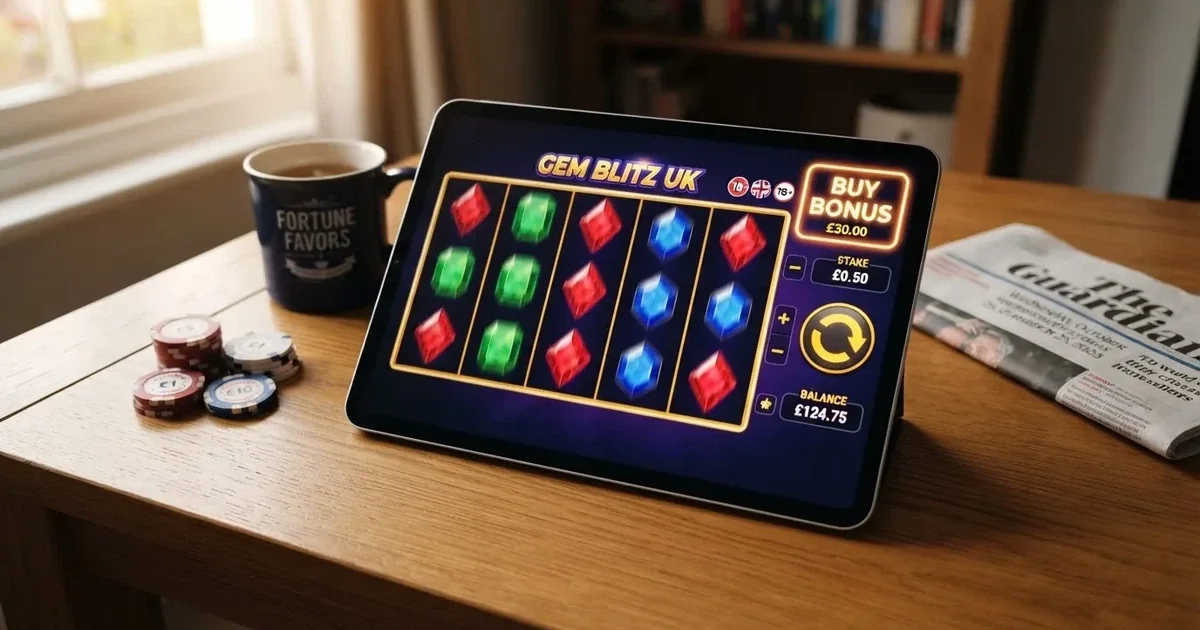
A bonus buy is not an offer on the house. It is a stake the player makes in exchange for skipping the wait and going straight into a slot’s bonus round, and the Gambling Commission treats it as one — same stake ceiling, same loss limits, same age verification, same GAMSTOP hooks as any other spin. That single framing is what the rest of this page comes back to, and it is the reason the question of where to play bonus buy slots gets answered honestly here by separating the feature from the licence that has to wrap around it.
Table of Contents
- What “bonus buy” actually means at a UK slot
- The licence every bonus buy in the UK runs under
- Player protection: stake limits, age checks, and where GAMSTOP sits
- Bonus buy as offer: the marketing word and the maths
- The top 10 UK-licensed rooms for bonus buy slots
- Beyond the slots: what the wider regulated market looks like
- Tax, payments, and the offshore question in one breath
- How to read a bonus buy slot’s maths in three minutes
- Understanding the market choice
- Where to get help
- Frequently asked questions
What “bonus buy” actually means at a UK slot
Bonus buy, also called feature buy or bonus bet, is a button on certain online slots that lets the player pay a fixed multiple of their stake — commonly 50x to 100x, sometimes 200x or more — to trigger the bonus round instantly rather than waiting for it to land organically. The bonus round is the game’s high-payout feature: free spins, expanding symbols, sticky wilds, multipliers, the wheel. Hitting it through ordinary play can take hundreds of base spins. Buying it takes one click.

Two mechanics govern how the price is set. First, the game’s own mathematics: the studio prices the buy so that the long-run return on the purchase approximates the return on a random entry into the same bonus. Second, the studio’s compliance with the regulator it sits under. The UK regime does not ban bonus buy outright, but it does impose the same stake cap that applies to ordinary spins. A £5-per-spin player aged 25 or over cannot lawfully spend £500 on a single bonus buy if the math of that buy treats the £500 as the relevant “stake” — which is why the licensed UK titles in this space carry a per-purchase cap, not a per-spin one, and why the bigger named games have a separately stated buy price printed next to the button.
The player-relevant shape of the feature, then, is:
- A buy costs a fixed multiple of stake, set by the studio, visible before purchase.
- The RTP (return-to-player) of the buy path is normally stated separately from the base-game RTP, and tends to sit fractionally below it because the studio prices the buy at a small premium.
- The bonus round itself plays out as it would have done had it been triggered organically: free spins, modifiers and a final payout are determined by the game’s random number generator.
- A bonus buy is a single transaction and counts as one “game cycle” under the Commission’s stake-limit rules.
That is the whole apparatus. Everything else on this page — the licensed rooms, the maths of the offer, the GAMSTOP question — is a consequence of treating the buy the way the regulator treats it.
The licence every bonus buy in the UK runs under
A bonus buy slot can only be offered to players in Great Britain by an operator holding a Gambling Commission remote casino operating licence. Section 33 of the Gambling Act 2005 makes providing gambling to people in Great Britain without such a licence an offence, and the (Licensing and Advertising) Act 2014 closes the offshore loophole — a Curaçao or Malta licence is not a substitute. The test a player can apply is the public register: every operator has an account number, every licence has the form account-R-number-suffix, and the leading six digits of the licence repeat the holder’s account.

On 18 September 2026 the Gambling Commission’s public register of gambling businesses listed 139 businesses holding an active remote casino operating licence. The same register’s domain list, which records each website against the licence account that runs it, carried 1065 active entries and 361 white-label entries on the same day. A white-label site trades under another company’s licence, which is why two very different front ends can sit on the same licence number. Every brand featured further down this page was taken from that register, and the licence line beside each name is the line a player can search and verify themselves.
Three things follow from that single requirement. First, every GB-licensed remote casino is bound by the Commission’s social responsibility code and Licence Conditions and Codes of Practice (LCCP), including the player-protection rules discussed in the next section. Second, every such operator must take part in GAMSTOP, the national online self-exclusion scheme, which is a condition of every online licence since 31 March 2020. Third, the player has somewhere to complain that is not the operator itself: the Commission’s approved alternative dispute resolution (ADR) providers, listed on the operator’s complaint page.
A site that markets bonus buy slots to UK players without appearing on the register — through social ads, an affiliate link, an “offshore” subdomain — is not offering a parallel product. It is offering the same product without the licence that makes offering it lawful, and the protections tied to that licence do not travel.
Player protection: stake limits, age checks, and where GAMSTOP sits
UK online slots are the most heavily regulated casino product in the country, and the rules that bind ordinary spins bind bonus buys as well.
Stake ceilings apply per game cycle. Since 9 April 2025 the maximum stake for players aged 25 and over is £5; since 21 May 2025 players aged 18 to 24 have been capped at £2 per spin. A bonus buy, where the studio lets the player choose the stake that prices the buy, has to fit inside the same per-cycle ceiling for the player in question. The framing matters: the regulator looks at the buy as a stake, and a £2 ceiling player who would otherwise have been able to buy a £200 bonus round cannot do so at a licensed site. That is the entire mechanism of the under-25 stake cap as it bites on bonus buy specifically.
Spin design is constrained. The Gambling Commission requires a minimum spin interval of 2.5 seconds, has permanently banned auto-play, and treats losses disguised as wins as non-compliant. A buy is one cycle, not many — it does not change the rhythm of subsequent spins — but the game the player lands in is bound by the same rules.
Financial limits are prompted, not imposed. There is no state-set deposit or loss ceiling in Great Britain; what the operator must do, since 31 October 2025, is prompt the player to set a financial limit before the first deposit. The bonus buy sits inside that limit, not outside it: a £50 deposit with a £25 deposit cap still leaves £25 of room, and the buy has to come out of it.
Affordability checks are tiered. From 28 February 2025, light-touch financial vulnerability checks trigger at £150 of net deposits in a rolling 30 days, using public data only. Heavier financial risk assessments have been announced but were not yet in force as of the snapshot above; they are the next tightening to watch.
GAMSTOP is mandatory. Every GB-licensed remote casino has participated in GAMSTOP since 31 March 2020. A self-exclusion can be set for six months, one year or five years and cannot be cancelled early. A self-excluded player cannot buy a bonus round any more than they can spin an ordinary reel at a licensed site. The mechanics are described in more detail under the question that follows.
Bonus terms are capped. Since 19 December 2025, wagering requirements on casino bonuses have been capped at 10x, and mixed-product bonuses — stake on sport, receive casino spins, or vice versa — have been banned. The buy itself is not a bonus and is not subject to the 10x cap; the cap binds the casino’s promotional offers around the buy.
Credit cards are out. Gambling with a credit card has been banned in Great Britain since 14 April 2020, including credit-card-funded e-wallets.
Anonymous play is not possible. Operators have been required since 7 May 2019 to verify name, address and date of birth before the first deposit or any play. A player who wants to buy a bonus round has already cleared that gate.
Two consequences follow for the question of bonus buy slots not on GAMSTOP. A site that markets itself as a bonus buy casino “not on GAMSTOP” to UK players is, by that signal alone, not licensed by the Gambling Commission. The protections above — stake limits, prompt to set a financial limit, vulnerability checks at the £150 threshold, ADR access — do not travel with the offer. The player keeps only what the offshore operator chooses to give them. And the Commission has tools — cease-and-desist, payment and hosting referrals, search-engine delisting — though not ISP blocking, which is why such sites keep appearing under new names.
The under-25 stake cap, specifically, is the rule that shapes the buy as a UK player meets it. A game priced at 100x stake would normally require a £500 buy at the £5 ceiling; that buy is itself a single game cycle, and the £5 cap is the cap on the cycle. The studio’s answer is either a fixed-price buy that fits the £5 ceiling by design, or a stake-tier selector that does not exceed £5 at its top. The player does not negotiate with the studio; the studio negotiates with the regulator, and the regulator’s number is what the buy button costs.
Bonus buy as offer: the marketing word and the maths
Casino marketing treats bonus buy as a feature to advertise, which is the framing that brings the buyer and the licensed operator together. The reader-side question is the one the marketing does not ask: what does the buy actually cost, and what is the player getting for it?
The published price is the clearest of the figures. A 100x buy at £1 stake costs £100 and triggers the bonus round on the next spin. The studio’s stated buy RTP — for example, 96.20% on the buy path against 96.50% on the base game — is the long-run return averaged over many such purchases. The expected loss on a single buy is therefore (buy price) × (1 − buy RTP). At £100 and 96.20%, that is £3.80 of expected loss on a single purchase; the rest is returned, in aggregate, to players in bonus-round payouts. The figure is a statistical estimate, not a guarantee, and the player who buys once can land anywhere from zero to the maximum payout the bonus round allows.
The wagering cap, separately, is the limit on what a casino’s own promotional bonus can demand. The 10x ceiling introduced on 19 December 2025 means a £30 casino bonus carries a turnover requirement of at most £300 before withdrawal, and the figure is read off the offer’s stated terms. The bonus buy sits outside that calculation: the buy itself is a stake, not a bonus, and the 10x ceiling does not touch it. The two numbers are independent, and a player who reads a casino’s headline offer as “we will give you free spins and you can buy the bonus round” is reading two separate mechanisms that interact only at the wallet level.
The arithmetic, then, has two distinct parts:
- The cost of a single buy: price × (1 − buy RTP). The player pays the price, plays the bonus round once, and either wins a smaller prize than the price or — more rarely, on the right bonus — a much larger one.
- The cost of clearing a casino bonus: bonus × 10x maximum wagering requirement. That is the upper bound; the operator can set it lower, but cannot set it higher.
Both are statistical averages over many plays. Neither is a budget a player should plan around. They are the comparison the marketing copy invites the reader to skip.
For a worked range, take the 10x cap and a £20 casino bonus. Required turnover is £200; at 5p a spin that is 4,000 spins; at 2.5 seconds per spin that is 10,000 seconds, or roughly 2 hours and 47 minutes of continuous play to clear. The same £200 turnover against a slot with a 96% RTP carries an expected loss of £8 — the bonus’s real cost, on average, over the clearing window. A larger bonus scales the figures linearly: a £50 bonus requires £500 of turnover, around 5 hours and 47 minutes of clear-time at the same stake, and an expected loss of £20 over the clearing window. The band is wide because the bonus is wide; the rule that produces the band is the same one rule.
That distinction — the buy as a stake, the bonus as a separate offer with its own ceiling — is the single most-muddled point in the marketing around bonus buy slots, and it is the one the rest of this page makes explicit.
The top 10 UK-licensed rooms for bonus buy slots
Each of the ten operators below holds an active Gambling Commission remote casino operating licence as of the snapshot above. The licence line is verifiable against the public register. The list is ordered by the research’s own ranking of subject support and is not a recommendation to play.
1. Paddy Power
Licence holder: PPB Games Limited (account 39411). Active domain Paddy Power sits against licence 039411-R-319335-010 on the register. Paddy Power’s slot lobby has carried feature-buy titles for several years and is among the more familiar UK-facing brands where a player will find them. The room runs on a single account and a single licence, which simplifies the question of where a complaint goes. Paddy Power is the natural starting point for a reader who wants one of the larger mainstream UK books and a slot lobby that already includes bonus-buy mechanics. Paddy Power is a staple for players seeking a recognisable brand.
2. kwiff
Licence holder: Eaton Gate Gaming Limited (account 44448). Kwiff.com is registered against licence 044448-R-323408-017. Kwiff is one of the smaller names on this list and has built its identity around randomised stake boosts — a “surprise” mechanic that does not interact with the bonus buy itself. For a reader who wants a less crowded lobby and the same GB-licensed protection, kwiff is the alternative the larger names sit beside.
3. Betway
Licence holder: Betway Limited (account 39372). Betway.com is registered against licence 039372-R-319367-029. Betway has carried bonus buy titles since they became a regulated category in the UK and is one of the few operators on this list with a recognisable casino brand independent of a sportsbook. The relevant trade-off for the reader is breadth: a wide slot lobby with feature-buy categories visible from the lobby page, on a licence the reader can verify in two register searches.
4. bet365
Licence holder: Hillside (UK Gaming) ENC (account 55149). Bet365.com is registered against licence 055149-R-331499-004. Bet365’s casino tab sits inside a sports-led product, but its games lobby is one of the deepest in the UK market. A reader comparing bonus buy slots across rooms will find bet365’s lobby filter useful precisely because the catalogue is wide enough that the filter does meaningful work.
5. Unibet
Licence holder: Platinum Gaming Limited (account 45322). unibet.co.uk is registered against licence 045322-R-324275-019. Unibet has a multi-vertical product with casino at its centre and a recognisable UK-facing presence. Its slot pages tend to expose feature-buy categories explicitly, which is the small usability advantage the reader is buying when comparing two equivalent GB-licensed rooms.
6. 888casino
Licence holder: 888 UK Limited (account 39028). 888casino is registered against licence 039028-R-319297-014. 888casino is the longest-running casino-only brand on this list and has carried feature-buy slots in some form since they entered the regulated UK market. A reader who prefers a casino product without a sportsbook will find 888casino among the more familiar options.
7. Virgin Games
Licence holder: Gamesys Operations Limited (account 38905). Virgin Games is registered as a white-label domain against licence 038905-R-319430-022. The white-label status is the relevant fact: Virgin Games trades under Gamesys Operations Limited’s licence, which is the same architecture that hosts several other UK-facing casino skins. A reader verifying the licence will land on Gamesys Operations, not on “Virgin” — that is normal, not a red flag, but it is worth knowing before the comparison begins.
8. Midnite
Licence holder: Dribble Media Limited (account 42647). Midnite.com is registered against licence 042647-R-321653-022. Midnite is one of the newer UK-facing brands on the register and positions itself around casino and sports in equal measure. The relevant trade-off for a reader comparing rooms is the size of the slot lobby: Midnite is a smaller catalogue than the larger names above; it is a choice for the player who prefers a focused experience.
9. Betfred
Licence holder: Petfre (Gibraltar) Limited (account 39544). Betfred.com is registered against licence 039544-R-319290-010. Betfred’s UK-facing brand has a strong high-street footprint that does not translate into a deeper casino product than the rest of this list, but it carries the GB licence and the protections that come with it. A reader who already has a Betfred account for sports and wants to keep one wallet has a direct path into the casino’s bonus-buy range.
10. BetVictor
Licence holder: BV Gaming Limited (account 39576). Betvictor.com is registered against licence 039576-R-319370-028. BetVictor rounds out the list with a brand that has been on the UK register in successive forms since the mid-2010s. Its casino lobby is comparable in depth to bet365’s, with a slightly older brand identity that some readers will already have an account with.
Side-by-side: what the rooms actually share and where they diverge
| Brand | Licence holder and GB remote casino licence | Domain status on the register | Bonus-buy slot support |
|---|---|---|---|
| Paddy Power | PPB Games Limited · 039411-R-319335-010 | Active | — |
| kwiff | Eaton Gate Gaming Limited · 044448-R-323408-017 | Active | — |
| Betway | Betway Limited · 039372-R-319367-029 | Active | — |
| bet365 | Hillside (UK Gaming) ENC · 055149-R-331499-004 | Active | — |
| Unibet | Platinum Gaming Limited · 045322-R-324275-019 | Active | — |
| 888casino | 888 UK Limited · 039028-R-319297-014 | Active | — |
| Virgin Games | Gamesys Operations Limited · 038905-R-319430-022 | White label | — |
| Midnite | Dribble Media Limited · 042647-R-321653-022 | Active | — |
| Betfred | Petfre (Gibraltar) Limited · 039544-R-319290-010 | Active | — |
| BetVictor | BV Gaming Limited · 039576-R-319370-028 | Active | — |
What the table says plainly is that the ten rooms sit on ten separate licences — nine active, one white-label — and that none of them is differentiated on the licence line. The differentiation, if the reader wants it, is in the size of each lobby, the filter design on the slot page, and whether the brand already lives in the reader’s wallet for another product. The research on the named games (RTP and volatility per title) is not carried in the underlying snapshot, which is why the right-hand column is left open rather than filled with a guess; a reader who needs that comparison should consult each operator’s individual game information page, where the studio-stated figures are published.
Beyond the slots: what the wider regulated market looks like
The reason the licence is the first thing to check on any UK-facing bonus buy slot is that the surrounding market is large, fragmented, and unevenly regulated. The Commission’s register is the only authoritative list: it records 139 businesses holding an active remote casino operating licence on the snapshot above, and that number does not include the brands that share a licence through a white-label agreement. The 1065 active and 361 white-label domain entries on the same snapshot are the consumer-facing side of those 139 licences — a single account can run several domains, each with its own brand.
Two adjacent products are worth naming because they share the regulatory frame.
Crash games, of which Spribe’s Aviator is the most-cited example, are the closest non-slot analogue. Aviator was released in 2019 and has reported more than 42 million active users across more than 5,000 operators worldwide; in the UK it sits inside a licensed casino lobby as a separate game type. A crash game’s bettor places a stake and must cash out before the multiplier curve randomly crashes, so the round is shorter than a slot spin and the loss profile is different. The same stake cap binds, the same GAMSTOP link applies, the same age verification sits in front of the first deposit.
Baccarat — particularly the Punto Banco variant that developed in Havana in the 1940s and is the most widespread form globally — is a table-game alternative. In Punto Banco both hands are dealt out by fixed drawing rules, so the player makes no strategic decisions, and the casino banks the game at all times. Punto Banco carries no bonus buy feature, which is why it sits beside the slots on this page rather than in the ranking: it is the regulatory frame without the purchase feature.
The historical depth of the slot machine is worth marking because it shapes how the modern feature is read. Charles Fey of San Francisco built the first automatic slot machine, the three-reel Liberty Bell, which paid ten nickels (50 cents) for three aligned bell symbols. Sittman and Pitt of Brooklyn had built a poker-based drum machine in 1893 that paid no automatic prize. Herbert Mills produced the first copy of the Liberty Bell in 1907. Inge Telnaes, a Norwegian mathematician, patented the random-number-generator-driven reel-stop technology in 1984 that lets studios weight symbol probabilities independently of physical reel frequency — the technology that makes modern bonus-buy maths possible at all. Volatility as a concept (low-volatility pays smaller wins more regularly, high-volatility pays fewer but bigger wins) and the regulator-set RTP minimum (75% in Nevada, 83% in New Jersey) are the wider context the UK sits inside.
Tax, payments, and the offshore question in one breath
Players pay no tax on gambling winnings in the UK. Operators pay Remote Gaming Duty, which rose from 21% to 40% from 1 April 2026 — a model-only figure, and one to verify with HMRC. The 40% rate is one of the reasons licensed UK rooms price bonus buy the way they do: a 100x buy is, from the operator’s side, a high-volume product taxed at the same headline rate as a single spin. The credit-card ban, in force since 14 April 2020 and including credit-card-funded e-wallets, removes a payment route that would otherwise have cushioned the buy for some players. With credit out, the player is paying from a debit balance or an e-wallet funded from a debit balance, and the buy has to fit inside that.
The offshore question is one that regulation refuses. The phrase “bonus buy slots not on GAMSTOP” implies a parallel product that the UK regulator does not actually offer: there is no licensed UK bonus buy slot that is exempt from GAMSTOP, because GAMSTOP participation is a condition of every online licence. A site that offers a bonus buy slot to UK players without a Commission licence is offering the feature without the protection, not a different version of it. The Commission’s enforcement toolkit — cease-and-desist notices, payment and hosting referrals, search-engine delisting — does not include ISP blocking, which is why unlicensed sites keep resurfacing; the player’s recourse when caught by one is limited to the operator’s own terms, which the operator writes.
The right-hand side of that trade is what the reader pays for choosing an unlicensed room: no GAMSTOP hook, no ADR route, no approved complaint mechanism, no wagering-cap protection, no enforced age verification, and no recourse to the Commission if the operator stops paying out. The price of admission to the regulated UK market is precisely the bundle of protections that some sites seek to escape.
How to read a bonus buy slot’s maths in three minutes
The page has covered the licence, the player protection, the room-by-room licence line, and the wider market. The mechanics still need a short, sharp read.
- Look at the buy price first. It is the fixed cost of the round and the only number the player must pay to enter.
- Look at the buy RTP second. Studios publish this separately from the base-game RTP. The two figures are close but not identical; the buy is normally priced fractionally below to cover the convenience.
- Look at the stake cap on the cycle. A £5 ceiling player is buying at £5; a £2 ceiling player is buying at £2. The studio’s published price tiers sit inside that cap, not above it.
- Treat the buy as a stake. Expected loss is
price × (1 − buy RTP). The figure is a statistical average, not a budget. - Treat any casino offer around the buy separately. Wagering requirements on casino bonuses are capped at 10x since 19 December 2025; the cap binds the offer, not the buy.
For a worked range: a £20 casino bonus carries a £200 turnover requirement at the 10x cap, which is roughly 2 hours and 47 minutes of clear-time at 5p a spin over 2.5-second intervals. The expected loss against a 96% RTP slot is £8 over the clearing window. A £50 bonus carries £500 of turnover, around 5 hours and 47 minutes, and an expected loss of £20. A £100 bonus carries £1,000 of turnover, around 11 hours and 34 minutes, and an expected loss of £40. The band stretches with the bonus; the rule that produces it does not.
What the band does not say is that the player will actually lose those figures. The expected loss is an average over many players, and any one session lands above or below it. The figure is the comparison the marketing copy invites the reader to skip, and it is the figure the rest of this page has been trying to make unavoidable.
Understanding the market choice
A reader who arrived at “best bonus buy slots UK 2026” is asking two questions stacked. The first is which UK-facing rooms carry the feature. The second is whether the feature is worth the price at any of them. The first is a register check, and the ten rooms above each pass it. The second is a personal budget question the register cannot answer, and the maths in the previous section is the comparison the marketing copy tends to skip. Both questions matter, and neither is well-served by a list of rooms without a licence line.
The honest answer to “best” in this market is one that the search terms resist: there is no objectively best room, because the rooms share a regulator and a stake cap, and the slot catalogue is shaped by studio relationships the player can sample for free before depositing. The “best” room is the one whose lobby filter surfaces the games the player actually wants to play, on a licence the player has verified themselves, inside a deposit limit the player has set themselves. The licence is the cost of admission; the lobby filter and the budget are the choice.
Where to get help
The National Gambling Helpline (GamCare) is the front-line service for anyone whose play has stopped being a choice. GambleAware funds treatment, education and research across Great Britain. GAMSTOP is the self-exclusion scheme every GB-licensed operator participates in; a player can register for six months, one year or five years, and the exclusion cannot be cancelled early. The Gambling Commission’s complaints route is the regulator’s own backstop for licensed-operator disputes that ADR cannot resolve, and it sits at the end of the same chain.
These are the services that travel with the licence. An unlicensed room offers none of them, and the page returns to that point because the concept is sometimes used to look for a way around it. There is no way around it that does not also leave the protections behind.
Frequently asked questions
What does buying the bonus round on a slot actually cost?
The studio sets a fixed multiple of the player’s stake, typically 50x to 100x but sometimes higher. At a £1 stake and a 100x buy, the round costs £100. The expected loss on the purchase is the price multiplied by (1 minus the buy RTP), an average over many plays and not a budget a player should plan around.
Do bonus-buy slots count toward the same stake limits as ordinary spins?
Yes. The Gambling Commission treats a bonus buy as a single game cycle, so the £5-per-cycle ceiling for players aged 25 and over and the £2-per-cycle ceiling for 18 to 24-year-olds apply to the buy in the same way they apply to an ordinary spin. The studio’s price tiers sit inside the cap, not above it.
Is the bonus-buy feature available on every slot at a UK casino?
No. Bonus buy is a studio-designed feature built into specific titles; the operator chooses which titles to host. A UK-facing licensed casino will normally carry a mix of buy-enabled and standard slots, and the buy button is visible only on the titles that have it. The lobby’s filter design is the player’s main tool for finding them.
How does the return-to-player rate change when the bonus is bought?
Studios publish a separate RTP for the buy path, normally within a fraction of a percentage point of the base-game RTP. The buy is priced fractionally below the organic-trigger rate because the player is paying for the convenience, so the buy RTP is usually marginally lower than the base RTP rather than higher. The expected loss on a single buy follows the formula in the first question above.
Are bonus-buy slots covered by GAMSTOP self-exclusion in the same way as ordinary slots?
Yes. GAMSTOP participation is a condition of every GB-licensed remote casino operating licence, and a self-exclusion applies to the player’s account at every participating operator for the period chosen. A self-excluded player cannot buy a bonus round any more than they can spin an ordinary reel at a licensed site. Sites that market themselves as “bonus buy slots not on GAMSTOP” are not licensed by the Commission.
Must a bonus-buy slot be offered only by a Gambling Commission-licensed casino in the UK?
Yes. Section 33 of the Gambling Act 2005 makes providing gambling to people in Great Britain without a Commission licence an offence, and the (Licensing and Advertising) Act 2014 closes the offshore route. The public register of gambling businesses is the test: every operator in this page’s top ten is listed there as of 18 September 2026, and the licence number beside each name is the one a player can search themselves.
Published by the livetablesuk team.